


HEADNOTE
“Journal of the Third Wolf” is a letter to my descendants about my interior life (and my life as an “Ear Witness,” to use Elias Canetti’s wonderful term) which anyone at all is welcome to read. What new readers do is their own business, but my advice is to start where it starts — with the first, or “oldest,” entry. The journal reads from top to bottom, like words on the page, not from bottom to top like a proper blog. The date at the top, September 22, means nothing; it’s just when I started. And a note to frequent readers: I revise the entries from time to time, putting new stuff in old places; thus there will probably be entries you haven’t seen in places you’ve already slogged through — especially audio clips and photos. I apologize for the likely inconvenience, but I can’t figure out any other way to do what I want to do here.
JOURNAL ENTRIES
I remind myself of the indolent sultan who loved to awaken from a long reverie only for the sheer joy of sinking blissfully into another one — or of actually going to sleep.
Why I Started this Journal. Two main reasons. The first is the same as Montaigne’s for starting to write his little essays in the late sixteenth century — to let my descendants know what their antecedent was like on the inside. (Montaigne also had his portrait painted for them, as in his day absolutely everything about a person vanished when that person died — except for his existence in the memories of those who would soon die themselves. Thankfully, we have throwaway cameras today and all too many images of all our boring relatives—including all those my descendants have of me. But they have nothing from inside.) When my mother died, she left nothing — just a few newsy letters to her relatives in Tennessee and twenty or thirty Kodak snapshots taken over a fifty-year period. Ditto for my father. But right after his funeral, his sister Margie gave me a little metal box which had once been used for fishing tackle. Inside it were his “personal effects.” These included his wire-rimmed spectacles (bifocal), his carefully scrubbed Saran-wrapped dentures, a wad of (to me) meaningless business papers, and snippings of all the polemical letters-to-the-editor he’d published in the Louisville Courier-Journal over his long lifetime (most of which I’d read previously). Now, when I teach Montaigne, which I do all the time, I take that box in and start things off by showing it to my seminar. “Montaigne left a lot more,” I tell them. “I wish my father had. I wish my mother had. Tell your parents to start writing to you about the life inside themselves. And remember to write to your own kids, if you have them, while you’re still alive.”
The second reason has to do with my one special talent or special state of grace. I have always possessed it, or lived within it. I am particularly blessed by what I just call Hearing Things. Nothing “mystical,” nothing about “channeling,” nothing “supernatural.” Nothing like any of that. I just hear things in my daily rounds, usually speech, of a sort that no one else seems to hear—or to remember. Some are said just to anyone within earshot. Some are said just to me (or “for my benefit”). Many of these things are just plain hilarious, and they always have been. Most are somehow ironic. Some are filthy. I tell family and friends (and even students) what I heard and they say, “God, I could go for a YEAR and not hear anything that great!” So it seems to be something pretty much unique to me (although it could certainly not be literally unique to me), as I have never heard anyone else speak of it—of its centrality through the years of their lives. Its centrality through the years of my own life is the primary evidence I possess that there could be some basis for believing in a personally experienced religion.
So in “Journal of the Third Wolf” I am going to pass on to you some of the Hearing Things stuff from my life past and present. Why, here’s an example just fresh from today! I am standing in the checkout line at the Food Lion. It is a long line (one of three or four), it is moving at a snail’s pace (they all are), it is 90-plus degrees outside, and the air conditioning is out. All of a sudden a very shrill siren alarm goes off by the Exit Doors. A loud recorded bass voice shouts: “Stop where you are! Return your merchandise to the checkout counter immediately! You have not paid for your merchandise!” All eyes turn to the Exit Doors, where two frightened-looking women with a gaggle of screaming children are standing with their filled carts, eyes looking wildly around. Then a loud REAL voice, the voice of one of the checkout women (who turns out to be the Store Manager), shouts: “JUST GO ON OUT THROUGH THE DOORS! DON’ PAY NO ‘TENTION TO THAT THING! WE AIN’T HAD THE TRAININ’ FOR IT!” So the women pass on through the doors, and somebody turns off the recorded voice and the siren alarm, and the Store Manager yells to everybody within earshot, “HOW THEY ’SPECT US TO CATCH US NO SHOPLIFTERS IF WE AIN’T HAD THE TECHNICAL TRAINING FOR IT?” Whereupon one of the other checkout woman nods dramatically and shouts, “Yolanda, you can by GOD say THAT again!”
My poor students wring their hands and tell me they worry endlessly about being “unproductive.” I tell them they should stop worrying. I tell them that productivity is one of the primary “evil virtues.” Junk in every direction, as far as the eye can see. Most of it ugly, useless, or both. “Look ABOUT you!” I tell them. “Shit EVERYWHERE!” Almost all of them immediately agree, although appearing shocked at the thought. They say they wonder why they never thought of that before. I wonder why with them. But the answer must be that they have never looked about themselves.
My students also say they they feel guilty when they “lose their optimism” — even for a day — when something bad happens to them or they hear about something bad happening to somebody else somewhere. I tell them that optimism is a very new idea in our culture — that it was introduced into intellectual parlance by Leibniz, then popularized by Voltaire in the novel Candide. An eighteenth century idea, in other words — no older. (And one that Voltaire himself hated — or thought hilarious.) Before that time all thoughtful people thought of an optimistic attitude as INSANITY. Which of course it is. Again, I tell my students: “Look ABOUT you!” And they say, “Yes, but we’re SUPPOSED to be optimists.” And I say, “Ever wonder why?”
People under thirty (unless they are untypically “experienced” in the Jimi Hendrix sense) tend to devalue the claims of experienced people who hold up their experience as a foundation from which to claim authoritative knowledge in disputed questions about what “life is really like.” The kid thinks the experienced person is cynical, and the cynical person things the kid is naive — same as it ever was. The only way to convince unbelieving people that experience is invaluable is to point to specific examples while in a discussion group of at least three or four. My favorite example is the inextricable connection between New Age-ism and grifterism. It is an inevitable coming-together, because New Agers really don’t believe other people exist — that the only world that matters is inside their heads, and thus that “I am the only thing that is really real.” If you are the only thing that is really real, then anything you do is good only to the extent that it benefits you. Which is why every New Age person I’ve ever known has been a con artist to the bone. If you are in a group of three or four, and if anyone other than you in that group is over thirty, and if you make the claim I have just made, all the experienced people will agree and all the inexperienced will not.
The inexperienced are, in other words, marks.
Experience will fix this. Nothing else can.
My students ask me what use logic is — what use things like syllogisms are in the real world. I ask them how many believe in God. About two-thirds raise their hands. I ask them how many believe there is only one God. The same hands, usually. So then I ask those students how many believe that this one God hears prayer. Same hands. I draw a circle on the blackboard and put a big “G” inside it. I draw twenty or other little circles around the big one. “These represent about a billion people,” I say. Two of the little circles I label “Bush” and “bin Ladn.” “Here is a syllogism that I think is worth something in the real world,” I tell them. “See if you can bust it.” The syllogism is: If there is a God, and if there is only one, and if that God hears prayer, then George W. Bush and Osama bin Ladn are actually being heard by the same God when they pray.” They are shocked. They try to bust it. They cannot. They agree, most of them, that it is very useful indeed.
Some people, when discussing (say) their problems, are forever saying things like: “Well, that’s an important part of the equation,” or “That’s just part of the equation,” or “That’s certainly a part of the equation that can’t be left out.” Why is it that there is never any equation whatsoever in their previous discourse to which they can possibly be referring? And, this being so, what in God’s name do they think they are talking about when they use it?
I was so happy the day I figured out the essence of true “primary” narcissism — of my own and of all others. It is the passion to possess the elusive person in order to have the luxury of rejecting him or her.
For all true narcissists, platinum is everything they want but cannot possess — value. Shit is everything they have successfully managed, by hook or by crook, to possess.
Not having ANY desire for a cigarette, or for a shot of heroin, twenty years after twenty years of addiction, is a narcissist’s paradise. “It wants me, and it wants me bad. But I don’t need it. I scorn it. It is excrement. I piss upon it from a great height.”
Simple pop narcissism is that of the hunchback who looks in the mirror and says “On me it looks good.”
My theory is that the memory “materials” (they aren’t really material, but just play along) of jokes, dreams, and fictional stories are some sort of flimsier, finer, more gossamer-like, more perishable stuff than the memory materials of real life. Which is why we can’t remember them, no matter how much we vow to try to do so. (Unless they contain a graphic image which either horrifies us or so stimulates us to erotic response that we are brought to orgasm — or both at once.) When Shakespeare said that WE are “such stuff as dreams are made on,” he knew what he was talking about: we will be forgotten not just shortly after we die, but as soon as we age to the point in our mortal lives that we cease being marketable.
I think the three key ingredients of good teaching are: 1.) First, do no harm (as with the apocryphal Item One of the Hippocratic Oath); 2.) Know a lot about what you teach and be passionately interested in it; 3.) Be someone who has had the good fortune of having personally experienced endless years of horrible teaching (preferably including parenting) yourself — so you know so easily what is missing and hence needed so badly by one student or a roomful of students. Each of the three is necessary but not sufficient. But all three, taken together, are sufficient.
More Pedagogical Bullshit. This takes off from a question about “identity” from an interview with me this past spring on the NPR/Smithsonian/Story Corps Deal:

Life Down South: I walk along the street in the summer sun and pass three obviously prosperous middle-aged lawyers in their seersucker suits drinking cokes on a trial break. One of them points to his forehead: “See that little brown scar? That there’s where the bullet went in. I didn’t feel nothin’. Doctors say their ain’t nothin’ in my brain. So naw, I ain’t worried.”
“They are right, of course. And fuck them!” What Gustav Flaubert wrote in his journal as he sat at his desk in his black and pink silk dressing gown, ten minutes after having arisen at 4:00 p.m. and having his first cigar of the day, upon looking out his study window and seeing three happy petit-bourgeois families out behind their houses in their gardens, babbling children everywhere.
My first talent to show up was for drawing and painting. I was thought to be a prodigy — but, as I now know, I was not. When I was ten or eleven, I actually won one of those “Draw Me” correspondence courses — from something called Art Instruction, Inc., in Chicago. (The instructional materials were surprisingly terrific, but the correspondence instructors themselves were execrable.) I didn’t finish. But I did go on to major in painting in college. I didn’t really enjoy drawing and painting by then — something about moving from doing it on the floor on my stomach to doing it at an easel standing up. By the time I graduated, I was totally bored with it. I had three reasons. First, I felt imprisoned in the normal rectangle, but no matter how one might try to avoid rectangle after rectangle by doing round or triangular or trapezoidal pictures, the result was always this dopey exercise in self-consciousness — in too-obviously seeming to “want to be different.” Second, I hated the smell and downright gloppy mess of painting (although I was ashamed of saying so at the time, for fear of seeming either unmanly or unwomanly or otherwise sterile or artificial in my abhorrence of “natural”-seeming things). Third, I couldn’t stand the way the thing never moved after you painted it. It just sat there staring back at you (or at whomever) for all eternity — or, until like Albert Ryder’s, it wore out because you’d used the cheapest possible materials.
When I was 22 and on my first teaching gig at Wisconsin State University, I saw an ad soliciting entries for a big regional painting show in Little Rock. The chief juror would be a woman named Katherine Kuh, a very big deal at the time, who wrote for The Saturday Review of Literature. I had never entered a show before. I knew I was going to Little Rock for Christmas with my wife’s family, so I painted a huge picture of a Pierrot-like matador looking all post-coitally depressed (like Truman Capote in his first book-jacket photos for Other Voices, Other Rooms) after having sunk the coup de grace sword into the (now-dead) bull. It was fashionably cartoonish for its time and on the whole pretty good. (It is now lost, although photos exist. Cormac McCarthy: “Three moves is as good as a housefire.”) When we drove down to Little Rock in the du rigueuer Volkswagen Beetle, we took it with us in the back seat, its huge canvas all rolled up and ready to be re-framed. But it turned out that I actually had to re-frame it on the premises of the gallery itself, as there was nothing big enough to carry it there in otherwise, and so this I did, hammering and nailing away for hours to the amusement of the museum guards and passers-by. I took it in, signed an entry form, and left. A month or so later, I got word back up in Wisconsin that I’d won the show. Good! I thought. Now I can quit this shit a winner. And so I did. I have never painted again, except to make birthday presents for friends who asked for paintings by me. How brilliant I was in those days!
But I cannot claim that I have not harbored the sucker’s dumb wish to leave artefacts behind — even monuments, probably. Most of my doodles through school were of rock formatiions, lovely renderings in red and green ballpoint on lined notebook paper, many of which I still have. My friends laughed about them. “You’re so transparent,” they said — especially the girlfriends — and I was. I have not left any. I doubt that I will. I am forever Getting Sentimenal Over Me about it.
And the dream is still there. To wit, here’s the actual vivid dream I had on the couch while napping away one afternoon last week forty years after doing all those doodles of rock formations: I am a statue standing amongst other statues in front of a giant stone building — a state capitol or giant library or something of the sort, something with (of course!) pillars and all that. We statues are covered in green sediment, bird droppings, and dirt turning into mud. It is a cold, gray day. It is raining. The other statues are bitching about how we should be cleaned up — restored to our pristine glory and dignity. “No,” I say. “All that is totally irrelevant. What’s important is that we’re HERE! They’ll probably clean us off someday. If so, so what? If NOT, so what? I’m just happy to be a statue here at all — and so should you be!” Upon awakening, I realized that it was just more transparent wishful thinking: just to be a statue, a monument, no matter how begrimed. It is not in the cards.
I wanted to go to college. My father did not want me to go. He was an old-time man of the hills, and he believed that men should only go to college to become doctors or lawyers. Women should go to become teachers. Nobody should go for any other reason. That was what he knew of college. We finally reached a deal: he would pay for college if I would be an agriculture major (as I had been in high school), and he could then justify the expense by reasoning that when I inherited the family farm I’d do a better job than I would do otherwise. I wanted to go to college so much that I agreed to the deal. So off I went — on the train, as one did in those days.
I hated farms and I hated agriculture, but I loved college — even with all the agriculture courses. I kept noticing all these people who fascinated me. They wore berets and cravats and sandals, and they drank “Chianti wine” (as we called it in Kentucky, cf. “Paris, France”). They smoked French cigarettes, meditated (reportedly) in front of black candles, and actually had sex (reportedly), as opposed to all the ersatz sex other students did in those days just a year or two before the pill. They were the artists — students and faculty. I had been thought to have a talent for painting (see above), and at that point, as a freshman, I still wanted to paint. Or, rather, that was what I told myself the afternoon I walked into the dean’s office and signed a paper changing majors from agriculture to art. What I really wanted, of course, was to drink Chianti wine, smoke French cigarettes, meditate in front of black candles, and have real sex all the time with long-haired women so sophisticated that they apprently knew how to have it without getting pregnant — and who would existentially peel off their black leotards to have it with me. I figured that my father, who never insisted upon anything so crass as inspecting my grades, would never know. And he never did.
The day after my freshman year ended, I went back to the farm to spend the summer — again on the train. My father asked me if I’d like to “take a walk down to the river” (the Rolling Fork). I knew this meant he wanted to have a father-to-son talk. And so we walked down there — about half a mile through the woods. I had been born terribly late in any father’s life for those days — he had been fifty-four — and so he was now seventy-three. He chain-smoked cigarettes hand-rolled from Prince Albert tobacco and rolling papers. (He’d held a life-long disdain for “hard-rolls.”) As we stood and looked at the river, he said, “Well, I want you to tell me how a year at the university has changed you. Start anywhere you like, but just tell me the important things.” Well. In those days, especially with art students the world over, the big buzzword was “alienation,” and I did indeed feel very alienated. So I started telling him about my alienation. After about ten minutes of stuttering around about it, I finally said, “I guess you could just say that I feel alienated from my religion, my country, my values, my whole culture, the whole world I grew up in.” There ensued a long silence. It made me more nervous than anything he could have actually said in response. Finally, he took his first deep draw off his newly rolled Prince Albert cigarette and exhaled for about twenty seconds, as he always did. And then he said: “Yeah, I think you are alienated, Francis [my first name — more on which later]. I think you always have been. I think you’re alienated from what you’ve always been alienated from: hard work and decent people.” He had hit the nail on the head.
To my astonishment, he hit it on the head quite often. Like the day he asked my Uncle Wayne if he was going to support Eisenhower or Stevenson. Uncle Wayne said, “Well, I’m still sittin’ on the fence there, Smoke” (my dad’s lifelong nickname). To which my dad replied, “That’s a smart thing to do if all you’re lookin’ for’s a sore ass.”
My father was a fan of nothing. He had no interests or enthusiasms — none that I could find, anyway. So my mother and I were truly shocked when he told us, sometime in the late 1950s, that he had become a Ricky Nelson fan. (We had listened to “Ozzie and Harriet” on the radio, and then we’d graduated to their TV show, and it was on that show that Ozzie pushed Ricky forward as an Elvis-imitating rock star — a push to which Ricky, who loved the music, was certainly not averse.) My father loved Ricky’s first two or three hits, especially “Travelling Man.” He asked me if I’d buy the 45 rpm record for him. I did. He played it over and over. He wanted more. I got them for him. He had always felt that Ricky Nelson was, in the Mozart sense, “beloved of God.” “That boy’s touched a humpback’s hump,” he’d say. But this was of course one of the times when he was wrong — when he’d definitely missed the nail.
When James Dean cracked up in his sports car and died, Ricky Nelson was devastated. James Dean, much more than Elvis, was his hero. So he bought the smashed-up sports car and had it perfectly restored. And he began proudly driving it around LA. At a party attended by both him and Alec Guinness, the latter told Ricky he knew he’d bought Dean’s car and restored it. He asked if he could see it sometime. “Sure, Mr. Guinness,” said Ricky. “It’s parked right outside.” As soon as Guinness set eyes on the beautiful vehicle, he was hit by a wave of fright and nausea. He glowered. “Ricky,” he said, “you would have no reason to know this, but I am something of a psychic and I’m very reliable — particularly when it comes to disasters ensuing. You must not drive that car. It is cursed.” Ricky laughed it off. Guinness insisted he was serious. They parted ways. Shortly afterward, Ricky cracked up in the car and was nearly killed. He was hospitalized for weeks and on crutches for months. Many, many years later, he was talking to Jerry Lee Lewis, another idol. He knew Jerry Lee’s battered-up touring airplane was for sale. He asked to buy it. “Ricky, you’d better not. God knows how much long this motherfucker’s got to go.” But Ricky insisted. And on New Year’s Eve around twenty-five years ago, as everybody knows, he, his whole band, and part of his family crashed in it and died. (Were they on coke, as some journalists claimed? Probably. Was that fact relevant? Probably not. They were always on coke.) It took the firefighters 36 hours to put out the fire, so intensely did it blaze on. I was glad that my father, who was wedded to the primitive hill-country Irish faith that some people, Ricky Nelson among them, were particularly beloved of God and the angels, had not lived to hear this news.
Jerry Lee Lewis is still rocking, still surviving everything. Jackson Pollock died just as James Dean and Albert Camus had died: at the wheel, pedal to the metal. When I was 22, all these people were heroes to me. I did not do what Dean and Camus did, but I did do what Pollock and Jerry Lee did: I painted abstract expressionist pictures and I played abstract expressionist rock and roll piano in a band. My friends the abstract expressionists hated rock and roll, and they particularly hated the barbarian Jerry Lee. The redneck rockers hated abstract expressionism because (obviously) it wasn’t Real Art. But I had seen Jerry Lee and Jackson Pollock perform, and I had seen them do it up close. (Pollock, admittedly, I had seen only via the now-famous documentary films in which you watch him paint from beneath a giant pane of glass — his “canvas” in these films. Jerry Lee I had seen from over his right shoulder.) I was convinced that, whatever the two of them were doing, they were doing the SAME THING. I still think so. Everybody talked about the “physicality” of drip painting back then — not for nothing was it called “action painting” — whereas the physical basis of rock and roll, even if you discount the sexual part of that basis (which you should not), was and is obvious. If you watch Pollock and Jerry Lee with an eye to being them, you can hardly fail to see the similarity: both are making mad “controlled sweeps” with their arms and hands. I think this might be easier to see if somehow monocolored three-dimensional visual tracings could be made of their respective arm movements for as little as 60 seconds each. (The resulting “pictures” would necessarily resemble Pollock’s paintings to some extent.) They are carefully (but not in a conscious sense) making the aesthete’s “unified fields” out of their repetitive sweeps, adding a little extra here and a little extra there—soucons— to break up the regularity of what they are doing and making. They are simply doing the same thing over and over in the air with their arms, without thought, and doing it with more than enough rhythmical force to make the proverbial “strong statement” — in spades — which is the only condition for big-time success in the modern arts which is both necessary and sufficient. The streams of paint flowing from Pollock’s brushes and wooden sticks are like the fingers of Jerry Lee Lewis, and the tip of the colored stream that hits the canvas is like one of the tips of his fingers as it hits the keyboard: exquisitely fine tuning, but (thankfully) damned little of it. Long ago I concluded that it is not necessary to be either anti-intellectual or stupid to do what they do — which is getting the mind out of it and letting the body take over. But I also concluded that it may be necessary that one not have learned how to “really play” or “really paint” in order to be a true virtuoso genius at such painting and playing. (In saying this, I am aware that Pollock was schooled under Thomas Hart Benton et alia, and that Lewis learned by listening to the black masters in the churches and clubs in rural Louisiana. But I don’t think this fact constituted, in either case, formal education in the two respective arts.) Am I making an implicit argument for either anti-intellectualism or the advantages of not having a formal education (in the arts or anything else)? No. All I’m saying is that doing what Pollock and Lewis did physically — at the level of genius they reached — is incompatible with being an intellectual in words or a formally trained artist.
What is my favorite book? Darwin’s Of the Origin of Species (which I see, correctly, as incorporating the slightly later, albeit separately published, Descent of Man). It should be everybody’s favorite book.
The people who put John Scopes on trial in rural Dayton, Tennessee, back in the ’twenties included some of my close relatives on my mother’s side. In the mid-’eighties their descendants were at it again in that same county. I went to a family reunion down there then — my first real trip back to the South after fifteen years in Seattle. We were smoking cigars and laughing and drinking hard cider and cussing (mildly) there in the church park, at least the men and the younger women were, prior grabbing our paper plates and falling to a big picnic lunch. I liked these people — especially after all the washed-out, humorless, creepy Scandinavians in the Pacific Northwest. I was having myself a real good time. So, having dropped my usual guarded sensitivity-training bullshit, so professionally cultivated for dealing with my puritanical Seattle socialist and New Age friends, I said in my customarily witty and charming and ironical down-home way, “Well, if I can believe that Communist Dan Rather, you folks down here believe that Charles Darwin is the Devil.” Oh, reader, the crashing silence! The fearsomely well-mannered nonchalance of the kinfolks as they drifted away in twos and threes, effortlessly appearing not to be drifting away so much as to be casually moving away toward something that they’d suddenly thought needed seeing to! I toyed with the thought of running after them and saying, “Hey, hey, wait a minute, I’m a Christian too!” (Which was and is true.) Thankfully, I caught myself in time, blessed by the Lord with the sudden epiphanal knowledge that the only true and honest and proper response to let rise up within me, albeit unspoken, was: Fuck them. I love them.
My Tennessee kinfolk (whom I DO love) believe that every word of the King James Bible is the literal truth. (How horrified they would be to learn that King James himself, who commissioned it, was both a devout Christian and a publicly raving queer. And that he saw no conflict between the two states — and the two behaviors.) Hundreds of millions of people in the United States, Mexico, and South America agree with them — this despite the fact that one cannot interpret it literally because, to take the most troublesome example, the text of Genesis is in stark conflict with itself when taken literally. In one place, for example, humans are put here before flora, whereas in another, the flora come first; in another place, the man and the woman are put here simultaneously, while shortly afterward we read that the man was put here first. But I tell my students that I see no conflict between the Bible and Darwin — and that they should not, either, no matter what they believe about either. For if Jesus taught in parables to those who were not prepared to understand the literal truth of a thing (as he tells his disciples he did all the time), then from whom did he learn to do this? From whom did he learn to teach? And if his father taught him to teach, as is certainly the case if anyone did, then we must assume that his father taught in parables as well. I tell my students that the problem is that we have yet to interpret Genesis (and all the other world creation stories) correctly as parable. How would we do this with any hope of being right? We would try to read it (and them) in the light of, and by the lovely light cast by, Charles Darwin.
One of my favorite words to use with students in talking about Darwin is funny. In truth, when you look at it from the angle I’ll unhesitatingly label correct, evolution by natural selection is about as hilarious as things get. I think it may well be the root of all humor, the core of all hilarity. For example, I heard a report on NPR the other day about elephants in Africa. Turns out that significant numbers of individuals from normally tusked elephant species are suddenly being born without tusks. This phenomenon puzzled the experts for about an hour, and then they realized, and announced to the press, that it is evolution’s way of saving the species (which is all evolution cares about). Their chief predators are men with elephant guns trying to shoot them for their ivory. So . . . VOILA! Oh, how I love this stuff! One can only imagine the countless scenes to be replayed over and over in the wild in when a young tusked elephant runs into an unknown (to him or her) young tuskless elephant: “Haw, haw, haw! Holy God, do YOU look stupid!” Second elephant blushes in embarrassment. BANG! “Oh, excuse me,” sighs first elephant in expiration. “I have been shot for my tusks and must die now. Such is the eternal way with us elephants.” Hardly.
The whole evolution by natural selection deal is really just one big Roadrunner cartoon. The Roadrunner is the individual species — e.g., my individual species of elephant. Wylie P. Coyote is everything that preys upon it (including, metaphorically, territory hostile to its survival). Enter Wylie stage left, double-barreled Roadrunner shotgun in hand, and then: Beep.-Beep! WHANG!!!!!! (In the real world, of course, the Roadrunner bites it more often than not, and Wylie gets to win. For life seldom actually imitates art—contra all the sophisticates who’ve tried to out-sophisticate Oscar Wilde by reversing his maxim.) The artists aren’t smart enough, or knowledgeable enough, to make it so. As Daniel C. Dennett (Darwin’s Dangerous Idea) keeps insisting: Darwin’s theory of evolution by natural selection is smarter than you are.
Thus much for cartoon (or other metaphorical) versions. The great entomologist Edward O. Wilson (Sociobiology, Consilience) very recently said it best: “[Darwin’s theory] states simply that if a population of organisms contains multiple hereditary variants in some trait (say, red versus blue eyes in a bird population), and if one of these variants succeeds in contributing more offspring to the next generation than the other variants, the overall composition of the population changes, and evolution has occurred.” (Source: http://www.harvardmagazine.com/on-line/110518.html Courtesy of Tom Maddox.)
Darwin’s Friend T.H. Huxley on the Theory of Evolution: “How extremely stupid of me not to have thought of that!”
I don’t exactly believe this, but it’s an idea I have a soft spot in my head for: that some conceivable evolutionary survival value of the emergence of prayer-based religion centered upon a supposedly loving God who hears the prayer and does whatever he wants with it may be the first step by a species toward the survival enhancement of its individual members, as opposed to species survival enhancement itself. All I have to go on is lifelong experience at observing the percentages. This experience has inevitably supplied me with a million dull stories — exempla — which I count (stupidly, in all likelihood) as “anecdotal evidence.” I spare you these.
Darwin was a Church of England guy but not a devout believer. Mrs. Darwin was. Darwin lay on his sofa for years with Mrs. Darwin knitting nearby, and every time he looked at her he had — in the Huckleberry Finn sense of “All right, then, I’ll go to hell” when he makes his crucial decision involving saving his slave friend Jim — pangs of conscience regarding publishing the stuff which was becoming the ORIGIN. He also fretted constantly about the terrible effects (emotional, ethical, and so forth) that his theory might have on individual people and upon society. Finally, he just figured out, and said, that no one ever need tell a lie for God — even a “lie by omission.” This was one of the great moments in world history. Not just because it allowed the Origin (and its sequel, The Descent of Man) to see daylight, but also because it was an initial intellectual freeing from a very dumb idea of (whether He or She or It exists or not) God. It let the conscience (which is very real and hard-wired in, no matter what you call it) see daylight. After much darkness. In fact, Renaissance, Schmenaissance: I think the real Renaissance began on the several crucial days of his life in which Darwin Saw Through.
For twenty-five years I have held the scandalous idea (my own, may God help me, which I have never before seen anywhere in print) that the real origin of speech lies in its ability to permit lying — which itself permitted, for the first time, INTRASPECIES deception. The other kind of deception, the INTERspecies kind, is the basis of all animal life: I’ll deceive you so you won’t eat me; you’ll deceive me into thinking you’re something that hasn’t the slightest interest in eating me; I’ll deceive the weird little guy next door so he won’t know that I have an all-consuming, if you will, interest in eating him; he’ll meanwhile try to deceive me into thinking he’s not something I could possibly want to eat. As Bruce Chatwin speculates in his masterpiece The Songlines, there arguably came a time in human evolution when our species felt reasonably safe from the species which preyed upon it. All the ravening monsters were dead. We had either killed them off because we were so much smarter, or they had gone extinct, or they had moved on. At that point we started seeing other humans as prey and predator — and acting that way. My own idea, which I got right after reading Richard Dawkins’ first two books (The Selfish Gene and The Extended Phenotype), was that speech emerged at that point in order to enable a much finer grade of intraspefic lying than had theretofore been possible without it. I still believe in this theory very strongly.
At Oxford, in 1978, just after reading his The Selfish Gene, I found myself having a drink with Dawkins in the outside beer garden of the ancient Turf Tavern (where Shakespeare himself doubtless drank as well, although the garden wall there is actually the oldest standing thing in Oxford, may trivialists take due note). We had met through a mutual acquaintance, Nancy Taylor, my colleague at The Evergreen State College in Washington state. Dawkins was young and tough then — 38, I think — and was somewhat bitter about how his “selfish gene” theory had made him seem the evil Thomas Hobbes of his day. (It is now of course the central paradigm of evolutionary biology — and rightfully so, as it is really only Darwin in really down-to-earth words which push the theory of evolution to the wall. And then through it. I dared to float my idea about lying as the origin of speech to him, briefly arguing that it was only a logical extension of Darwin’s, and his, ideas. I guessed, before doing so, that he might, in his brusque Oxbridge way, start blurting out “Oh, no, no, no, no . . . .” Or that he might go “Hmmmmmmmm . . . well, that’s rather interesting” in politely dismissive fashion. Or that he might — joy of joys — shout “Eureka! You have have found it.” So he surprised me a good bit when he merely raised one eyebrow somewhat avuncularly (although he was younger than I by a couple of years) and looked at me with a mildly sardonic grin, as if I had just offered up the most obvious thought in the history of the world and said “Well, what ELSE could have caused it?” I said, “Well, it will certainly be news to the linguistics people.” (I thought of myself as something of a linguist as I’d done a brief few months of postdoctoral work with Chomsky at MIT.) “Ah,” said Dawkins. “The linguistics people.”
The Varieties of Mystical Experience I: the Automobile Graveyard: I have actually had several “mystical experiences” (so-called, and for lack of a better term), none likely to meet anybody’s strict definition. But here is one that may qualify — one of my first. I was riding in a car with four or five other guys. I was twenty-three and on my first full-time college teaching gig. I detested it. Despite the fact that we were driving in a Virginia twilght, I could not stop thinking about how ugly all the man-made stuff was, here right outside Norfolk, one of this country’s hell-holes. I looked up at the stars, now just becoming visible. I looked back down. We were passing a junk yard on one side of the highway and an automobile graveyard on the other. To escape the view, I looked back up at the stars — so pure, so crystalline, so lovely to my young and alienated eyes. And suddenly I realized: Good Christ, if an automobile graveyard could be on THIS star, then an automobile graveyard (or something far worse in every conceivable way, and of course in every INconceivable way) could well be on one or more of THOSE stars out there!. And doubtless is! Why not? I suddenly stopped detesting the world. I have not detested it since.
The Varieties of Mystical Experience II: Suspected Supply-Side Prober Busted in Amarillo
The Varieties of Mystical Experience III: The Prober Probed: A good many years later I did indeed find myself on the other end of the probe. Or something. It had been a long day during a long week during a long summer. I was Home Alone — and had been for a week or more — in my brown house on Eld Inlet just outside Olympia, Washington, where I was teaching at Evergreen College. I was temporarily leading the life of a recluse — by choice. No teaching, no nothing. Just reading and meditating and trying to lose a few pounds. I decided to take a long afternoon nap. I did. During this nap, I had (what may or may not have been) a vivid dream. Aliens had come into the bedroom. Friendly aliens. Light blue. “Don’t worry,” one said. “This is just a routine procedure. You will not be harmed.” “Fine,” I said. “Go to it.” For in my dream (or whatever it was), I was glad to see the aliens (in whom I did not believe, and in whom i still don’t) finally show up at my house. So they gently and cheerfully probed away, using the long needles you’ve heard so much about to “extract” various things from my head and upper body. I felt no pain. My only emotion was just one of, you know, “I am glad to help you aliens in any way I can.” Finally, one of them said, “We’re nearly done here, and so we’ll be going soon.” “What were you looking for?” I asked. “And did you find it?” I don’t remember the answer in words, but the message was that they thought I knew some deep secret about human language (i.e., speech) and that they wanted to know that secret. I do remember one of them saying in words “We know you studied with Chomsky and we think he may know things, but you know what he knows plus what you know.” (This I did not exactly believe myself, since I disagreed with Chomsky about many things and doubted that I knew much of anything at all — except the stuff about lying which is mentioned elsewhere in this journal.) Anyhow, they zoomed off. Out through the roof, it seemed. And I woke up. At the same time I heard the sound of a nearby explosion and the whole house shook violently. I leapt up. And that’s where the trouble began — for me, a skeptic. I had gone to bed fully clothed, just for an afternoon nap, but I woke up stark naked. (I had never before slept naked in my life, and I never have again. I don’t like sleeping naked.) More wondrously, however, my shoes, socks, shirt, cutoffs, and underwear were all lying in the four corners of the room, as if thrown there carelessly, randomly, and in haste. I ran into the living room. The whole place was a minor wreck. Books on the floor, lamps turned over and broken, smashed cups and dishes on the floor. I ran to the telephone to call my dear friend and colleage Richard Jones (yes, yes, coincidentally and ironically the famous DREAM psychologist Richard M. Jones) and ask what the hell had happened. I suspected that Seattle, sixty miles north, had been nuked. “How about that EARTHQUAKE?” laughed Richard, as usual about one-fourth into a quart of Dewar’s at 7:00 p.m. “Our house is a wreck. Fortunately, my back is out again and I can’t help Susie clean it up. Thank God for Scotch.” Earthquake. Ah . . . .
I got dressed and went out to the car to drive into Olympia for supplies. Earthquake supplies. OTC abduction remedies. Scotch. Whatever. But as I drove up the long gravel driveway from my house to Sunset Beach Drive I was alert enough, fortunately, to spot a huge fissure now bisecting the driveway, a fissure at least three feet wide. An earthquake fissure. What to do? Well, I did what any farm boy would do in such circumstances. I went back to the house, found a flashlight and four or five old planks, and took them back up the driveway and threw them across the fissure. Bridge Over the Fissure Kwai. “That’ll work for a day or so,” I thought. Four years later, they were still there. Just as stuff like that is still always and forever still there on the farm. Until some new person buys the property, notices the plank bridge for the first time, and says “My God, Margaret, look at this. We DROVE across this coming in here. It’s a wonder we all ain’t dead.” indeed.
And this is the place to mention that “bridge” is my favorite word. My favorite word of all words. I loved it the first time I heard it (or remember hearing it), at about age four, and I still love it today. I love it every time I hear it. I shall never stop loving it. Bridge, bridge, bridge. Ah . . . .
A snowflake magnified so powerfully that I could see every single one of its microsections — all in one view. It was perhaps the loveliest image I had ever seen. It was in a dream. And in that dream I looked at the snowflake for about two minutes, and I thought, “I shall never stop looking at this.” Slowly, it began to unfold, to deconstruct, to metamorphose, changing slowly but with seemingly inevitable logic into . . . a bridge! The most beautiful of all possible bridges, too. Each of the tiny ice-lines of which it was made changed into a shiny steel-line which was part of, and indispensable to, the bridge. The bridge was the same color as the snowflake, a pale blue-white which I still see more clearly in memory than I see most other things either in memory or in front of me.
People’s Perceptions of Me: Life Down South. I walk out my front door a few days ago on a hot sunny day. I am wearing a dark-blue Hawaiian shirt. When I get to the gate, I stop before opening it because a woman is just about to cross my path on the sidewalk just beyond it. I sweetly decide to let her pass, rather than swinging the gate outward (the only way it goes), thus momentarily blocking her way. She lumbers past. Our eyes do not meet. She is elderly (at least as old as I am). She weighs (conservative estimate) 350 pounds. She is wearing a bright purple jump suit. She is wearing hair-curlers. She is carrying about five plastic bags of foood from the local grocery. She is also carrying a boom box which is playing hip-hop at top volume. I cross the sidewalk and get ready to step into my 1979 Cadillac DeVille, parked at the curb. When she gets about twenty feet down the way past me, she turns off the boom box and says, seemingly to herself but in actuality of course to me, “Now THERE’s one crazy-looking motherfucker THERE!”
Bill Clinton, whom I detested for many years but began to appreciate, perhaps even to adore, after the Monica Lewinsky scandal, so gracefully did he and his family bear it, and so horrible were the press and the impeachment subcommmittee in the right-wing House, repeatedly parroted a proverbial supposed truth which is in no way borne out in my own experience. He said, “Hard problems yield to hard and sustained effort.” Nothing could be further from my own lived truth. For me, hard problems may have “yielded” to such hard and sustained in the sense that they somehow got finally resolved. But they were never resolved in any really successful, or even meaningfully satisfying, way. In my experience, hard problems only yield to grace itself — to luck, serendipity, or whatever you might choose to call it — in any way that really matters to me or to anyone else. Hard work might get the job done, but that’s all. If you really care about the job, so what if it does?
People’s Perceptions of Me: What A Life-Long Befuddlement! People have told me so many things about how they have perceived me over the years, one of whom was the woman in purple. None of it makes any sense, either in terms of how I perceive myself or in terms of what other people were saying to me at the same time about their own perceptions of me. And also in terms of any “objective” standard — or so I believe. For example, the eccentric and irascible Oxford historian and poet A.L. Rowse shouted to me in the Christ Church Common Room on two or three occasions, in his deafening (for he was growing deaf) singsong Cornish voice, “Well! You look exactly like an American CIA man to me!,” adding immediately that he could therefore could never quite trust me. Here is a photo of me from that same month (accompanied by my faithful personal florist):

Perhaps it IS all “Roshomon”: and perhaps you have looked yourself, and have said with the redoubtable Rowse: “Yup. Fucker’s just flat CIA all the way.”
Today, at almost the moment I am writing on August 20, 2005, Hunter S. Thompson’s ashes are being shot out of a giant cannon at his memorial service at Owl Farm near Woody Creek, Colorado, in dutiful accordance with his longstanding expressed wishes. There are many things I could say about Hunter, and in some of these journal entries I will. (I was, for example, his junior high school compadre in Louisville.) For now, I just want to talk about Fun. Hunter didn’t invent it, but I think he actually pushed it as a philosophy and actual way of life further than anyone else ever did in the world. This is important. It is a new idea, “Fun.” It is not the same as the literary “pleasure” or “hedonism” or “Epicureanism.” But neither is it necessarily a philistinish or juvenile idea. It is its own pursuit, leading to its own farther shore: the Shore of Fun. Hunter was the first person on earth who both turned it into a philosophy of the good life AND into a daily practice OF the good life. Into “praxis.” And onward into Art with a capital “A” — the Art of Fun. Although Hunter has had, and will have, many disciples in this art (and I’m not talking about all his febrile stylistic imitators in writing), he will have few, and perhaps no, successful ones. The Art of Fun is too difficult — and, unlike most arts, which only talk idly of danger (Picasso: “What I do on canvas is actually dangerous to the extreme, actually the greatest of risks” — Oh, what pretentious bullshit!) — it is very, very dangerous. It requires the greatest of virtuosos. Thus far, only one.
The Global Village. Forty years ago Marshall Mcluhan announced that we were living in one. He based this pronouncement mainly upon the establishment (and growing power) of television. He was right. Sort of. But for all his supposed prophetic powers, he had no idea what it would feel like to live in that village in the twenty-first century. It isn’t just that he didn’t know about living within the context of the internet and of 200-plus cable television channels. Primarily, it is that he had no idea how much the experience of living in the global village would bring about the end of all “exoticism” — the romanticization of faraway places with strange-sounding names. Forty years ago, we in monolingual North America had very romantic ideas about — well, BAGDAD! Not to mention Cairo, Chartres, Pakistan, Tibet, even . . . God help us, London. Now we don’t. Most of those places have become as de-exoticized, deromanticized, for us as Omaha — maybe moreso with a good many of them. We no longer fantasize about going there. In fact, you couldn’t pay us to go there (unless you paid us CNN’s major correspondant salaries). For we Americans living in island-mentality America, even those of us who’ve traveled a bit, the global village phenomenon in its reality has certainly made us more conscious of the world around us — more aware of its nearness, more aware of the interconnectedness of us all. But has it made us less ethnocentric? I don’t think so. I think it has made us more ethnocentric. We have now seen and heard a lot of the rest of the village. And we don’t much like it.
I was the first person of my acquaintance to become interested in computers and to actually buy one (an Apple desktop, in 1978). I then became the first person of my acquaintance to lose interest in them totally (in about 1980). Since that time, I have grudgingly used them, grateful for word processing and, increasingly, for the internet. (Word processing was a greater leap forwardfrom the mighty IBM Selectric than the IBM Selectric itself had been from the pencil. “Sure, I type on the damned things,” said the late Gene Siskel. “But that hardly seems to merit all the hype.”) But the reason I grew to be not only uninterested in them but to ABHOR them is that their existence did more to bring down the quality of human discourse among bright and witty people than anything else in my experience. In fact, computer talk amongst intellectuals dumbed down discourse to a frightening and depressing extent after the first year or so of the Reagan administration (fittingly enough, of course). And speaking of presidents: in the fall of 1972, during the first of my twenty-five years in Seattle, I saw a wonderful piece of graffiti in the men’s room of the old Brasserie Pittsbourg in Pioneer Square: “Nixon! He has done for the American Presidency precisely what pantyhose did for fingerfucking!” The direct analogy is what computer talk did for the quality of American discourse. Ah, but I digress. The point is that now, in 2005, I feel differently about computers (though not about Nixon, the American Presidency, and pantyhose). The first reason I am interested in them again is that have become much simpler to use, thus relegating almost all the endless chat about “computer problems” (to the exclusion of all other topics) to the proverbial dustbin of history. Second, they are vastly more useful and incredibly faster — and more fun — in terms of what they can do.
So I am interested in them once again—twenty-seven years after I first bought one, and twenty-five years after I quit giving a damn about them.
Here’s one specific reason why. I am writing this on a new Apple laptop computer. It came with a program called iChat (Apple’s chat program). I had used chat programs before, including iChat, and had found them mainly a bother, because of all the little noises emanating from my computer all the time, indicating only that somebody, somewhere, wanted to interrupt me by writing me little squibs about something really dumb. So I was chatting last week with a woman from California about a gift I wanted to send someone. She wrote a note asking, “Why don’t we just TALK?” “Talk?” I asked. “How?” “See that little green telephone icon next to your name and mine on the iChat board?” “Yes,” I said. “Click it,” she said, “and talk in the general direction of that little tiny hole to the right of your screen.” I did. Immediately we were talking away. TALKING FOR FREE! She said: “For a hundred dollars you can get a little camera that mounts on your screen like the one I have here. With that, we can see each other in real time as we talk.” “Just as free?” I asked. “Just as free, yes.” Later that night, I did the same thing with a pal in Paris for three hours. He had the technology on his own new Apple laptop but didn’t even know he had it — didn’t know what the “little hole” was. Now he does. We are now finally living in the future.
So I run into my goddaughter (for lack of a better term, for the relationship is a boringly complex one) in the Mudhouse coffeeshop in Charlottesville. She is sitting at a table with five of her peers. They are having a mini-reunion four years after graduating from Wesleyan. They are Apple girls, so I announced to them the same news I just told you about how I’d just learned about “talking for free.” They looked at one another and sort of rolled their eyes. The goddaughter said, “Where ya been, Leo?” Then the girl next to her said, “Hmmmmmmmm, I guess I know a FEW people who still use cell phones.” I am stunned. (She had said it in the same way she might have said, “Hmmmmmmmmmm, I guess I know a FEW people who still use the abacus.”) They all nod. They are totally blase. “Oh thank God,” I said. “I got to skip the cell phone altogether.” Second girl to me: “You really didn’t miss dick.”
Yup. Living in the future. At last.
1 September 2005
Not really. We have all just re-learned that we are still stuck in that part of the past which is hideous and barbaric beyond the power of any words to describe — and reminded, too, that we are stuck in it forever. The blithe social theorist who ten years ago proclaimed an “end to history” — cunning, carnal history as humans have lived it — spoke before 9/11 and before today.
“I Come No More To Make You Laugh” That is the first line of Shakespeare’s Henry VIII, spoken by an actor who comes on stage alone as a character called “Prologue.” This character was probably played by Shakespeare himself, famous throughout London at that time as the senior playwright genius of his time. He apparently planned to retire immediately from writing — to quit not only the effort to “make us laugh,” but also to quit all writing. The ensuing play is a sober, elevated chronicle about his beloved country in its recent past. I think of that line now as I sit here writing during the New Orleans disaster. A disaster which is not so much an act of God as it is an act of man: a failure on the part of the people in charge to prepare (particularly in their neglect of the decaying levee); a failure on the part of the federal and state government to respond to the suffering of hundreds of thousands, a racist failure, a classist failure. There is absolutely nothing to say — nothing that isn’t rhetorical bullshit, inexcusably offensive cant, one more example of the horror that so often springs “self-expressively” from (what we mistake for) good intentions. One of the writers I admire most, Leon Wieselthier, an editor at The New Republic, long ago said that anybody’s attempt to produce any kind of self-expressive rhetoric at all in response to the Holocaust — laments, bromides, pontifications, disgustingly airy promises of “never again, “ whatever — is not just inappropriate in the extreme, but amounts to, and is, profanation itself. For what happened there, and what did not happen but should have happened, is beyond words. He is right. His words apply here. Not equally, certainly. But they apply. Shakespeare changed his mind, and with the help of his young collaborator John Fletcher wrote a bit more before finally throwing it in. And so will I. But right now the “thoughts that lie too deep for tears” certainly lie too deep for words. Even words about anything else. Right now, there is not, nor should there be, anything else for any of us.
4 September 2005
My dear old friend Tom Maddox, deeply disturbed about Katrina and the lack of response on the part of those in positions of responsibility (and/or other power to do something), emails from California. After a page or two of speculation about how so many could have been so neglectful in the face of so much human and (animal) suffering, Tom begins to wonder if he has not felt his way to one central cause: the deep-seated ideology forever alive in the hearts of right-wing conservatives (starting, in modern history, with Herbert Hoover during the Depression), which holds that any federal response to anything within our national borders is a moral error. A sin only to be “corrected” when the political heat gets turned way up — at which point the right-wing convervative rationalizes his way into believing that it’s okay to sin in order to avoid suffering a loss of power or credibility, a loss which might result in diminished party coffers and lost elections. I wrote Tom back to say I thought he was absolutely right to think of the “too much gummint” thing, wondering at the same time why I had not thought of it myself — had not REMEMBERED to think of it. It is because I forgot that they keep on acting in such tragically stingy fashion upon what they so deeply and powerfully believe in their extremist Ayn Randian heartfelt idiocy, all results to the contrary when real crunches come. And so we let the heat get turned off — over seventy years after everybody vowed they would never forget, would never let the heat go down again: 1932, the year the people threw Hoover out.
Kevin Sullivan of the Washington Post’s Foreign Service today reports something nearly unbelievable — and something we in America would never know about at all if we relied solely on the domestic electronic media for our news: the Bush Administration, in its indifference and arrogance, and again in support of its Randian ideology, has turned down all offers of foreign aid for New Orleans from over fifty other nations, including some of the poorest. South Africa, Cuba, Venezuela, France, Italy, Germany, Russia, China, El Salvador, Bosnia, Kosovo, Belarus, even Sri Lanka — all have offered millions upon millions of dollars to the suffering poor of New Orleans. Fidel Castro offered to send eleven hundred doctors, each carrying emergency medical supplies amounting to tons of relief aid. Upon being turned down by the American government, some of the heads of these nations, in order to get around that government, just threw up their hands and made their donations directly to the American Red Cross. Meanwhile, the conservative cable pundits in America fleetingly (and sneeringly) dismiss these offers of aid as being motivated by PR concerns, one-upmanship, and the desire to make American democracy appear hypocritical in the eyes of the world. Yeah, of course they are — to some extent — and so what? And your point, in agreeing with Bush that we should turn down the aid for the suffering thousands in New Orleans, is what, exactly?
I had at first thought that the already-famous words of Sheriff Bell (in Cormac McCarthy’s new novel No Country for Old Men) might apply to what is happening in New Orleans: “This ain’t America.” Perhaps especially to the act of giving the National Guard, MPs, and metropolitan police the command to shoot looters on sight in order to “protect property” and “restore order,” when in obvious fact most of the poor bastards doing the looting were just trying to get food and bottled water in order to save themselves and their families. The Sheriff Bells may say all they want that “this ain’t America,” but of course it precisely is. Right underneath all the bullshit. And always has been. So are most, perhaps all, other places. I agree with the estimable Anthony Holden in yesterday’s London Daily Mail: “Rarely has such lurid evidence of the darker side of the American dream been so brutally exposed.”
6 September 2005: Encouraging News at Last! At the moment this idiot Chertoff (new Bushoid Head of Homeland Security) orders “everyone out of New Orleans,” the first bar re-opens in the French Quarter (Jack’s). Internet video footage shows happy drinkers inside socializing by candlelight— the usual Big Easy wackos doing Tarot readings, talking tattoos, and wishing Fats Domino were President. Chertoff— who on NPR dismissed as “mere rumor” three days after the Convention Center was opened the news that the place was a chaotic disaster area with absolutely nobody, anywhere, in charge. Least of all, it now turns out, the head of FEMA, Brown, Bush’s cattle-baron Texas crony appointee, who is also talking about “all these unsubstantiated rumors.” Meanwhile, another rumor had been sweeping through the thousands of suffering people wandering around inside the Convention Center: that they’d coralled them all in there so they could firebomb the place and finally “get rid of all the niggers in this town.” The rumor Chertoff and Brown dismissed was true, the rumor the flood victims heard was not true; but the point is that one cannot understand how Chertoff and Brown could have been, at that late point in the action, so ignorant of the realities inside that he would announce them as unlikely rumor, whereas one can easily understand how the folks inside the Covention Center could so easily have believed the one they heard—not just because of what had happened to them in less than half a week, but also (and more crucially) because of what had happened to them for their entire lives. EASILY have believed it? Of course. Because on that same day thousands of the fleeing poor were turned back at gunpoint—and gunfire!— by mostly white cops as they tried to escape New Orleans via a bridge called the Crescent City Connectiion to the affluent higher-ground suburb on the other side—a suburb which itself had been evacuated because of Katrina’s winds, and which had charged its police force to protect its empy homes and shops from the “thousands of fleeing criminal looters” who would soon be pouring across the bridge into their town. [11 September Update: this last horror was acknowledged today on CBS by the suburb’s police chief—who defended the decision and added the reassuring note that if he discovered any of his cops to’ve fired theirr guns during the bridge turn-back, they would most certainly face the possiblity of disciplinary action.]
7 September 2005: A friend and I get the idea, since nobody in power is doing anything, of renting a semi, announcing that we’d park it in a convenient location for the weekend (Lowe’s parking lot, actually, which is adjacent to several big markets and drugstores), filling it up with what knowledgeable people say is needed, and then driving it to Franklin, LA, which is apparently a distribution point for New Orleans relief. At the last minute, after we have actually arranged to rent the semi, we learn that somebody else here has had the very same idea (even down to the Lowe’s parking lot) and has just set up. I go to the nearby Kroger’s and buy five hundred bucks worth of stuff (not much, but all I’ve got in my checking account) and take it over to the truck, which, thankfully, is filling up fast in this truly charitable town. My friend and I decide to register as volunteers (now being recruited) with the Red Cross and drive on down to see if they can use a couple of old guys for anything. Leaving soon.
7 September 2005: I hate to admit it, but I guess if I myself were still sitting at the bar in Jack’s (as I know I would be!), I would have to hang it up and leave today. The risks from bacteria (expected) and from lead (unexpected and unexplained) in the floodwater seem just too great.
7 September 2005: The frighteningly cynical and self-serving assertions by the Republican leadership (especially Speaker of the House Denny Hastert) that New Orleans should not be rebuilt once all the people get out (or are gotten out) are apparently too outrageous even for some of the lunatics (“the craziest right-wing motherfuckers we could find and hire — Jon Stewart) at Fox News. Everybody knows that New Orleans is, for Hastert & Co., a constantly lacerating thorn in the side: It is a heavily Democratic city, and it regularly tips conservative Louisiana into the Blue column. How attractive it must seem to them to turn it Red simply by eliminating an entire troublesome city! You say you doubt that even Hastert and Delay and Rove could be THAT Machiavellian, THAT cynical? Oh, innocent reader!
8 September 2005: My brilliant, loving, sweet, witty, intellectual, artistic, beautiful daughter’s birthday. The temporarily super-responsible, super-adult, and hence grossly overscheduled, overextended, soccer mom. The culture she lives in like a fish in water, the culture of overscheduled, overextended, soccer moms, is beyond me. Totally beyond my comprehension, no matter my widely reputed powers of empathy (powers falsely ascribed, obviously). I observe this culture as the proverbial anthropologist from Mars would observe it, seeking for understand it. I will never understand it. But that doesn’t matter. I understand her. I understood her before she entered this culture and became “immersed” in it, I understand her now, and I will always understand her. Of all the people I know, or have ever known, she is the one who most fits T.S. Eliot’s line about the “still point in time”: the one who, at any and times and places in her life, is always most exactly like herself! And this is all the more wonderful because it — she — is a most wonderful self!
9 September 2005
Bob Bennetta and I learn that we can’t go to New Orleans with the Red Cross. They demand — and where’s the persuasive logic in this? — a minimum one-month commitment. We’d do it anyway, except that he has contractual commitments here (gigging jazz pianist and school music teacher), and I can’t get away from teaching at the University for that long. We shall find something else — probably opening up our homes to evacuees, quite a few of whom, it turns out, are bound for Our Town.
Somewhat cheered up by hearing James Joyce’s Definition of an Irish Queer: a guy who prefers women to whiskey.
The brilliant composer and diarist Ned Rorem, whom I admire, in Ben Jonson’s words, “this side idolatry,” and who is openly gay and openly alcoholic (dry for over twenty-five years), reports that he is not amused by Joyce’s definition — that, though not offended personally, he can’t find the “ha-ha” in it. I have reluctantly decided that Rorem’s main Achilles heel is his lifelong (and perhaps congenital) insensitivity to other people’s humor. His fifty-plus years of diary and journal entries prove that he is, as it were, tone-deaf to it. An odd characteristic to find in such an ironist. But not unique, amongst ironists, to Rorem.
Think of the world without certain sui generis things in it: asparagus, the yo-yo, cold and perfectly ripe watermelon, oysters, the martini, Cormac McCarthy’s Blood Meridian (read it—warily), Hunter S. Thompson, Jerry Lee Lewis, and . . . Ned Rorem. (You will have your own list.) How much poorer we would be without even one of these things which, in Doctor Samuel Johnson’s words, “put one in mind of nothing else.” It frightens me to think of a world—one in which I had to live, anyway—without even one of them. To think of a world without any of them, without any such people and things, is just to be flat-out scared to death.
One such singular entity for me was my old friend and mentor Morse Peckham—author of such brilliant books in social and critical theory as Man’s Rage for Chaos, Beyond the Tragic Vision, Explanation and Power, and The Romantic Virtuoso. In my “Introduction” to this last book (published posthumously by Wesleyan UP), I tried to say exactly what was so special about Morse, and of course I failed, as one always does when trying to articulate what was so special about anything at all. Two of his most brilliant ideas (both indispensably useful to me over the years) did not ever manage, to my knowledge, to find a place anywhere in his writings, and so I give them here as, to the best of my remembrance, he spoke them:
- Unconscious and Conscious. “People say to me that they don’t really believe in the idea of the Unconscious — whether in Freud’s formulation or in anyone’s. I cannot find a formulation of it that exactly satisfies me, either, but I do believe in it. In the end, one simply has to. What I DON’T believe in any longer is the Conscious—in Consciousness itself. The older I get, the more untenable it seems. At this point in my life, I would be more ashamed and embarrassed to admit belief in Consciousness than to admit I believed in the Tooth Fairy.”
- Unity (and Holism and Oneness and Monism and Fusion and so on). “I am amused and disheartened by the yearning for Unity with a capital “U”—a yearning which immediately gets turned into an assertion by those possessing the passionate yearning within their breasts. ‘Everything is Unified,’ they will tell you. Then they’ll make one of four assertions about Unity: (a.) that although it may not be evident on the MERE SURFACE of the world, beneath that surface, or behind it or something, everything is really Unified after all—for those with the discernment to see it; (b.) that although it may not be evident TODAY, things were once Unified, probably in some sort of Golden Age (e.g., Eden), but have fallen into chaos because of people’s failures or sins, and that this Unity can be recovered by our species if it works hard enough, because it is still ‘really there’; (c.) that although it may not be evident TODAY, we are inexorably moving TOWARD a final Unity — in some sort of Apocalypse, perhaps, or in Marx’s Workers’ Paradise—and so of course that Unity exists today, too, albeit in embryo; (d.) that although it may not be evident HERE, things are really Unified in other places where the people themselves have become Unified—Tibetan monks and stuff. But I think the truth about Unity boils down to an axiom I made up long ago: ALL PERCEPTUAL FIELDS WILL BE UNIFIED FOR ME IN DIRECT CORRELATION TO THE LOOSENESS OF MY CRITERIA, AND ALL PERCEPTUAL FIELDS WILL BE DISUNIFIED FOR ME IN DIRECT CORRELATION TO THE RIGOROUSNESS OF MY CRITERIA. Thus, for example, those with a strong need for Unity, such as those among the terminally ill who believe that their discovery of Unity Within and Without will heal them, will easily ‘find’ it and begin asserting it, probably as some sort of mantra. And those with no such need for Unity during their lives, such as the healthy Bertrand Russell even at the age of 99, may easily be cheerful, contented believers in Disunity, Atomism, and even Chaos all the way. Not having the need for Unity, they don’t Yearn for Unity enough to assert Unity’s existence, either to others or to themselves. ’Screw Unity,’ they say. As I do myself. It is the best-disguised of man-made prisons, inside of which humans can never, ever have a new idea.”
In Dreams We Kiss Ourselves Goodbye. Another person who reminded me of no one else was Richard M. Jones. He was both the greatest teacher I ever knew and the greatest theorist of education. (Odd as it may sound, it is nearly impossible to find a great teacher who is also a great theorist of teaching. And it IS impossible in my experience—Richard aside—to find a great theorist of education, indeed ANY theorist of educatiion, who is a great teacher.) Richard’s specialty was the psychology of dreams. His sub-specialty was the application of dream psychology to teaching. He invented the Dream Reflection Seminar. He wrote books with titles like The New Psychology of Dreaming and The Dream Poet. He had lots of good ideas but probably only one truly great one. And it was the truly great one that, tragically, never made it into print. It was the idea that dreams, in actuality, are IMPERSONAL. They are impersonal because it is not the Constructed Self who dreams them. In fact, the Constructed Self, being a fiction, can ipso facto not dream at all. How could it? It is, after all, only a bit more than T.S. Eliot’s face constructed every morning “to meet the faces that we meet.” It is our art work, our personality. We think of it as “me,” but it is not. It is simply the best public me that I could make—including myself among my public, of course. The dream is dreamt by the child inside, albeit with the grownup’s memories—the child who was there before “I” started constructing my “self.” (This is obviously not in agreement with Fritz Perls’ popular theory, which some readers may know, that “everything in my dream is in reality a part of me.” Nor is it in agreement with Jung. But Richard thought, and I agree, that it is not in any real conflict with anything in Freud’s own theory of dreams. Not that any of that matters, or ever did! ) So Richard was puzzled as to why so many of his clients, students, and patients would often sigh to him, “Oh, dreams! I hate them. My dreams have nothing to do with my SELF. I wish they did, but they just don’t.” So Richard titled his last book, never finished or published, In Dreams We Kiss Ourselves Goodbye. It exists in a manuscript of about two hundred pages. The first few pages, in which he does at least get the idea out clearly, is brilliant. It starts going downhill pretty soon and, after a while, dissolves into gibberish. Richard had tried to write it while battling Alzeimers—a fact of which he had no idea. It is all too clever to write that Richard kissed himself goodbye while writing In Dreams We Kiss Ourselves Goodbye. But it is the literal truth: Richard did. He had a laugh like no one else’s, ever. It was a supercilious, avuncular, maddening, risque chuckle. It was “Heh Heh,” but there was a pause, a beat between the “Heh”’s. So it was “Heh . . . . . . . . Heh.” Almost everyone hated it. I loved it. You cannot imagine how much I miss it now.
As I was lying on the couch today, deep in Bachelardian reverie, acting out my cosmically ordained role as the Sultan of the Supine (so yclept by Alex Scarbrough), something became clear to me for the first time ever. It is why I have always thought of hard-core homosexuals (male and female) and hard-core atheists as inextricably linked together by a sort of one-dimensionality—without ever knowing why, indeed without ever even WONDERING why, I did so. Today, it came to me as I was daydreaming about Ned Rorem while looking at a squirrel just outside the window. Serious homosexuals and serious atheists seem one-dimensional because they evince the passionate yearning for sameness rather than the Other. They seem immune to any yearning for the Other, and that lack of yearning strikes me as itself a lack. An emptiness that “people like me” fill simply by the constant yearning for the Other, whether that yearning be consummated or not—ever. It is the yearning with which the fourteenth-century poet Petrarch filled himself up—the forty-year yearning for a woman named Laura whom he had only seen once in passing, a woman who seemed to him to embody the Divine Idea, who seemed to him to embody his (orthodox, Roman Catholic) God. (The great irony with Petrarch today is that he is generally regarded as the Father of Humanism, itself generally regarded as “secular,” although very little of it is, or ever has been “secular”—all the American Jerry Falwells and George W. Bushes to the contrary.) I bring Petrarch in here only because, let’s face it, could any idea, could any practice, seem dumber than his today? He is the prime example of just how dumb the whole idea of a constant yearning for the Other is. And yet it is only those people whose centers are PRECISELY that constant yearning who seem three-dimensional to me. Those who do not yearn for the Other, who have no interest in it, do not.
Re-reading the paragraph I have just written: It is silly, but is it only silly? My educated brain tells me it’s about the silliest thing I have ever written (or thought). Yet something within which seems about as deep as Shakespeare’s “certain fathoms in the earth” tells me there is something important about what I feel—in addition to its being just silly as all hell. I do need to stress, not just to you but also to myself, that a feeling is all it is. It is not an argument or an assertion. It is not even a belief—whatever that is. In other words, I feel it strongly, but I don’t believe it at all.
This feeling is exactly analogous to (or is the same thing as) the feeling reported by seemingly half the people I ran into thirty-plus years ago: “I just don’t trust anybody that doesn’t smoke or drink.” They mean that they don’t trust anybody who doesn’t feel the Yearning strongly enough to act upon it. Or to have felt it strongly enough to have acted upon it in the past, despite whatever wagon they may be clinging to now—and who admit it to you freely: “This is my state.” (Admittedly, I met most of these people in Southern bars.) So: Do I “believe” people are better or more trustworthy who experience a yearning for the Other in the form of smoke and/or drink? No. Do I “believe” people are better or more trustworthy who experience a yearning for the Other in the forms of heterosexual consummation or of meeting God on the road like Jack Kerouac or Saint Paul? No. In fact, I “believe” the precise opposite. And as for what I do with those beliefs, I know myself to be (and others know me to be) a rights-centered libertarian, in particular a supporter of gay rights and religious freedom rights in these times. Still: this feeling of different “dimensionalities,” with respect to yearning, stays strong in me.
Hearing Things: The second reason I am doing this online journal (for the first reason, see the second paragraph from the top) has to do with my one special talent—or special state of grace. I have always possessed it, or lived within it. I take myself to be particularly blessed by what I just call Hearing Things. Nothing “mystical,” nothing about “channeling,” nothing “supernatural.” Nothing like any of that. I just hear things in my daily rounds, usually speech, of a sort that no one else seems to hear—or to remember. Some I hear people say just to anyone within earshot. Some I hear people say just to me (or “for my benefit”). Many of these things are just plain hilarious, and they always have been. Most are somehow ironic. Some are filthy. I tell family and friends (and even students) what I heard and they say, “God, I could go for a YEAR and not hear anything that great!” So it seems to be something pretty much unique to me (although it could certainly not be literally unique to me), as I have never heard anyone else speak of it—of its centrality through the years of their lives. But: its centrality through the years of my own life is the primary evidence I possess that there might be some basis for believing in a personally experienced religion.
Hearing Things: Life Down South. As I get set to race across Water Street to the daily gym torture today, I see three sweating guys in ball caps standing by a parked black Hummer with all the doors open. They are vacating a suite of offices downtown. One guy is waving his arms at the other two. As I dart across in front of oncoming traffic I hear him shout: “It was the irony that got us, boys. I mean, who ever dreamt that a prosperous dot-com could get its ass thrown into bankruptcy by a fucking hardware problem?”
Hearing Things: Life Down South. I am standing in the checkout line at the Food Lion supermarket. It is a long line (one of three or four), it is moving at a snail’s pace, it is 90 degrees outside, and the air conditioning isn’t working. All of a sudden a very shrill siren alarm goes off by the Exit Doors. A loud recorded bass voice shouts: “Stop where you are! Return your merchandise to the checkout counter immediately! You have not paid for your merchandise!” All eyes turn to the Exit Doors, where two frightened-looking women with a gaggle of screaming children are standing with their filled carts, eyes looking wildly around. Then a loud REAL voice, the voice of one of the checkout women (who turns out to be the Store Manager), shouts: “JUST GO ON OUT THROUGH THE DOORS! DON’ PAY NO ‘TENTION TO THAT THING! WE AIN’T HAD THE TRAININ’ FOR IT!” So the women pass on through the doors, and somebody turns off the recorded voice and the siren alarm, and the Store Manager yells to everybody within earshot, “HOW THEY ’SPECT US TO CATCH US NO SHOPLIFTERS IF WE AIN’T HAD THE TECHNICAL TRAINING FOR IT?” Whereupon one of the other checkout women nods in dramatic agreement and shouts, “Yolanda, you can by God say that again!”
Yellow. I have severe problems with Yellow. (All who know me know this. So to readers who know me well, this will all seem [and be] redundant.) On the one hand, Yellow is actually my favorite color. When I was a little boy, Yellow had to compete with fire-engine red for my affections. But Yellow is the one I married. I give myself great credit for having married Yellow, for in doing so I have lovingly, forgivingly, and most charitably overlooked Yellow’s great flaw. Which of course is that it’s the color of some of the most vomitously disgusting food ever invented by a colorblind God: Eggs, (and egg nog, and egg custard), bananas, pumpkins, sweet potatoes, butter, honey (so acrid and downright abrasive beneath its surface sweetness), and on and on literally ad nauseam. But, in order to be more clear, I must be more specific: bright yellow food is mostly okay (lemons, summer squash, corn). It is the yellow veering down to orange things that are the most consistently and unrelentingly disgusting. But these yellow-veering-to-orange things also have to be sort of sickeningly sweet (albeit sometimes bitter beneath) in order to really and truly pass the projectile-vomit test. (The one exception is bananas, which are bright yellow but also sickeningly sweet, in addition to possessing at their very centers the most horrible of all flavors . . . banana!)
Eggs. Again, when I was a little boy, I would sit at the breakfast table with my parents and we would be eating soft-boiled eggs (always with toast and bacon, which are themselves admittedly damned tasty). I hated these things, these soft-boiled eggs. My mother said, quite sensibly, “Well, Frank, maybe Francis would just like them some other way.” So she tried frying them, scrambling them, poaching them, and even hard-boiling them. No difference. All disgusting. Finally, one day (which I remember very well, even though I was only five and just starting kindergarten), I had the brilliant idea of asking my parents, “What ARE these things?” They told me. At which point (as they later told the story to the delighted kinfolk), I did about a twenty-second take (unintentional, artless) and then looked at them incredulously and said, “And we’re actually EATING these?” I believed at that moment, and I believe even more strongly now, that this is one of the most barbaric practices I have ever heard about: the eating of eggs. William S. Burroughs, whom I discovered in my late teens and cherish until this day (see photo above), put my thoughts and feelings about this unexaminedly sickening human practice into just the right words when he would say in his sepulchral Missouri voice with his dismissive sneer: “Egg-sucking mammals!” So eggs are just the worst of all—chicken embryos, yellow-veering-to-orange, and hideously sweet just underneath. Think upon it, reader. Let your true feelings emerge. Unlike all the billions of chickens who will never be, let them peck their way through your socially constructed egg-eating shell and stride forward, living, into the light.
Can I hear you out there grumbling and whining in the egg-sucking mammalian darkness inside which which, imprisoned, you live? I can. “Oh, Leo, if only you knew how much I love to eat eggs! Only a horrible person like you could not love to eat them too! If only you knew how much they MEAN to me! If only I could get you to APPRECIATE them!” Ditto for the simian screams and shrieks of you branch-to-branch-swinging bananaphile monkeys, forever lost in your blind monkey banana lust. Fucking nasty unevolved benighted babyfood eaters all of you!
Francis. I was Francis until I was nineteen. Then I became Leo. It happened (predictably, for a southern boy) like this. I was pledging a fraternity as a freshman in college and, after eight weeks, we finally got to Hell Night. This is the night when all the so-called brutal hazing you’ve heard so much about used to take place—and hopefully still does. Anyhow, by about 5:00 a.m. on a dark Sunday morning in November, after being forced to eat live goldfish out of the public fountain downtown, after enduring the whack of the Ancient Ceremonial Paddle (which inflicted no real pain), and after being force-marched fifteen miles blindfolded back into town along some kind of obscure dirt road, we were all reassembled by the Pledgemaster, Kenneth Hightower (who later became an Army General), and then taken, boy by boy, through the Ancient Induction Ceremony. When it was my turn to be inducted, Pledgemaster Hightower said I could only be inducted into the fraternity on one condition: “We can’t have no fucking Francises in this fraternity, so you’ll have to agree to be Leo [my middle name] from this point on in your life. Deal or no deal, Pledge?” “Deal,” I said. I’d always hated Francis. I’d always loved Leo. And now I had an excuse for my mother for changing it—my dear mother who loved the name Francis and had only middle-named me Leo out of the dutiful need to honor this one certain “other man” in her life.
This was Dr. Leo Bloch, her physician in Louisville. (Mine, too, until, we left Louisville.) I was my mother’s first and only child, born to her when she was past forty. Everything about this pregnancy, from the effort to get pregnant through the birth itself, was one enormous physical (and probably emotional) difficulty for her. When I was finally born and pronounced a well baby,, she named me Francis (my father’s real, formal name). But two days later, after she thought about things, she added Leo to my name to honor Dr. Bloch, for both my mother and father would forever say to me afterward (after I was of a certain age), “If it hadn’t been for Dr. Bloch, I don’t think you’d be here now, Francis.” I always loved the name Leo. And I loved it all the more when I found out, as an adult, something even my parents didn’t know about Dr. Bloch: he had been a Jewish refugee from Hitler’s Germany who got out right before his family’s train left. When I graduated from college, my mother said, “You must send Dr. Bloch an invitation.” Dr. Bloch was by then in his nineties, but I did. And I subsequently received a very nice gift from him in the mail: a set of monogrammed handkerchiefs, pink on ivory—“FLD”— with a note saying that he was sure “Frances” had grown up to be a “wonderful young woman.”
1 October 2005: I have now been doing this online journal for about six weeks, and in that little patch of time it has received nearly six hundred “hits” from nearly six hundred different readers. (My “counter” is set so as not to count revisiting readers; it will give me the greater number if I ask for it, but I have not done so to date.) This seems an excellent tiime and place to set down some of these readers’ in-person and email responses—and also to invite you to respond as well (email address provided in “Profile” sidebar above). To wit:
- LG and I are having dinner yesterday. Even before the drinks arrive, she indicts me as a liar because . . . “You know full well that your favorite color is not Yellow! Your favorite color is Pink!” I flush with embarrassment—not because I have lied (although I have, albeit unconsciously) I, but because I have been so thoughtlessly cavalier and inconstant with respect to my passionately beloved Pink. (What would Petrarch think?) I am just as embarrassed about the cause of my sin, the tritest cause of all in love stories both true and fictive: the “out of sight, out of mind” factor. You just never SEE True Pink anymore. The paradigm of True Pink is the so-finely-woven cotten Hathaway shirts from the 1950s. It is not merely “Shocking Pink,” although it is certainly that. It is a Pink so strong and pure that it seems to be of one essence with the cotton. Together, they seem one wondrous thing. A thing at once strong, delicate, bright, soft, almost shiny in the best of senses, a thing perfect to both the sight and the touch. You don’t see it anymore. What you see in its place is pinkish cheap coarse-weave Oxford cloth (so-called from the beginning to give a touch of phoney button-down class to the cheap and tawdry). Today, anything even resembling True Pink survives only in such weird manifestations as peppermint ice cream, those tiny Valentine’s candy hearts with the red writing on them, and the “pink center” of medium rare steak. My own heart leaps up when I behold, on occasions all too rare, one of those things going into other people’s mouths.
- On Hearing Things. My beloved former student BR writes from Chicago: “I read your journal regularly. Some sections make me wonder ‘What the fuck is he talking about?’ Some stuff I respond to in my own notes because it reminds me of something I have noticed about myself. This morning I read the stuff about ‘hearing things.’ That I really get. I don’t know if I would have ever thought about it like that, but I hear things. For quite a long time I was kind of upset that I couldn’t do anything with it. This talent had no value. Being privy to some sort of ridiculousness never materialized into anything bigger than a story that might elicit a chuckle. My guilt over this resembles the guilt you described students as having about not being productive. That has changed. Now, I enjoy these moments quite a bit more. Some I tell my wife or pals about, and sometimes I write them down and email them to people who might also chuckle, and sometimes I just shake my head.” As for the head shaking, me too! I thank you for your friendship and readership, Brian.
- On Hearing Things. Linguistics professor JML writes from Ann Arbor: “As for your singular talent, as you mention it in the blog, I was irresistibly reminded of [Elias] Canetti’s ‘Earwitness,’ which I copy for your delectation if you’re unfamiliar with it: ‘[The Earwitness] forgets nothing. . . . He does nothing else, he says it very precisely, some people wish they had held their tongues. All those modern gadgets are superfluous: his ear is better and more faithful than any gadget, nothing is erased, nothing is blocked, no matter how bad it is, lies, curses, four-letter words, all kinds of indecencies, invectives from remote and little-known languages, he accurately registers even things he does not understand . . . . When it comes to this useful gift, which he alone has, he would take no heed of wife, child, or brother. Whatever he has heard, he has heard, and even the Good Lord is helpless to change it. . . . He looks people in the eye, the things they say in these circumstances seem quite unimportant to them and do not suffice to spell their doom. He is a friendly person, everyone trusts him, everyone likes to have a drink with him, harmless phrases are exchanged. At such times, people have no inkling that they are speaking with the executioner himself.”
Canetti is absolutely right, and I thank JML for putting me in touch with the only writing on this topic I have ever read—or ever even heard anybody mention. But memory is indeed selective, and what Canetti’s Earwitness remembers from what he hears people say is rather the opposite of what I remember. For the great Canetti, the Earwitness remembers pieces of speech which convict his ownknowing speakers from their own mouths, and the Earwitness is thus in Canetti’s sense their “executioner.” (“This is a great example of the Biblical “You yourself have said it!”) For me, though, the pieces of speech I remember are ones that manifest, and prove, what is (for lack of a better and less semantically loaded word) the speakers’ very divinity. Or so I believe.
- Under the Covers with Sara! Oh My! Old pal and former teaching colleague SH writes from Olympia: “I only wish I could take the thing to bed—lie on my side under my lamp and fall asleep reading it. Funny, I often scream at my writing students: just because it happens to you, doesn’t mean it’s interesting. Well, here I have an answer to that: a model for how to make an interior life into a piece of work—not exposure but contemplation, discursive wandering punctuated by surprise, insight, admonition, and so forth. The writing has what I like to call shape, tone, elegance. Lions, tigers, bears. Oh, my!” Because SH is one of the greatest writing teachers on earth, I was nearly reduced to tears of gratitude upon her words.
- First, Second, and Third Wolves. KL, sans doubt the sweetest of all former students, writes from Seattle: “Why ‘Third Wolf’?” Ah, Kerry my darling, I was just waiting for somebody to write and ask. The First Wolf is my great hero Laura Cereta (1469-1499), a brilliant humanist whose snarling, luminous words survive only in her letters and journals. She was discounted, even ignored, by the other brilliant humanists of her day solely because she was a woman and thus “could not be taken seriously.” She famously refers to herself as a wolf in an acidic letter to one of these eminent philosophers, who she (correctly) feels has condescendingly praised her as someone he both fears (as a predator upon him) and yet tries to hunt down and kill (as his prey). The Second Wolf is William S. Burroughs (1914-1997), whom I believe to be one of the two or three great writers of English-language narrative prose (including his letters and journals) in the second half of the twentieth century. As a boy, kept a secret little book on ruled yellow notebook paper which he called “Journal of a Wolf.” So I call this “The Journal of the Third Wolf.” But this is also the place to acknowledge the obvious: there has been, and will be, a virtual infinitude of journal-keeping wolves.
Here is the only known image of Laura Cereta:

And here is one amongst millions of images of William S. Burroughs—but my own favorite, and a rarity:
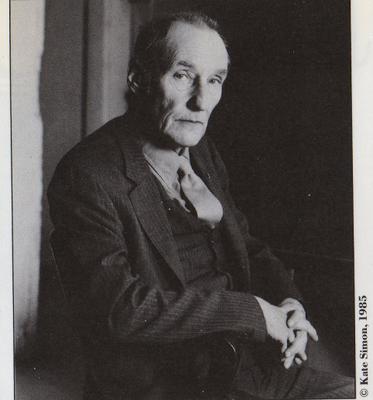
- Is the Third Wolf Really a Christian? KL (who has known him for 25 years) also writes: “I’m also a bit confused, having read perhaps too quickly and befuddledly at this late hour, about your beliefs. You say you ARE a Christian? As in, Christ is the son of God and Christianity is the one true religion? And there is some sort of an afterlife? I am interested to hear more, as I have recently been trying to bring together the fact of my mostly atheist beliefs and strictly atheist upbringing (“I thank God I was raised an atheist!”) with the fact that I definitely do believe in something, although it doesn’t involve any kind of an afterlife or a conception of God that has a ‘master plan’ for all humanity and individual lives.”
Alas, Kerry, I just wrote those words too quickly and thoughtlessly. Too BADLY, I am ashamed to say to a former writing student who writes as beautifully and clearly as you do. I thank you for calling my attention to it. No, I don’t believe that Christ was the literal son of God. No, I don’t believe that Christianity is the one true religion. No, I don’t believe in the Christian afterlife, or for that matter in any, and I don’t believe in Heaven as an existent locatable “place.” And (to anticipate other obvious questions): no, I don’t believe in the virgin birth or in the resurrection of Jesus. (I acknowledge the slight chance that some or all of these things are literally true, but no, I don’t believe in the truth of any of them.) So I am not a Christian in the sense that any good Christian could possibly accept. But I call myself a Christian anyway because the words of Jesus, as set down in the four gospels, are the words by another person with which I am most fully in agreement. All I pay attention to in the Bible are the four gospels, and all I pay attention to in them are the quoted words of Jesus, and, of these words, the ones I pay MOST attention to are the ones scholars think are actually his. (I pay no attention whatsoever, for example, to Paul. Nice guy, but . . . .) William F. Buckley once famously said that if he found out that Jesus was not literally the son of God and literally resurrected, he would “immediately turn Jew.” But if Jesus is the teacher in whom you most believe (he is for Buckley), why go so far? Why can’t you be a Christian in the same way you can be a Confucian? Why can’t you just say, This is the guy who got it right and said it best when it comes to the conduct of life? One difficulty, admittedly, is that of trying to make Jesus into a coherent person with a cohrent teaching, for he seems much different in, say, Matthew, than he does in, say, John. I try! I think it is worth it to try. But, as I also believe in a God of some sort — a God who (whether he, she, it, or all of them together) is much like the “Father” spoken of by Jesus—, then the enormous difficulty lies in relating Jesus to that “Father.” For if Jesus is not God’s literal “son,” how can Jesus’ words be taken as a reliable characterization of God? The only answer I have is the usual inadequate one: Jesus was “inspired” by God—literally having the true words about God BLOWN INTO HIM. Of course, this answer in itself blows. It begs the all-important questions, How?, and, Why should anyone believe THAT?” I don’t know. My own experience, which is all I have, indicates strongly that (a.) there is a God, (b.) he, she, it, whatever, is well-enough understood as “good” and “loving” (leaving it at that), and (c.) this God hears prayer—and then does whatever he, she, it, or whatever wants to with it, knowing full well that the Rolling Stones got it right: “You can’t always get what you want, but if you try sometime, you might just find, you get what you need.” Sometimes, if rarely, what you want IS what you need. In my own experience, which is all I have, I have found out years later that, when I prayed for what I dearly wanted, and when that dear want was also what I needed, I got it—and that when I did not need it, I did not get it, no matter how desperately I wanted it. For we don’t know what we need until . . . . later.
I also have trouble with Jesus because he seems to be (like Jehovah/Yahweh) so devoid of humor—so irascible, perverse, and contrarian at every chance in his recorded dialogues with people (or seemingly so). Such a snippy, cheeky smart-aleck in those dialogues (or seemingly so). But this is also one of the things that amazes me about him: in all my experience, although I have known many such young men, I have never known one who professed, and who practiced in his recorded actions, anything approaching Jesus’ teachings of love and forgiveness. Whether he was literally “divine” or not, and whether he literally worked miracles or not, if he was anything like the Jesus portrayed in the four gospels, he was certainly a person like none of the thousands I’ve ever known. For me, this is one of the most important facts about Jesus—and one I’ve never seen remarked upon anywhere.
- KL Weighs in on Unity. “On the whole unity/chaos topic: I don’t think there is any ‘unity,’ and I do think there is ‘chaos,’ but there is also indisputably pattern (if not design) and quite complex function in living things that really is hard to understand in terms of pure chemical science. I do believe there is an interconnectedness of things—not UNITY of things, since life is indeed random and chaotic, and since lives are in competition, and evolutionarily jostle and smother and prey upon one another. But even so, there is interconnectedness.”
I agree—almost. I’m just not so convinced that “interconnectedness” equals “pattern.” Consider the Internet. It is all “interconnected” by these miraculous things called “links.” But the fact that it IS all connected by links does not not necessarily mean (to me) that those links, taken in their totality, form a “pattern”—unless one wants to assert simply that any bunch of connectons/links existent within anything anyone perceives as a “whole system” (like the Internet or even a framed painting) is ipso facto a “pattern.” If we PERCEIVE something as a whole system and/or as a pattern, we will of course be convinced that it IS. But is it? I doubt it. It is comforting to believe (as Peckham says, above), that it is so. But I see no reason to believe it, other than my emotional desire to be comforted and consoled and reassured. This is what Peckham is talking about when he says that we will perceive unity and pattern in perceptual fields to the extent that we have the emotional NEED to do so—and that, at those psychological moments when we completely lack that need, when we feel very healthy and strong, we will indulge ourselves in the good wholesome evil fun of seeing no unity or pattern whatsoever in anything we think about or look at.

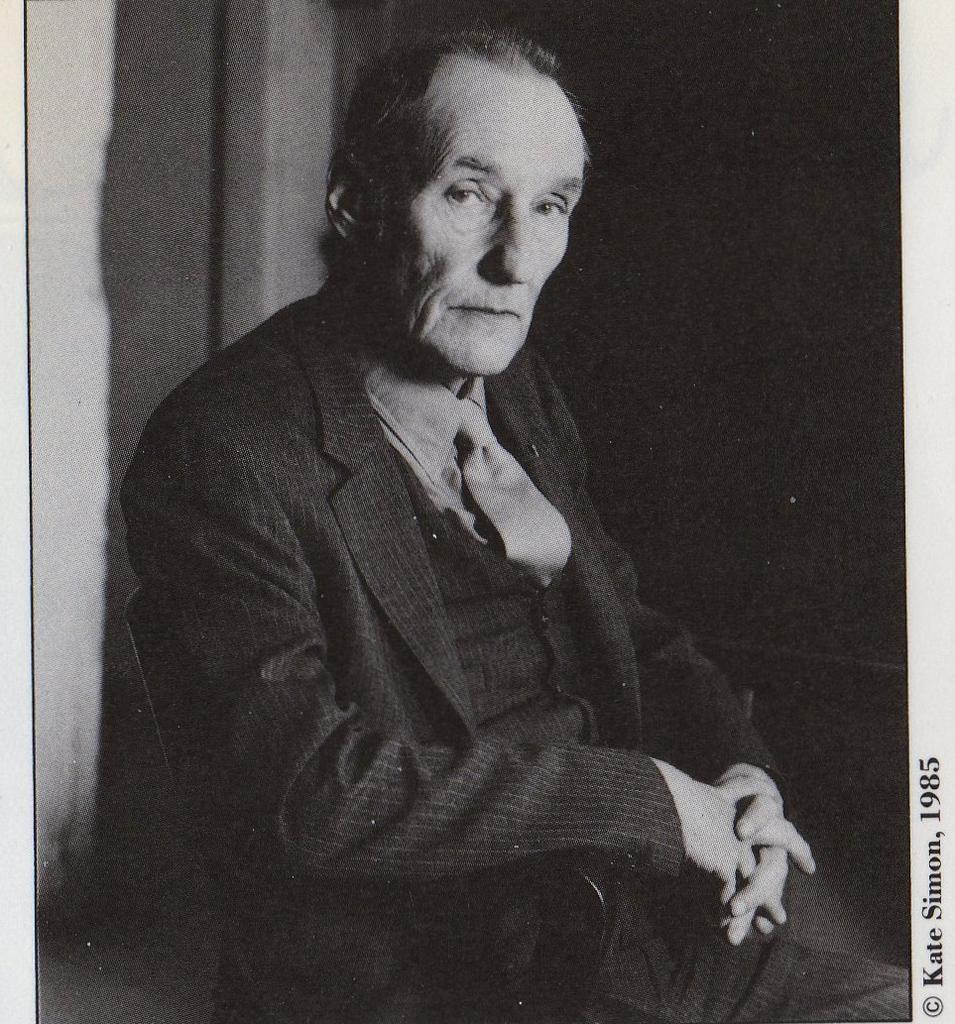
[By the way, I apologize to one and all for the excessive use of all-caps words for emphasis in this journal. They should all be italicizations, but the embarrassing fact is that stupid Leo can’t get the italics function to work. As soon as he figures it out, he will tediously and obsessively convert every all-cap word to an italicized word.]
Life Down South/Hearing Things. I am down at the tiny B & R Market on the corner of my street around 10:00 p.m. last night buying canned coffee and cashew nuts. The sweet lady behind the counter (who has been there for years, and who, because of her motherly sympathetic ear and crinkly smiling eyes would make an excellent bartender) is listening to the musings of a sad-looking customer whom she obviously knows. The man takes a drag off his Newport and says: “We all got to give Bobby Joe time. He’ll put the bottle down. The old boy’s trouble is that he’s only forty-five years old and just ain’t got used to this fuckin’ death shit yet.”
HYPOSTATIZATION. And Now for a Few Words (and Paragraphs) About One of Life’s Greatest Words, HYPOSTATIZATION. (The verb, which is really more important, is HYPOSTATIZE.)
Yup. HYPOSTATIZATION. Like you (probably), I hate nine-dollar words that are also nubulous (and maybe even totally meaningless) abstractions. But I love it when I find a word, no matter how big or little, that nails something humans REALLY DO—especially when it’s something that no other word really nails. HYPOSTATIZATION is such a word. (The word REIFICATION is sometimes used in ways that come close, but its usage has been fuzzed up by Marxian theorists [such as Georg Lukacs] to such an extent that if you use it to mean HYPOSTATIZATION, most educated people won’t understand what you’re getting at.) HYPOSTATIZATION is breathtaking in its implications. Consider the following other words (all nouns) that name things we are taught to believe are actually inside of us somewhere: IMAGINATION, REASON, the UNDERSTANDING, and MIND itself. (Sometimes these HYPOSTATIZATIONS are broken down hierarchically. For example, the poet and philosopher Samuel Taylor Coleridge, who wrote “Kubla Khan,” claimed that there was both a PRIMARY IMAGINATION and a SECONDARY IMAGINATION. And sometimes HYPOSTATIZATIONS are given “add-ons.” For example, Coleridge, along with the German philosophers he followed, also argued that there was a special kind of IMAGINATION inside of you called the FANCY—one of the few that has actually sort of died out over the years, although some readers will have heard of it. ) These particular HYPOSTATIZATIONS are some of our supposed human “faculties” (a term invented by eighteenth-century philosophers and psychologists). We are taught that they are “real,” and we are taught to develop them, and we are taught to worry when they seem not to be working right. Maybe your grandmother, when she thought you’d done something both stupid and wrong, shouted at you: “Have you lost your FACULTIES?”
Anyway, HYPOSTATIZATION is what we do when we turn a human ability (including the ability to feel or sense stuff) into an actual entity (albeit a nonphysical or noncorporeal entity) that supposedly resides inside of you. Of course, this “turning into” is almost totally done for us by the cultures into which we are born. We “receive” it. So, as social theorists would say, these supposed entities are “social constructions.”
Thus, the fact that we have the ability to think logically, to think “reasonably,” has led us to believe that we have an entity called REASON inside of us. (We think of such a “faculty” as residing inside our heads, but it is of course possible, since faculties are non-corporeal, non-physical, that they have their homes in our little fingers.) Why is this important? Well, just to name one little thing, it was the supposed absence of the faculty of REASON in women—an absence claimed by men, of course—that made it illegal for women to vote in America and most of Europe until the twentieth century!
But that’s just the beginning. There’s a lot more to HYPOSTATIZATION than just your supposed “faculties.” Consider all the following words: CONSCIENCE; SOUL; EGO, ID, SUPEREGO (all three from Freud); the UNCONSCIOUS (Freud again), along with its pals SUBCONSCIOUS and PRECONSCIOUS; and ARCHETYPE (from Plato, Jung, Northrop Frye and others). The psychologist Wilhelm Reich HYPOSTATIZED when he decided that certain kinds of “good human energy” live in things inside us called ORGONES. (He invented the ORGONE Box, a big wooden box, insulated with lead, in which people sat for long stretches, and still sit today, accumulating that good old ORGONE energy. (My hero William Burroughs owned one and spent many hours in it. So did Allen Ginsberg. So did the brilliant British educator A.S. Neill, who wrote SUMMERHILL. So did thousands of other Reichians. And, lest you think Reich was ONLY a crackpot, consider that he is still regarded as one of the most important psychologists of both sexuality and the “Fascist Impulse” in the twentieth century.) Marshall McLuhan, the major media theorist of the twentieth century, came up with a HYPOSTATIZATION he called the SENSORIUM—a “thing” inside you that directs the traffic between the five (at least) senses. My teacher (for all too short a time) Noam Chomsky invented a HYPOSTATIZATION he called the SENTENCE GENERATOR—the “thing” that creates the “infiinite number of sentences” he thinks you are able to speak.
Another of my favorite writers, the eighteenth-century aphorist Georg Christoph Lichtenberg (horribly neglected outside his native Germany), worried quite a bit about HYPOSTATIZATION. He worried about it even though he didn’t know the word (or any German equivalent), and even though he did not foresee how much HYPOSTATIZATION would explode in social theory by the end of the nineteenth century. He likened it to the trick of the classical Greek dramatists called the DEUX EX MACHINA. (When they couldn’t solve a complicated mess they had created, the playwrights sometimes had a god come down out of the sky at the end of the play to tie all the pieces together. This god was lowered down onto the stage via a crane of some sort—therefore, “GOD FROM THE MACHINE.” Lichtenberg said that whenever we humans feel the need to explain why we can do or feel something, we invent a god inside us that can do it. But that was the eighteenth century and this is the twenty-first, and Lichtenberg’s multitudinous gods have long since been fired from their jobs, replaced simply by a multitude of machines with nothing supernatural hanging from hooks or wires fastened to them. Nowadays, it is the machines themselves that are supernatural. For it is almost certainly the case that none of them really exists.
For me, it is liberating to the point of joy to be free of all this clutter—to know to a point of near-certainty that I don’t have any of these bothersome damned things rattling around inside me.
I admit that I feel a somewhat alienated from people who don’t, or who wouldn’t, feel likewise.
Does LANGUAGE count as an HYPOSTATIZATION? I have believed for years that it must be one, and here’s why: LANGUAGE is not a “thing.” We use it as a noun all the time, of course, and so we get habituated to thinking it’s a thing. We’re always saying stuff like “LANGUAGE exists,” or “LANGUAGE is the most important FACULTY humans possess.” (Note, above, that the word FACULTY is also an HYPOSTATIZATION—yet another “thing” that doesn’t exist. So saying “LANGUAGE is a FACULTY” is like saying that Zero equals Zero.
But where IS this LANGUAGE? The usual answer is that the “thing” called LANGUAGE is resident somewhere within a human being. We used to say it was in his or her MIND. Nowadays, we usually say it is in his BRAIN—specifically in places such as the BROCA CENTER. Getting to BRAIN, and to BROCA CENTER, helps a lot, because we know those are real, existent things. But what is actually IN those things is not actually a thing called LANGUAGE. If it is a thing at all, it is a thing called SPEECH.
Is SPEECH the same as LANGUAGE? No. SPEECH is the primary human form (not the only one humans have) of what we habitually think of as LANGUAGE. But is SPEECH a thing? Is it actually a noun? No. Where is “it”? It is much closer to reality to say simply that humans SPEAK—that they TALK—and that their ability to do that seems to reside in the BROCA CENTER (and other specific areas) of the human BRAIN.
Well, if SPEAKING, or TALKING, is what we humans actually do, then what do we need the word LANGUAGE for?
Here are two primary models of what I am talking about here:
Model I: Traditional Modern Theory. There is a big THING called COMMUNICATION, and under that THING are human LANGUAGE and other-animal COMMUNICATION SYSTEMS (barking, chirping, mooing, and so on), and under the thing called human LANGUAGE are all the various human LANGUAGES (or “tongues”). (Brief technical note: within the category LANGUAGE itself, most modern linguists since Ferdinand de Saussure in the nineteenth century, and including Chomsky in our own two centuries, have said there is (a.) the “capacity” (dangerous word) to USE the THING called LANGUAGE (which Saussure called “langue” and which Chomsky calls “competence”; and there is (b.) the actual doing of it (which Saussure called “parole” and which Chomsky calls “performance.” )
Model II: My Theory. Animals, including humans, can COMMUNICATE. Humans do it by speaking (talking); the other animals do it by barking, chirping, mooing, and so on. When humans do it, they make noises specific to where they were born and/or now live (which we commonly call “languages,” but which it is probably more accurate to call “tongues” (English, Arabic, German, Swahili, and all the rest of them). And that’s it. (And regarding the “brief technical note” which concludes the previous paragraph, sure: certain areas of the brains of us animals do indeed primarily “govern” or “enable” or “make possible” the species-specific strings of oral sounds we make when we COMMUNICATE. It in those areas that Saussure’s “langue” and Chomsky’s “competence” reside, if one must have such terms—although we probably don’t need such terms at all. It’s both a lot more accurate and a lot easier to say that certain areas of the brain make it possible for us to do it (“performance” or “parole”), and so then we just do it.
In other words, I theorize that the word LANGUAGE is not only completely unnecessay to an accurate account of, and understanding of, speech (talking). It also makes for an erroneous picture of what’s actually going on. Stated simply, the theory which sets it forth (Model I, or any variant thereof) is wrong. I have never seen a convincing argument for it . In fact, I have never even seen it ARGUED. it is just ASSUMED. It is a “social construction.” We should deep-six it.
Boiling it Down: SPEAKING is one form, the primary human way, of animal COMMUNICATION. And that’s it.
Ah....... Once again, how much lighter and freer one feels without the imaginary burden of LANGUAGE
SUBSPECIATION (or PSEUDOSPECIATION). This will be the second of my my nine-dollar words, and the last. I promise. It is closely related to HYPOSTATIZATION, demonstrating that HYPOSTATIZATION itself isn’t just cluttery and burdensome and silly. It is also goddamned dangerous. SUBSPECIATION is the act (mostly unconscious, but so what?) of changing other types of people into something less than fully human. We do this by claiming that those people lack some crucial entity or entities we deem necessary to being fully human—like US! This crucial entity is always an HYPOSTATIZATION, and the most popular one in the western world throughout history has been REASON. It is an anthropological truism to say that all tribal peoples (and most if not all national peoples) see themselves as the PROTOTYPE of humanity. To them, all other types of people are lesser “variants” of some sort—not quite as good as the prototype, not quite as “fully human,” not quite up to snuff. This is “ethnocentrism” (so-called), and the peoples in most tribes and nations have a special word all their own that labels the prototype. This local word, whatever it is, means US. Other peoples somehow lack something. They are “missing a piece”—or pieces. And within the tribe or nation itself, of course, the “creme de la creme” of the prototype has been the dominant sort: the men. And in most of the history of European-American culture these men have been white, non-semitic, and “of a certain class”: people who not only look like us but who turn out to be, upon examination, REALLY like us. (The great psychologist of the human life cycle, Erik Erikson, used the alternate term PSEUDOSPECIATION because he was interested in the constant suspicion of the dominant “prototype” that lesser beings were pretenders who were constantly trying to “pass”—thus to fool them and grab some of the Good Stuff for themselves.)
At the risk of boring your very ass off, I repeat: the act of HYPOSTATIZATION has served throughout history as the major rationale for the act of SUBSPECIATION/PSEUDOSPECIATION. For example (as I think I have mentioned before in this journal), women were denied the right to vote in most western democracies until the middle of the twentieth century because men SUBSPECIATED them by claiming they lacked the FACULTY of REASON (or had some sort of “lesser version” of it which hardly qualified as REASON at all). In other words, women couldn’t vote because they were deemed less than fully human. Ditto for African-American slaves, whose supposed lack of any and all necessary HYPOSTATIZED FACULTIES rendered them non-human and thereby rationalized their enslavement.
So it isn’t just dumb foolishness and airy philosophical error that come out of the ethnocentric (and phallocentric) behavior called HYPOSTATIZATION. No. Rather, because this behavior is (ironically!) so “primitive,” it is one of the major causes of the survival of barbaric evil in the so-called civilized world.
Life Down South/Hearing Things. I am once again down at the corner store. This time, the nice lady who runs the place after hours has her 17-year-old daughter with her to keep her company. The girl is doing her homework. When I walk in, they both look up and smile and the lady says, “Oh, Leo, I was hoping you’d come in! I know you’re some kind of a teacher, and we’ve got us a problem on our hands with her [points to daughter] school!” I don’t teach in the public schools, but I let that pass and just ask, “What’s wrong?” The lady says [points to daughter] “Tell him.” The girl says: “Well, I got put on social probation. Do you know what that is, Leo?” “I do,” I said. “I was on it.” “You WERE!?” “Yes. A few centuries before you were born, but yes. What did you do?” She looks down. “I’m too embarrassed to say.” “I was too,” I say. “So, other than that, what’s the problem?”
The girl tells her very short story: “Well, they say I gotta do 25 hours of community service if I want to graduate in June, and I sure as hell DO want to graduate in June, so I gotta find some way of doing it, but there’s nothing on this list [shows list to The Third Wolf] that I CAN do, so I’m sorta screwed really.” I look at the list. I find many things that ought to work for her. I say: “Well, how about this Habitat for Humanity work? It’s a great organization, and it’s a great cause, and I know the local director here, and I could put in a good word for you.” Her mother breaks in: “She can’t do that. She needs to drive to get to where they’re buildin’ the houses. She flunked Drivers Ed there at the high school, so she can’t get her license.” The Third Wolf goes back to the list. “Well, here’s the PERFECT thing. You read stories to little kids or to blind people. You do it right down at the public library on Market Street. I’ve done it myself. It’s fun.” “That’s no good,” the girl says. “I can’t do that because I can’t read.” Beat. Beat. Beat. “You can’t READ?” “Naw, I never learned how.” Beat. Beat. Beat. “But you’re set to graduate in June anyway, if you can just get this community service stuff done?” “Yeah,” she says. “They’ll let you graduate without knowing how to read?” “I’m not sure they really know. We don’t have to do anything to prove it very often at ALL! A lot of the kids can’t read, and they’re all graduating too.” Beat. Beat. Beat. “Aren’t you talking about a Certificate of Attendance instead of an actual high school diploma?” “God no!” she laughs. “I mean, you gotta be a really BAD STUDENT to get a Certificate of Attendance!”
I have so far learned at least one important thing from writing “The Journal of the Third Wolf”—that there’s a lot more, in my own weird case, to “Hearing Things” than I had suspected before I began.
It isn’t just that I hear things in the “out there” and remember them. (Or that, to borrow a title from one of Henry Miller’s books, that I “remember to remember” them.) It is also that I hear things in the “in here.” Not creepy stuff like Son of Sam heard “the voice” telling him. Not like Manson heard “interpreting” the Beatle’s “Helter Skelter” song for him. Not like Jerry Falwell saying God told him He will curse San Francisco for being Sodomy Central. Not like George W. Bush saying that God told him to invade Iraq. Nothing like any of that.
Like WHAT, then? Like this. The great poet Jack Spicer claimed all through his short life that his poems seemed to come to him from Outer Space—that they had nothing to do with “him,” or anything “he cared about,” but rather that they just seemed to float into his head. Most contemporary poets say, in one way or another, that they write poetry in order to “express themselves.” Jack did not and could not. Jack’s poems expressed “someone else.” He did not know who. He didn’t even care if there WAS a who. All he knew was that his poems were not “about” “him”—and did not “express” “him.” Jack was almost one of those tinfoil-on-the-head guys you see on buses, except that Jack wasn’t crazy. (Eccentric, certainly. But not crazy. Not delusional.) Well, I write poems, too, and I have written them all my life, and my poems are exactly like Jack’s—except in quality, of course. They have nothing to do with me. They do not “express” me. They have nothing whatsoever to DO with me.
For example, I wrote a bunch of tatty little poems about ten years ago about a classical cellist named Cluny. They came out of the air. None of them has anything to do with me. (Psychoanalysts would obviously differ. And they might be right. Nevertheless . . . .) Here’s the first one:
Celebrated cellist Cluny, uncontrollably in love
  with the supremely innocent yet most ravishing
  of M. Gabriel’s three much-noted daughters: Ninette,
  she with the white taffeta gowns,
  she with the white cat named Villon,
  she whose fingers upon the white virginal make a babble
  like a free-flowing forest rill,
  its dark bed lined with smooth white stones,
  its music ordered just by two soft banks
  which shape its course through space and time,
  her two commanding hands.

Mustachioed Cluny, the great lover, the infamous one,
  amplified (or, if you will, reduced) to scattered scraps of erstwhile fin-de-siecle
  Music-Master Manhood,
  to random wisps of lingering mad blue smoke—
  as from the embers of a dead duellist’s still-smoldering cigar
  by one small sixteen-year-old musical student,
  still hanging in the air for all to see.
Or all save she.

For her bright eyes there was only Mustachioed Master:
  Mad genius poet of the cello, Belgian National Treasure at twenty-seven,
  Embodiment of Music-Master Maleness,
  Lord God of Space and Time. . . .
Where Did Those Words COME From? I don’t know or care about any of that. I don’t know where it came from. I don’t care where it goes. It isn’t a very good poem by me, and it isn’t a very good poem by anybody, but it’s the poem that best serves for an example here. Does it “mean” anything? Not to me. I’ve got about a hundred of ‘em lying around here doing nothing. Go figure.
To take another example, all the dreams that strike me as being vivid enough to remember are not about “me,” and Richard Jones, in his unfinished In Dreams We Kiss Ourselves Goodbye was, in my own experience, right. There is an “I” in them who “lives” them, in the sense that they are in the “first person.” “He” has some things in common with me, but seemingly no more than anybody else you’d dream about (or see on the real street). There has been a series of these dreams lasting over a period of years and still continuing. In them, I am an early-middle-aged African-American man who heads up a fairly large nuclear family (kids, siblings, a mom and a dad, all living there in his big house). The family is upper-middle-class. He is something like a doctor or lawyer. He is very responsible and very bourgeois. In fact, he is a bit like the character I understand Bill Cosby to play on “The Cosby Show”—which I have never seen. His name is Clarence Page, and his nickname is “The Grip.” (I have done research to see if “The Grip” might in fact be Page’s real nickname—or have any known connection to him. It is not and it does not.) Now, Clarence Page is a real African-American guy—a horn-rimmed journalist, pundit, talking head, and after-dinner speaker who is perhaps a few years younger than Cosby. In all those roles, he is reasonable and charming. In the dreams, “I” am a lot younger than Cosby and a bit younger than Page: 35 or 40. The dreams are about “my” problems as Clarence Page. They are extremely bourgeois problems, but they worry “me” to death. For example, one dream was about whether or not “my” son was going to get admitted to Phillips Exeter Academy in Andover, Massachusetts (a real and very prestigious prep school that is in fact notoriously hard to get into). So there is nothing else to add here, EXCEPT: I am a white man close to Cosby’s age who had no siblings and who had a very small nuclear family (just Mom and Dad and me). I do not identify in any conscious way with the real Clarence Page (or Cosby). I do not wear glasses. I am not a journalist, pundit, talking head, or after-dinner speaker, and would very much dislike being any of those things. I am not very bourgeois in my values or interests. And, while I did and do have a child of my own, she has managed to gain admission to, and to graduate from, some of the best schools in America. So why do I dream that I am Clarence “The Grip” Page? I have no idea. I don’t think there is a real reason. (And by the way, the phrase “The Grip” means absolutely nothing to me.) I think that “my” dreamt Clarence Page is like “my” pianist Cluny—and like all the people and things that filled up Jack Spicer’s wonderful little poems. Do I believe, with Jack Spicer, that these things LITERALLY come into my head—from God, space aliens, or who the fuck knows what? No. I believe none of that. It is all beyond me (no pun intended). I have no theories at all about it. I don’t seem to care, and I don’t seem to think it matters. I don’t know why I don’t.
And to take yet another example: It has been my good fortune to know a good many brilliant, hilarious people—people who were like no one else, who were truly sui generis—and it has been my further good fortune that these people have on occasion told me, privately, some of the most brilliant and hilarious things I have ever heard—things which they apparently told no one else (no one else who remembers, or who is telling, anyway), and things which they did not publish in their writings. (I stress, to your possible disappointment, that none of these things had to do with their private lives, and therefore hat none of it involves any wonderful juicy gossip.) I was there. I heard them. I remembered them. I carry them around in my isolated head. None of them has anything to do with me—or, for that matter, with THEM. I really feel the need to write them down in order that they do not die with me, as they would have done with themselves, had they not lived on in my head, and so I will do so here. (See, for one example already mentioned, the entry above on Morse Peckham.)
And finally: all this “intellectual” stuff I have always been so interested in (and obviously still am) about hypostatization, language, evolution by natural selection, and all the rest of it? I now realize that it’s the very same as the things I hear in the marketplace from all kinds of people, the things I hear in private from one person, the dreams I have, the poems I write . . . . None of it is me. All of it is coming through me. Except for THIS. This is a me I know to be me. And I can no more explain that to you than I can levitate, sing like Pavorotti, or hear the very voice of God. But it is true. This is me.
Hallowe’en, 2005, Charlottesville
As I walk into the Mud House Coffeeshop on the Downtown Pedestrian Mall, I see my casual pal RC sitting out front. He is a Street Person—middle-aged, bespectacled, paunchy, clad in gray sweats. As usual, he has spread his belongings around him in plastic bags. As usual, his battered bike leans against his bench. As usual, he is chain-smoking and reading a book (Paul Bowles’ The Sheltering Sky). As usual, he looks doped-out in that over-medicated way you see all about you these days in America. But, in a radical departure from the usual, he is wearing a bright orange toboggan. Our eyes do not meet.
“Nice costume,” I say in passing as give him a gentle pat on the shoulder.
“Thanks, Leo,” he says without looking up.
I walk into the neighborhood drugstore to buy dental floss. The place is crammed with screaming subteen Hallowe’eners, some with parents, most by themselves in jerky but secretly coordinated subteen clumps. The Manager, DG, is taking a shift on the registers to relieve the exhausted staff.
“Happy Hallowe’en, Dude,” I say to Don in my best chipper ironic mode.
“Fuck Hallowe’en,” he says. “Fuck it all.”
“Too busy?”
“Shit-slammed by these ill-mannered cocksuckers, Leo.”
“Cocksuckers?”
“Cocksuckers. You’ve seen DEADWOOD. COCKSUCKERS!”
“I believe you speak of the decline in manners so evident to those of our generation,” I say.
“Believe this,” he whispers, pseudo-surreptitiously giving me the finger behind his white pharmacist’s coat.
“Cheer up,” I say. “Soon you’ll be off work and safely at home facing these selfsame cocksuckers at the front door with a bowl of Tootsie Rolls in your hands.”
“Yeah, I’m going home, but listen: this ain’t nothing, this is just the beginning.”
“The beginning? Of what?”
“The FOURTH QUARTER, you ivory-tower moron!” I must have looked at him quizzically, because he immediately shot back with, “Don’t know what I’m even TALKING about, do you?”
“No,” I said. “I am truly an ivory tower moron.”
“The Fourth Quarter, that’s the last three months of the fucking so-called Business Year. Hallowe’en, Thanksgiving, Christmas, and New Year’s, plus whatever the fuck it is the Jews do. And then, right after that, fucking Valentine’s Day. He glanced around me at the line of screaming kids in vampire and werewolf drag growing ever-longer behind me as we chatted idly away. “It’s just this UNBROKEN SERIES of different hideous, revolting store displays that they bring in here for us to put up.”
He shot a furtive look at the line again. “Listen to the bastard parents muttering,” he said. “Let the bastards mutter.” And muttering they were.
“And the goddamned music! Unending. Andy Williams out the asshole.”
“Yup,” I said. I didn’t know what else to say.
“Leo, do you remember when we had Thanksgiving and Christmas?”
“Sure.”
“Well, so do I. I wish to God we had ‘em again. Instead of this fucking Fourth Quarter. Guys from the Home Office come in here yellin’ ‘Rememeber, we make or break in the Fourth Quarter!’ Fucking football analogies anyway.”
“I miss ‘em myself,” I said. And I truly do.
“Fucking Hallmark,” he said. “Did you know those cynical bastards lobbied Congress years ago to create these national holidays tget called Mothers Day and Fathers Day just so they could make even more money off this evil shit? What REALLY pisses ‘em off is that they haven’t found a way to make much offa New Year’s Eve yet. They’ll figure it out.”
He glanced at his watch and smiled at me maniacally. In an undertone, putting his hand beside his mouth in a mock whisper, he said: “Mwuahahahahahahahahahhhhhhhhhhhhhhh! I’m outta here.”
He slapped a sign down in front of him sharply: Go to Next Register Please. He winks at me says, “Happy Fourth Quarter, Dude!” He runs for the staff door behind him as twenty-odd people behind me start in to cussing and booing even more than they’d been cussing and booing before.
I walk back out onto the mall. I immediately see two Hallowe’eners strolling separately in their separate worlds. One is a lovely young retro-Goth punkette in a black tee-shirt. She is skipping along, smiling and waving, toward a small gaggle of retro-Goth friends. Her tee-shirt shouts in huge yellow letters: “Fuck Christmas. My Soul Belongs to the Antichrist.” The other is a hugely obese man of about fifty-five who is dressed like a cowboy: black Resistol cowboy hat, lizard-looking boots, a wide bejeweled belt fronted by a gigantic Navajo silver buckle. (Note to readers: this is not a costume, Hallowe’en or otherwise. This is him.) I guess him at about 350 pounds. He waddles along red-faced, puffing and grinning. He too is headed toward a small group of friends to whom he waves, and who wave back at him, obviously happy to see him. He too is wearing a tee-shirt. It is huge, probably a 3-XXX, but it is not big enough cover his navel area, which, along with the rest of it, hangs down on all sides over his belt. The tee-shirt reads: “I BEAT ANOREXIA!”
I then walk across the street to The Jewelry Store, a very old and very old-fashioned shop run by a very old and very old-fashioned family of jewelers. It is five minutes of five. They close at five. I walk to the back counter and say, “This wristwatch just needs a new battery, so I just brought it in to leave overnight or however long it takes you to get around to it.” “Oh, we’ll just do it now, Honey,” says the nice lady at the counter whose name I am ashamed not to remeember. “Well, I don’t want to keep you after five,” I said. “Don’t you worry one bit,” she said. “Momma and me are always here after five.” She takes my watch and goes to work with her tiny little tools and illuminated magnifying glass.
“Don’t know what the world’s comin’ to sometimes,” she says without looking up.
“What happened?”
“Store next door’s run by some new people. We don’t know ‘em.” She glances over at her mother: “You haven’t met ‘em, have you, Momma?” (Momma looks up: “Nope.” ) “Well, I think they’re from New York. Anyhow, it’s some kind of I-talian ice cream place. We hear the ice cream’s real good, don’t we Momma? (Momma nods: “I haven’t had any of it yet, but that’s what they say.”)
“What happened?”
“Oh! I nearly forgot. Well, yesterday morning I was out front sweeping up. It was right before 11 and I was getting ready to go across to Timberlake’s for lunch. And this fella went up to the door of the I-talian ice cream place and he tried the door and it was locked. He saw them New York fellas inside, so he knocked. One of them came to the door and pointed to his watch. I heard him yell through the door, “We don’t open for four more minutes yet!” So this poor fella had to wait the full four minutes before he could get in there and get his ice cream.” (Momma looks up: “Actually, I think it’s more some kind of sherbert.”) And it just upset me. I mean, What’s the world coming to? I came back in here and sat back down and told Momma about it. It bothered Momma too. (Momma looks up: “It did.”) “I mean, four minutes. I’ve been here at least fifteen minutes early every day for the past twenty-some years and when people come before we open and look in I don’t wait for ‘em to knock. I just go to the door and let ‘em on in. I mean, that kind of town. I grew up here. I know.”
“You’re right,” I said. “I’ve been in and out of here since the late 1950s myself. It’s that kind of town.”
Momma looked up: “Four minutes,” she said. “I never really left, I guess. So I really just don’t know what to think about that.”
My watch was done and it cost me $5.75. It was one minute past five.
A few days later I run into IH. She, like RC on Hallowe’en, is sitting at the outdoor cafe in front of the Mud House. She, like RC, is reading Paul Bowles’ The Sheltering Sky. At first I wonder, My god, is it International Paul Bowles Week or something. But then I remember that Bowles graduated from the University of Virginia here, so the thought crosses my mind that maybe it really IS Paul Bowles Week (at least locally)—a thought which proves, upon inquiry, to be false. IH is the twenty-year-old brilliant and lovely daughter of two dear old friends here, but I haven’t seen her for some time, and she has grown up, and so I do not recognize her. I only find out from her a day or so later, to my intense embarrassment, that she is indeed Isabel. But she does recognize me, and she has no idea that I do not recognize her. So this is a Comedy of Errors on the Road of Life from its inception and all the way around . . . ah, but I get ahead of my fool self in the telling. ) I ask her about her interest in Bowles and we begin to talk about him—and about his wife Jane, and about his friends Burroughs and Ginsberg and Kerouac and all the rest. IH begins to talk about the Beats and her adventures in reading them—and about the entire Idea of the Road. I am fascinated and gladdened by how much more she knows, how much smarter she is, how much more articulate she is, and how much wiser she is than I was at twenty—when I was reading, unbelievably, the same writers! She talks for about five minutes, pulling her thoughts together—successfully—and finishing up with the brilliant and beyond-her-years observation that . . . “There is just no CONTENT to the Road.” Implied in this (at least to me) is the conclusion most of the Road is Stealth Style. Also implied in this (to me) is that most Romanticisms may themselves be illusorily contentless. I was running late for a class I teach at the University, so I had to run off and I did, but I thought all the way as I drove there about the Road as an illusion of content, and I also thought about how much I wished I had known at twenty what Isabel knows at twenty about the Road, and about all those seekers who go looking for Knowledge on it—out there in the moonlight on the endless Lost Highway—most of whom, in my own experience, remaining every bit as contentless as the Road itself for as long as they stay on it.
Leo’s Eight Favorite Remarks About Music Overheard in 2005
- Sir Thomas Beecham: “The English do not like music at all — but they absolutely love the noise it makes.”
- Mark Twain: “I hear that Wagner’s music is actually a hell of a lot hetter than it sounds.”
- Ulysses S. Grant: “I only know two tunes. One of them is ‘Yankee Doodle.’ The other one isn’t.”
- Emperor Joseph II on Mozart’s Music: “Too many notes.”
- Sir Thomas Beecham on Pfiitzner’s opera PALESTRINA: “Like Wagner’s Parsifal but without the jokes.”
- Sir Thomas Beecham on Why he Hated Bach: “Too much counterpoint. And, my God, PROTESTANT counterpoint!”
- Sir Thomas Beecham on Why he Hated the Harpsichord: “Because it sounds like a birdcage played with lobster forks.”
- Arnold Schoenberg on Why he Hated the Harpsichord: “Because it sounds like two skeletons fucking on a tin roof.”
7 December 2005: My dear mother’s birthday. Her maiden name was Mollie Brown. She hated the fact that Pearl Harbor happened on her birthday. She also hated the fact that her name would be forever associated with yet another disaster, the sinking of the TITANIC, because of that ship’s most famous survivor, Unsinkable Mollie Brown. She died of cervical cancer in the summer of 1966. “I have to face the fact that myself am NOT unsinkable,” she said on her deathbed. I was an only-child Momma’s Boy and I loved her with all my heart. Her death came as the greatest shock of my life (I had not been told that she had been pronounced terminal), and it caused me to suffer (what was then termed) a “nervous breakdown” for most of the next year. I am still not over it, nor will I ever be. I think of her every day, not just on her birthday, and I always will. A second thing she told me on her deathbed, in response to some phony, de rigueuer consolational words from me about how religious faith could still hold out some hope: “Francis, this experience has made me just about stopped believing in God and faith and prayer.” Because she had been such a devout person, I was deeply shocked by her blunt honesty in saying this, out loud and to me, but it made me love and admire her more than almost anything else she had ever said or done, and it still does.
On his own deathbed two years later, my father, Frank Soden Daugherty, instead of telling me something, made me promise him something: “Francis, just promise me that, wherever you work, you’ll be a member of the labor union there — and if there’s not one there, you’ll try to start one.” (He had been a militant unionist all his life, and an organizer in the coal mines of Eastern Kentucky and West Virginia in his early days. He and my Uncle Ed were at Matewan when the deal went down there, and Uncle Ed was murdered there.) I promised. And, even though my only work as a “laborer” has been in university teaching, I have kept the promise. When we faculty began organizing at my first teaching job up in northern Wisconsin (centuries ago now), the initial wrangling was about whether we should affiliate with the American Federation of Teachers (AFT) or the Wisconsin Education Association (WEA). As the youngest and least experienced teacher there, I stood up and said: “Why don’t we get serious? If my father were here, he’d recommend that we stop fucking around with lame outfits like those. He’d recommend that we join the Teamsters — if they’ll have us.” Well. The idea of becoming a Teamster was deeply troubling to a lot of the faculty — primarily because many of these men and women were first-generation “professionals” who wanted badly to put their blue-collar family backgrounds behind them forever. “Teamsterism,” and all words and things like it, was something to be fled, not embraced. But they did it, and the Teamsters did have us, and everybody’s glad now — except the administration. Ten or fifteen years later, when I became Dean at another college, the faculty in that college’s own union tried to force me to leave it during my time in the administration. I refused. They insisted again. I refused again, this time citing my deathbed wish to my father. They sort of issued this collective sigh and shrugged and nodded, as if to say, “Okay, okay, okay. We don’t like it, but okay.” My father, whom I did not exactly love but to whom I had sworn the unionists’ deathbed oath, would have been ecstatic. I think this was about the only thing I ever did, during or after his lifetime, which might have actually made him feel joy. But it was, at least, one thing.
7 December 2005 Again: Just after writing the two paragraphs above, I posted them and shut down my computer. When I looked up, my pal Brigit Dee, the daughter of Kathleen Dee, was standing beside my coffeehouse table, looking down at me. I jumped when I saw her standing there, as I’d been writing away in my usual obliviousness. “Jesus,” she said, “I was just waiting till you finished. I know how you are.” We both laughed, but I couldn’t help noticing that she was blinking back tears. I asked her if she was okay. “Sorta,” she said. “I’m okay, but I’m just sad because today’s my mother’s birthday. I’ve been thinking about her all day.” “I asked her why her mother’s birthday made her sad. “Oh, I thought you knew,” she said. “She died a month ago.” I asked her to sit down and wait a second for me to power up the laptop so she could see what I had just written. She did. She read it. She said, “This is unbelievable.” “Yup,” I said. We talked some more. “Cancer with my mom, too, of course. One month from diagnosis to death. She was a doctor and she did everything right. She didn’t drink, didn’t smoke, ate right, and exercised five times a day. I just don’t know.” Then Brigit left to run off to a night class at UVa. I sat and thought: well, I’ve certainly got to write this down here, too, as it’s one of the most curious examples of “Hearing Things” that I’ve ever experienced. I also decided to add, and here do add, my usual boring, obligaory note stating that I attach no mystical or religious or supernatural significance or meaning to such events, even to such weird and wonderful conjunctions as this one. But I am beginning to suspect, after all these years and after all these addings-of-the-note, that I may actually be crazy for being the skeptic that I am, and for forever insisting upon adding them. The trouble is that I would be likely just as crazy, or more crazy, if I believed otherwise and DIDN’T add them. It is a troublous world.
26 December 2005: Happy Henry Miller’s Birthday! I write these words outdoors on vacation under a palm tree at a Starbuck’s near Jacksonville, and I am reminded that Miller’s first “story of my life” writing was set in Jacksonville in the late 1920s — much later published as Into the Heart of the Everglades. (Jacksonville is nowhere near the Everglades, of course, but Miller did not really think facts about the exterior world of much import, particularly geographical facts. He sneered at them — and at people who took them seriously.) Miller’s parents had hoped desperately for a Christmas Day birth and didn’t get it, so they named him Valentine. Henry Valentine Miller (1891-1980). He was something of a silly old pill following an epiphanal experience at the (supposed) tomb of Agamemnon sometime in the early 1940s — after which he seemed to have lost most of his unique sense of humor — but he was arguably the world’s greatest English-language autobiographical writer of the first half of the twentieth century, and he was still a great observer to have on the scene until his death, and he almost hit ninety. Most people assume that I did my Ph.D. dissertation on Shakespeare, as that is what I write about now when I do scholarly writing, and as that is what I teach. But I actually did it on Miller — a scandalous project thirty-five years ago which would probably be even more scandalous today. I love Miller still. Happy birthday, Henry, from Jacksonville and Planet Earth.
28 December 2005, 3:00 a.m., at a Denny’s counter somewhere on I-95 North. The woman sitting three stools down looks to be about 85. She has a croaky upper-class English accent which exactly matches her crinkly brit complexion. She is smoking an unfiltered Player. (Yes, you can smoke at the Denny’s counter in Virginia.) She reminds me of the brilliant English piano jazz diva Marilyn MacPartland (whose longrunning show you may have heard on NPR). Thinking that she might BE MacPartland, who is a hero of mine, I am too intimidated to ask her if she is or isn’t; I content myself by merely fantasizing that she is. The super Oriental waitperson behind the counter, who has brightened this wintry night for me for half an hour with her great service and chummy conversation, walks up to the British lady, pad in hand, and says, “You like fresh pot? If you wait, I bring you fresh pot.” To which the British lady responds in a loud voice, “Oh, my dear, if I’d known there were going to be DRUGS involved, I’d have brought my bong in from the car!” The whole joint (no pun intended) resounds with holiday laughter. I take comfort in this good evidence that America in the George W. Bush years isn’t really the hideous, joyless place it can so often seem to be on a day-to-day basis.
New Year’s Eve 2005-2006. After I get home from this coffeehouse (Charlottesville’s Mud House), I will start the black-eyed peas. In case you don’t know, it is traditional in the South to cook and eat black-eyed peas with your company (which you of course have over to the house) on New Year’s Day. This ritual is supposed to bring good luck for the year, but I observe it because of my passionate love for black-eyed peas — and my moderate love of ritual. Here, for your education and possible future culinary pleasure, is my mother’s two-hundred-year-old (at least) handed-down recipe, as edited, although in no way modified, by me:
Mrs. Daugherty’s Black-Eyed Peas
(If using dried peas, soak for 12 hours or more beforehand.)
- Chop three or four medium to large turnips into chunks.
- Fill a LARGE pot (cauldrons are best) 3/4ths full of water.
- Add a TINY amount of salt and a LARGE amount of fresh sage (an entire package if store-bought-fresh), unchopped, to the water.
- Toss in the turnips.
- Boil them turnips down. At highest heat! Don’t use a top for the pot. Keep adding water until you have something approaching . . . GRUEL!
- Refill pot to 3/4ths full with water. (Repeat if necessary — that is,, if you don’t yet have gruel.)
- Add peas. (If using dried peas, use an entire package from the produce store. If using frozen peas, use three or four packages.)
- Boil them peas down. Highest heat again. No top. Keep adding water as needed. The goal is (a.) near-mush-like peas that have (b.) turned almost RED (like tiny lobsters). This may well take two or three hours!!!!
- Don’t worry about the peas losing their “construction.” It is virtually impossible to boil a black-eyed pea until it stops looking like a black-eyed pea. I have tried.
- But don’t let them burn (through allowing the water to run out).
- When you sense that they’re maybe an hour from being done, you might add more spices of a gentle sort that you like. Nothing at all sweet! Fresh parsley, thyme, rosemary maybe (all unchopped).
- [I throw in a huge dash (no pun intended) of Mrs. Dash spicy seasoning at the same time I do #11. And I add more if, upon tasting, I find the peas to lack “depth of character.” Mother might not approve, but probably would.]
- Finally, when you think they’re done, add a half-stick of butter or Margarine (I use the no-cholesterol stuff — Benecol or Smart Choice or Take Control), and if that’s not enough, add more. There’s nothing like this final step to give black-eyed-peas “depth of character.”
- Resist the Devil when he tells you “This will be better with chopped onions and/or diced carrots boiled up with the peas.” It won’t be.
Humans and the Other Animals: The Real Dividing Line
Most western religionists believe in a sharp dividing line between people and animals. Most western philosophers believe that people are animals, but that there is still a sharp dividing line between us rather than a graduated continuum — that we are still different in kind rather than degree. From Descartes (and before) to Chomsky (and after), they have drawn that line at speech — which they persist in calling “language.” As a Darwinist, I very much believe — indeed, I know — any such dividing line to be fictitious wishful thinking. Yet there is a true dividing line, and it is this. Humans can experience nothing with all five senses at once. They are too civilized. Thus, I can see my new car, I can smell my new car, I can feel my new car, and I can hear my new car all at once. Four out of five. But neither you nor anyone else can think of anything you can experience with all five senses at once. But animals can do it; indeed, they can often do no other. Consider food as one example. If you have a plate of tofu, you can taste your tofu (if barely), you can smell your tofu (if barely), you can see your tofu, and you can touch your tofu — but you can’t hear your tofu. But members of many other species can hear their food scream as they taste it, see it, smell it, and feel it. T.S. Eliot was right: people cannot bear too much reality.
Lies. I loved it that Ned Rorem titled one of his most recent journal collections Lies. Another one he titled Pure Contraption. These titles recognize the twin facts (a.) that everybody thinks you’re lying anyway, whenever you say anything historically or autobiographically interesting, and will say so to others, so why not preempt them and just say so yourself? and (b.) that it is so very hard, if not impossible, to tell the literal truth about anything historical or autobiographical, even if you’re really trying, because it is well-nigh impossible to know such a thing for sure in the first place. I know that some people will think that some of the things I say in this journal are lies; I know, moreover, that some of them probably are, albeit unintentionally. But I do try. i really do. Anyway, the unbelievable truth is that I have been able, since the age of puberty, to gain as much as seven pounds in one day (to my sorrow, of course), or (if I try) to lose seven pounds in one day. I did this just last week, and when I told my friend NV about it, she said to me that this is a flat impossibility (both ways) —- that it cannot happen. “Not seven pounds!” About fifty others have said the same thing over the years. On a couple of occasions, I have demonstrated the truth of this claim with a scale over a 24-hour period. Friends’ responses varied from “That scale is broken” through “That’s pure water weight” to “That’s some kind of trick.” I was once willing to admit to the second possibility (water weight), but experiment proved it wrong: my seven-pound weight gain was definitely related to dietary excess in all cases, and my seven-pound weight loss was definitely related to dietary abstemiousness. (And I drink lots of water all the time.) The weight stuff is just an example. What interests me is that people seem unwilling or unable to believe that weird stuff — albeit unsupernatural stuff — really happens to people all the time. To be more specific, they seem unwilling or unable to believe that it happens “atomically” — just one unbelievable thing at a time, to one person at a time, without discernible pattern or order, while they seem very much willing to believe in such things if they come in patterns or clumps and affect either themselves personally or a large group which includes them — which is why paranoia and optimism (two sides of the same coin) both run rampant in even the postreligious western world.
Lies (Continued). Upon reading the entry immediately above, NV responds from Santa Fe that the only reason she denied the possibility of gaining seven pounds on one day was out of fear of believing that she herself could possibly gain seven pounds in one day. The logic of this line of reasoning eludes me, but NV is an artist. And a damned good one.
Lies (Continued). BR responds from Chicago: “‘He used to say, ‘Nobody should ask anyone else about anything, because questions only oblige one to lie.’” — Rosa Elena Lujan, wife of author B. Traven.
Lies (Continued). KL responds from Seattle: “Clearly, there must be a link between your 7-lb plus-or-minus metabolic mutantism and the alien visitation/earthquake incident . . . .”
Lies (Continued). The Third Wolf responds to KL: “Alas, no, faithful reader. I was able to gain or lose the 7 lbs. long before the alien visitation.” To which KL replies: “That is, if the time dimension is strictly linear . . . .”
A former student — himself very much of a Cannetian Ear Witness — wrote me today. Interested in my love of bridges and the word “bridge,” he enclosed a faded photograph of a bridge he found in a neighbor’s trash pile. He writes on the back: “If there is sin, throwing away old photographs should top the list. Thou shalt not dispose of graven images.” He has sent bridge pictures before. So have five or six others. They are all Scotch-taped to the wall here at Wolf Central. I am looking at them now. He graduated in ‘90 and is yet another inexplicably faithful reader of this online journal. He’s now some sort of honcho with the Teamsters in Chicago (literature major, of course), and he had written in the past about some things I say here about the Teamsters. (To repeat: my father and I were both members — he a railroad engineer, me a college professor.)
In this letter, he told me how he had sort of idolized me as a student (which I hadn’t known). And about how he was always telling his mom and dad back home in Florida about “Leo this” and “Leo that.” And then he told me about his experience at his 1990 graduation. His family had flown in from Florida for it. His mother immediately asked, “Where is this Leo?” He said, “He’s up there sitting with the faculty.” She said, “I’ve got to meet him.” In the words of his letter, “Even at 22, this idea seemed about as cool as her dropping me off at the eighth-grade dance in our Pontiac Grand Safari wagon.” After the graduation, she said, “I see him!” And then she ran off by herself to talk to me. She went back to the family after about fifteen minutes and said, “Well, I met him. He is really nice!”
At that point, I’ll just quote from his letter:
So I was horrified. I ran up to you. I was totally frantic and said something along the lines of, “What did my mom say to you? What did she say?” And without blinking an eye, you said, “God, it was great, Brian. She walked right up with this big smile on her face and she said, ‘Hey, Sailor, new in town?’”
Ah, Mister Chips Lives. As does Chaucer’s own don from The Canterbury Tales: “And gladlye would he learne, and gladlye teache.”
Bobby B and I are having one of our all-too-infrequent Music Evenings at my house — after-dinner sessions at which we mostly drink and talk about women and theology. And put off listeing to all the music we’ve both brought for the occasion. Bobby is a good, cheerful Buddhist of many years’ standing. Rarely have I known a religious person who walked the walk as well as Bobby does. Yet he would be the first to assert, and I the first to second, that he is no ascetic: wine, women and song are probably his principal interests, with song the most passionate. (He is a professional jazz pianist who practices four or five hours every day. He doesn’t like to play gigs, although he plays a lot of them, because “They steal time from practice.” Like I said: A Buddhist Bigtime.) Anyhow, after a couple of chiantis, we start talking about our mutual friend Randolph. “Fucking Randolph,” Bobby said. “He started off on his tiresome old rap yesterday about how ‘the earlier you can get up, the more you can get done.’ He said, ‘You know, Bobby, I’m getting up at 4:00 a.m. every morning now, and it’s AMAZING what I can get done by noon! And then I have the whole rest of the day to do even MORE in.’ And I suddenly found myself saying to him what I’d been wanting to say to him for years but just couldn’t find the right words for, or maybe felt I just shouldn’t say out loud: ‘Randolph, I just don’t like fucking LIFE that much!’ He seemed stunned, Leo. Stunned.”
Which of course leads logically and directly right into our next New Years’ Topic: Murder. Well . . . not just Murder. But Murder is where it starts. God, what a mess it all is.
“Life Against Death,” as the brilliant Norman O. Brown titled his first book — referencing the traditional psychoanlytical binarism (Freud’s) of Thanatos versus Eros, the two opposed instincts which Freud (and the ancient Greeks) thought reside within us and do battle second by second. Creativity v. Murder, you might say. And I do.
I’ll start with my daughter’s best friend K. Like my daughter, K is a young woman with a sweet husband and young children. Like my daughter, K is also brilliant and creative and dear. But that’s where the similarities pretty much stop. Let me tell you about K. She is one of six children born to a mother who had three husbands and now has a fourth. Despite what may be your first inference here, i stress that this is not a poor, “disadvantaged” family. It is a solidly middle-class, well-educated family. (More, by way of postscript, on the mother below.) My daughter is the first to marry, and she chooses K to be her bridesmaid.
The oldest of the children, K’s brother, died at birth of a cause which, though unrecognized at the time, now appears to be a certain rare kind of congenital heart defect. Many years later, shortly before K and her husband had their first baby, they were told that it, too, had this rare kind of congenital heart defect and would not survive long after being born. This baby lived six weeks. It’s important to point out at this point that K had had several previous romantic relationships, but that when she decided to have children, she decided to have them with the young man she married, who also wanted them. But this young man, they shortly afterward discovered, had a father who had been afflicted with the same congenital heart problem, also diagnosed before his birth. (Miraculously, he survived long enough to father K as a young man.) So you’re following, right? K “just happened” to marry a guy who carried the same rare congenital disease that was being (randomly?) passed down in K’s own family line, and they had a a baby who had it, and that baby died at six weeks. Of her mother’s children, K was the only one who herself bore a baby so afflicted.
K’s mother walked out on the family when K was three. She never came back. K never knew why. Her father, within a year or two, married the family babysitter. (No, reader, they had not had a previous relationship which was the cause of the mother’s sudden leavetaking. This story is nowhere near that simple in any respect.) The babysitter raised K — and proved something of a wicked stepmother figure in K’s life.
K was raped at the age of eleven. Ah, but: that story is also far from simple. It turned out, upon police investigation, that her little eleven-year-old girlfriend, her best friend, had set K up for the rape with a twelve-year-olf boy who was a friend of this “best friend.” Why? Nobody knows.
K ran away from home at fifteen. She goes in search of her real mother — and finds her! Her mother is now on her second marriage and has two children — new to K, anyway. K is ecstatic, and so is the mother. The mother invites K to come and live in her home as her daughter. Bliss. Ah, but . . . six months later, K’s mother leaves her family again. And she never went back. Instead, she went into a third marriage.
Shortly after K turns twenty, her uncle comes down with a rare, deadly form of cancer. Shortly after his initial diagnosis, he and his family go searching for a specialist in this disease. It turns out that there are only three in the United States. One is a brilliant young woman at Johns Hopkins in Baltimore; so, because K’s family is from Virginia, they opt for this specialist, who gladly takes the uncle on as a patient. Shortly afterward, the uncle, whose cancer has been caught very late, dies. The specialist, however, knows that this particular form of cancer is highly congenital and is transmitted in various known patterns to family members. The specialist therefore sets up, and carries out, a thorough study of K’s entire known family, including of course K herself. It turns out that, of all the people included in the study, K alone has the cancer. Golfball-sized, in the kidney. The doctor takes a special interest in K, her history (medical and otherwise), and her particular case. K has kidney surgery and does well. She continues to see this doctor for five years, and the two become dear friends.
This friendship ends after only five years because, at about the time K turns twenty-five, this brilliant young doctor is murdered by her own stepson. K is of course once again devastated. She has lost not only a wonderful friend but also one of the few doctors in the world who know anything much about her disease.
Shortly afterward, K sights a guy crawling up a rope ladder toward her second-storey window. She screams and calls the police. The police come, but the guy is of course gone, and his rope-ladder with him. The police take this case very seriously and set up 24-hour guards on K and her home. K is of course very impressed by what strikes her as unusually thorough and interested treatment by cops. So she asks them if this is their usual M.O. in such cases. The officer in charge says, “Ma’am, I’m not supposed to tell people this kind of thing, but we know this guy. We’ve had him under surveillance for years. We can’t prove it, and so we can’t bring an indictment against him, but we know this guy has killed before — including at least one child.” (This subsequently turned out to be true.)
And to repeat: shortly after K turns thirty, she and her husband have their first child. It is diagnosed in the womb as having the same congenital heart disease that has earlier killed K’s uncle. Medical tests shortly prove, however, that the disease had not passed from K HERSELF to the baby (for she does not have the genetic defect), but had rather passed down to the baby from K’s HUSBAND. (Remember?) The baby dies six weeks after birth in its mother’s arms.
Meanwhile, of course, K has had a life apart from all this. She is an entrepreneurial businesswoman who has for many years co-owned and operated her own excellent, successful little restaurant. Ah, but . . . she has had two partners in succession. The first one exploited her, embezzled her money, and treated her horribly for years. She finally got rid of him and got another. Ah, but . . . the second one did exactly the same thing for yet more years. Though she is now free from the second as well as the first, both continue to sue, harrass, disturb, and in general do anything they can to get her money. For that is all it is about, or has ever been about, in both their cases: getting K’s money. They are both smart enough to do nothing illegal, nothing really “actionable” (the occasional restraining order aside), and K is thus stuck with them in her life for the foreseeable future.
Pause. Sigh. Groan. You’ve just had enough of reading about K and things K-ish, haven’t you? Come on, admit it: HAVEN’T YOU? Of course you have. So I pronounce you free to skip the next few paragraphs here if you want to — and who wouldn’t want to? I’d skip them myself in your place. But I am not in your place. I am right here in my own.
Still there? Okay, this won’t take long. Flash forward to New Year’s Day 2006 — about three weeks ago. (Or maybe it should properly be “flash back”? Who knows or cares?) There is K on New Year’s Day walking up the front steps of her dear friend’s house (also a K), where her dear friend lives with her husband B and their two young children S and R. (Dear friend K owns and operates a successful toy and novelty shop called — of course — The House of Mirth.) There is K, our K, who despite all her variegated life experience is still as cheerful and optimistic as she was before any of it happened. She has come bearing New Year’s greetings. She has her small daughter with her. Ah, but . . . . K thinks it odd, and it is odd, that the front door is ajar and that there is no sound anywhere from this normally boistrous, hard-laughing family. She goes inside and looks around. Nothing. She calls out. Nothing. Then she hears the sound of someone coming slowly up the stairs from the basement. She runs to the door to the stairs with her daughter and looks down. They see, coming up the stairs but looking rather weird in some way, the other K (K the friend) and her own two kids. Our K’s daughter runs down the stairs to greet them. K (K the friend) makes gestures for her to go back UP the stairs quickly. She does. K (K the friend) then looks at our K and places her index finger to her temple and makes the usual rotating gesture that in our culture signifies “crazy.” Our K and her daughter are a bit disconcerted, but our K’s immediate interpretation of the event, especially including the gesture, is that she is having a fight with her husband B downstairs, and that either (a.) B is acting crazy, or (b.) there is some sort of crazy family tiff going on. Our K takes her daughter by the hand, turns around, and leaves.
What happened? Murder, faithful reader. Crazy, psychopathic, random murder is what happened. Later that day, neighbors called 911 to report that the house was on fire. Cops and firefighters rush to the scene. The fire is put out. inside, all four family members are found dead in the basement, their mouths covered with duct tape, their throats slashed. The murderers (it turns out) have set the house afire and fled the scene in a van. It later turns out that three other local people (at least) have been murdered in the same spree. A short while later, in a Philadelphia convenience store, two young men are overheard bragging — Mirthfully — about having got away with just such a killing spree. The police are called and the two young men are arrested. Their names are Ray Joseph Dandridge and Ricky Gevon “Cooley” Gray. They are both 28, although one turns out to be the other’s uncle. They are charged with the murders. They have now been extradited to Virginia and are awaiting trial.
Have I mentioned that I don’t make this stuff up? (With stories such as this, I wish I did.) Read all about it at the “America’s Most Wanted” site.
As for our K? Who knows? She is overcome with guilt about having misinterpreted her friend K’s appearance and gesture. She comes to Charlottesville and talks with my daughter about it for an entire day — “it” being not only “this,” but of course ALL OF IT. K goes back home feeling a bit better. My daughter goes to bed feeling a whole lot worse. Two weeks later, my daughter is coming out of it. She and I have dinner. We discuss the whole thing to hell and gone. In the process, she tells me the update on her friend K’s mother: “Dad, I worry that you think she’s some kind of wacky redneck, but she is far from that: she has remarried yet again, this time to a California gazillionaire, lives out there in his mansion, has completed her long-abandoned Ph.D., which I think is in history, and is devoting all her energies to — yup! — Children at Risk!” Of course.
I then tell her three further stories, after which all we can do is stare at each other and wonder. Here are those further stories:
- Laurie. Laurie was the childhood next-door neighbor and dear friend of my own oldest and dearest friend LG, who first told me about Laurie back in the ‘70s. Laurie was a little girl when she and her family moved next door to LG’s family in suburban Chicago. Laurie’s family was comprised of a mom, a dad, and five children. Shortly after moving next door, Laurie’s father, a high school football coach of about 35, got lung cancer and shortly died. A few weeks later, the widow, Laurie’s mom, who is a piano teacher, hadn’t fixed the turn signals on the family station wagon, so she stuck out her arm to signal a left, and it was immediately chopped off by a piece of flying glass thrown up by a passing semii. She can no longer teach piano. And a little bit later, there is Laurie’s mom again, out front shoveling snow with her one arm in freezing Chicago weather, and so she just drops down dead of a heart attack. By this time the kids were mostly teenagers, and they lived there in the house alone, attended by frequently visiting uncles and aunts and grandparents. After a year or two, one of the grandparents dropped by and caught one of Laurie’s sisters in the throes of lesbian passion with a girlfriend. She was thrown out. Where did she go? LG doesn’t know. Soon afterward, another sister becomes pregnant and is also ostracized. She (apparently) moved out with her boyfriend. Where to? Nobody knew or knows. LG’s mom, BG, when asked by LG if she worries about living next door to this cursed family, or if she ever worries about taking one of the kids to the movies, answers, “Oh, goodness no! I always feel the absolute SAFEST when I’m near any member of that family! I know that if anything bad happens — car wrecks, tornadoes, whatever — it will be one of them who buys the farm, not me!” Laurie went to work, and she also worked hard at school. Shortly before high school graduation, she applied to a very fancy small college up in rural Wisconsin — Ripon, as LG remembers it. Near the end of her freshman year, in the only such incident ever reported at that school and in that town, Laurie is murdered in her dorm at random by a psychopathic drifter just passing through town.
- Y. Y is one of my own best friends. Among other things, Y is one of the funniest and smartest people I’ve ever met. Y is a computer expert who ended up as a social theory professor at the college where I spent most of my teaching life — 25 years. Y has had an extremely weird (and in some ways wonderful) life. But . . . as the son of a Chinese knight, one of his earliest memories is of the collapse of his father’s entire royal world (and his) during World War II. “Leo, we ended up playing soccer on the beach using human skulls as balls. When we were given our soup in the evening, we would sometimes find things in it like, oh, a human FINGER. And the question, mostly academic, was always, ‘Do we keep eating, or do we stop?’ Of course, we usually just threw the thing away and kept eating. We were starving.” Y was found by the Japanese authorities to be in possession of a letter of introduction and recommendation which had been written by his father. The letter was addressed to the Master of one of the colleges at Oxford University (Christ Church or Balliol, as I recall, but I am not sure), where his father had been sent to be educated. The letter said, in effect, This is my son; please take him in. So Y was sent on his way, bearing only a small bag of belongings and his letter. After some weeks of travel, he ended up knocking on he gate at the Oxford college and getting looked at strangely by the venerable Porter who answered the knock. The Master was given the letter and Y was admitted. He was, I think, only 13 or 14 at the time — unusually young to matriculate in modern times, but what was the Master to do? Years later, Y found himself working for IBM in America. He was a success story. He married (somewhat ironically, as he knew) a Japanese worman in New York with whom he had fallen in love: E. They had several children, the oldest of which was Y Junior. Flash forward several years. Y and I are teaching at the same college. We are both there a long time. We both take hilarious turns at being Academic Dean. (We are both fairly good at it, but I hate it and quit as soon as I can, whereas he really doesn’t mind it and stays on for two or three years but then, like me, runs back to teaching as well.)
One day Y gets a call from his son’s — Y Junior’s — school. He is told there has been a horrible freak accident. He drives to the school. Y Junior has been killed in an inexplicable sliding-board mishap. Y and his wife E are devastated. As devout Buddhists, they go into a formal six-month period of mourning. During this period, they do not go out to socialize in any way. They only go out to work. To their friends, their sadness is palpable. And what else could it be? On the sixth-month anniversary of Y Jurnior’s death, they decide to end the formal mourning period by going out to dinner. And they do. On the way home, on the downtown streets of Tacoma, their car is hit at high speed by a drunken driver. Y’s wife E is killed outright. Y is seriously injured and hospitalized for weeks. I go to see him as often as I can. Being Y, he takes upon himself the job of cheeering up the mourning visitors, including me, who are simply overcome by his tragedy. The hospital room is usually filled with people who are either sobbing quietly or trying as hard as they can not to. Eventually, he is pronounced well enough to go home. This was all perhaps twenty years ago. In the meantime, Y has remarried and has a new bunch of kids to go with the older, more grown-up ones. Whatever it was — if anything! — it is gone. It has, in the Jewish sense, “passed over.” Y and his second family have prospered, and Y, now in his seventies, spends most of his time doing what he likes to do best: fishing with a bamboo pole. But nobody who knew Y then or who knows him now — nobody — will ever forget what happened. Nor, in my view, should they.
- That Guy in the Car Downtown. “What guy?” you ask. Listen. I was living in Seattle about ten years ago and one day the headline in the two local papers was about a guy who’d been driving along blithely downtown the day before when, four storeys up in a parking garage, a parked car’s brake suddenly just “turned off” and the car started rolling, eventually hitting the brick wall (from the inside of the building, of course) and falling a hundred feet or so down onto this downtown city street — landing on this guy’s car, smashing it flat, and killing him. The newspaper stories referred vaguely to comments from the guy’s family and friends about how, “Well, old Bobby [or whatever his name was] had been having a real hard time lately, and this was just the last thing that coulda happened, and I guess none of us are really all that surprised, because if the thing was gonna fall on ANYBODY, it’d be old Bobby.”
I thought about that story for weeks.
Then one day a student came in to see me wanting me to sponsor his senior thesis project. I knew the guy and liked him and thought him capable of doing something good, so I listened. He said he didn’t exactly know what to write about (they all say that), but that he wanted it to be, somehow, on such phenomena as “streaks” — as in streaks of good luck, streaks of bad luck, being on a roll, etc., as experienced by most people who’ve played games like baseball or poker, or who’ve tried to sell stuff — cars, encyclopedias, bibles, whatever. He wanted to find out if streaks were real or just delusions superimposed upon the phenomenal world by people unconsciously seeking patterns and order. He was interested in probability, coincidence, chance, statistics, all that stuff. Great! So was (and am) I! So made a conference date with him the next day, and when we met I gave him these newspaper stories (including all the followup stories) about the guy the car fell on and killed. I said, “You’re a sensitive, diplomatic, mature, people-friendly sort of guy, so why not go find this guy’s friends and relatives, just starting with the ones cited in the newspaper stories (who’ll put you on to others), talk to them and see if there’s anything to what they say about this poor bastard’s seeming bad luck streak for the past couple of years? I mean, why not use him as an example of what you’re talking about? A real-world example or test-case, as opposed to a bunch of abstract philosophical and mathematical meandering-about? The student thought it was a great idea. He wrote a formal proposal to try to investigate this guy’s life, I suggested a good, solid academic reading list to back up his person-to-person interviewing, I signed off on the proposal, and we were rolling. And three months later he was done.
I won’t bore you with the horrible string of details my student found out about from talking to the guy’s friends and family. You can guess them. (You already have.) Just stuff like bankruptcy, divorce, accidents, broken bones, chronic illness, the deaths of loved ones, and on and on and on, at the rate or about one every two or three weeks for over a year — with, of course, nothing going right in the meantime. Did the guy “bring the stuff on himself?” Apparently not. Most of it “just happened.” At our Evaluation Conference, the student said, “I’m through with studying this kind of crap. It’s too weird and scary. Screw it.” And so he went off to graduate school. But (and see above) he won’t “really forget it.” Nor (and see above) should he. Nor should any of us.
So, anyway . . . . Those were the three stories I told my daughter G after our dinner together in response to her own story about her friend K (most of which I already knew) — and her attempts to grapple with having just heard K tell her about it all again, centering on the New Year’s Day killing spree K had just happened to walk in on — and, with her small daughter, to unsuspectingly walk away from. And so G and I sat and stared at each other. One of us said (I forget which one mentioned it first) that these stories can make you think you’re living in a good old-fashioned black-humor novel, frought with cosmic and comic irony, by some master of the genre like Joseph Heller, Kurt Vonnegut, Jr., or Terry Southern. And we talked about that for a while, concluding only that, well, we are not! We are here. Right here.
Inescapably, we talked about the Big Question: does any of this “mean anything”? We talked about the ancient Greek idea of tragedy as cosmically ironic Fate which comes to haunt the “innocent” inheritor of a big-time family curse (e.g., Aeschylus’ Orestes). We talked about how anthropologists find this same sort of idea in the tribes they live with. We talked about “magical thinking” — the sort of thinking most of us engage in a good bit of the time in the attempt to wrest from the gods some sort of “control” over such misfortunes: thinking which results in throwing salt over one’s shoulder, making sure one’s two shoes aren’t touching each other after one takes them off and places them on the floor before going sleep, or sacrificing a virgin (or anything else) in the hope of “propitiation.” (In this connection, we talk about Joan Didion’s new autobiographical book, The Year of Magical Thinking, in which she attempts a painful examinatiion of her own “magical thinking” behavior during the recent period which saw the deaths of both her husband [the writer John Gregory Dunne] and her beloved adult daughter. You should read this book if you’ve got the guts, reader.) We also talk about paranoia — noting Thomas Pynchon’s famous remark that it doesn’t matter whether you’re paranoid or not, because they’re still after you. (And we talk about its opposite, optimism; for it is in fact optimism which is paranoia’s true antonym, not the supposed “pessimism.”) And we talk about the idea of grace — grace freely given — to some, at least, and why them? Why Ronald Reagan, who went through his life on a roll? Why Hunter Thompson, who rolled through it just as blessedly on his Vincent Black Shadow, despite his infamously high-risk lifetime (until he decided, almost exactly a year ago, to just pull the trigger)? And, as I mentioned earlier, we talk about chance, odds, streaks, randomness, statistics, chaos theory, and all of that — along with the human need (or apparent need) to find patterns whether they are “really there” or not. (I tell her about Amy Lowell’s lovely poem “Patterns.” You should read that too. And about Morse Peckham’s first great book, Man’s Rage for Chaos, at the end of which he concludes that chaos is what people REALLY WANT, not order at all, a conclusion which has, for obvious reasons, convinced few. It convinced one of its early chance readers, Andy Warhol. You should read it, too; it’s out now in a new edition put together by Morse’s former student Pat Wilkinson.) Do bad things come in threes? Of course not.
But . . . .
But do they really? Of course not. But . . . . But . . . .
We talk about today’s best-seller phenomenon involving books about chance, probability, odds, and pattern-making. (The most interesting and readable of the new ones are probably Bart Holland’s What Are the Odds?: Voodoo Deaths, Office Gossip, and Adventures in Probability in Everyday Life, and Horace C. Levinson’s Chance, Luck, and Statistics.) People are fascinated with the topic, obsessed with it — now more than ever, or so we conclude — even in, or perhaps because of, the industrial, very secular (except for America, of course) western world. And how could they not be? For here we are, skipping or trudging along every day through our post-postmodern landscape, having read and assimilated Darwin, Marx, Nietszche, Planck, Baudrillard, Hawking, Inc., and so what?
In the end, G and I are sitting in her driveway giving each other a bigger goodbye hug than usual — even for us. We can see each other in the lamplight very clearly. It is obvious to each of us that neither of us, nor anybody else in the world, knows fuck-all about anything — and never will. I tell her about my dear dead friend JC, with whom she is fascinated although she never got to meet him, and the night I was riding with him (along with the aforementioned LG) as he piloted a boat along the Ohio pushing seven or eight loaded barges in front, Mark Twain’s Life on the Mississippi (his favorite book) lying half-open on the seat between us. We’d been drinking Maker’s Mark and smoking marijuana. As usual. But HE was piloting a boat at night pushing seven or eight barges. HE was Captain C. I was not. I was on summer vacation with LG. And so the time came to dock the boat and tie up — which operation, however, involved pushing the seven or eight barges in ahead of us, with the first one being at least five hundred feet out ahead of us. “This is going to be goddamned tricky,” JC observed to me as we headed toward the dock. “In fact, it is impossible, given the combination of its natural difficulty and the state of my own brain and resultant motor skills.” (Yes. That’s how he talked. Even though he was a cowboy from East Texas.) “I’d better knock on wood really hard,” he said. “You see any?” “No,” I said. Everything in the cabin seemed made of either metal or plastic. But then I located a little wedge of pure wood stuck under the cabin door. “Here’s some,” I said. “Ah,” he said. “We are saved.” He took it and knocked on it. And then he took us in. Successfully — despite the fact that, as he had said, it was impossible to do so. When we came to rest and he’d turned the motor off, he took a huge pull off the Maker’s Mark bottle and said, “Thank God for wood, Leo!” And then, after sixty seconds or so of silence, he asked: “Don’t you wonder how in God’s name that works — that wood thing?” And then he said: “One of these days, they’re gonna figure that out. All that stuff. They’re gonna figure it all out.” (My daughter laughed as I told her JC’s words.) And I replied to JC: “Nope. They’re not.” And so, even now, the best I can do is stand by that. Which is what I told my daugher. She agreed.
Driving home, I think about the one-paragraph “Epilogue” to Herman Melville’s Moby-Dick, which (although you never hear it mentioned by Melville critics and scholars or anybody else) is the key to the book. Quoting from the Book of Job, Melville has the sole survivor of the Pequod’s sinking by the white whale, Ishmael, say to the reader what the messengers keep running (in sequence) and telling poor Job about all the horrible things that have happened to his family back home — all the deaths and disasters — all variations on the message to the Ladybug (“Your house is on fire and your children will burn”). The messengers always end their message to Job by saying “. . . and I alone have survived to tell you.” And that is what Melville has Ishmael say to the reader as the very last words of Moby-Dick: “And I alone have survived to tell you.” The implication is that the reader is Job — and that Ishmael is the messenger to the reader, shouting that all the horrible things that happened to others, others seemingly so far away out on the ocean, actually happened to him or her.
Which of course they did. And do. A roof collapses on a huge stadium in Poland and kills fifty-odd people gathered there beneath it for the annual convention of a gigantic carrier-pigeon fanciers association. One almost has to laugh out loud. And yet . . . . It happened to you. And it happened to me.
Finally: my apologies, reader, for being so boring in this last part of the journal recounting my dopey reflections upon tragedy, irony, contingency, probabilities, “karma,” and so on. All good, experienced writing teachers know that student writers (i.e., all of us) wax most long-winded, incoherent, and tedious when they don’t know what they’re talking about but trying, like the fools they (we) are, to talk about it anyway. Ludwig Wittgenstein was right in the penultimate aphorism of his Tractatus:
“That which we know in our hearts we cannot say, we should pass over in silence.”
“How do People Find Out About It?” “It” is this folly of a journal, and I get asked that question all the time, and I ask myself that that question all the time. I have the “counter” set to record only first-time hits, and the number is approaching two thousand. Internet or no Internet, this strikes me as a staggering number — particularly since I know of about a hundred readers who read it once or twice a week.
Take last night, for example. Last night I got an email about “it” from BSS out in Oregon, a woman I haven’t seen or heard from for 35 years. She was the first person I actually talked with when I arrived to teach at The Evergreen State College, where I stayed for 25 years. (Yes, reader, i stayed too long. But more about that somewhere else.) I didn’t expect to hear of, much less FROM, BSS ever again. I remember her well because she was wise and insightful far beyond her years — which years then numbered no more than 23 or something. It was as if she had been on earth for at least a couple of centuries. ((My daugher is like that.) BSS and I were stuck in student housing for the month of August before school started (I had not yet found a place), and I met her in the laudromat, and we ended up talking for most of the next year. I also remember her because she was (and doubtless is) such a tiny woman — and such a brilliant writer (of both poetry and prose). She asked me, there in the laundromat, where I was from. “Charlottesville,” I said. “You?” She got sort of an unpleasant look on her face, paused, and then said “Boring!” “Well,” I said, “tell me anyway.” “I just did,” she said. “Boring, Oregon.”
Anyway, in BSS’ email of last night, after the preliminaries (which were gleeful responses to the entry above about Chomsky and the aliens), she wrote this: “You are finding your writer’s voice when you write about other people — not books or intellectual thought — and that’s similar to the way you are with people. That’s your calling. That’s why you have the talent for listening to special things people say. It is as if all the trauma in your life [here, I think BBS is talking about mainly but not exclusively about childhood trauma, which I’d told her all about], pushed you out of your self, leaving you with the spirit of mercy in you. It only comes into play when you are concerned or focused upon others, and that comes through in your writing. That’s home.”
Well. When most people issue abstract theories about your (or my) own life to you (or me) like “. . . all the trauma in your life pushed you out of your self, leaving you with the spirit of mercy in you,” you (or I) just shrug (albeit inwardly) and think, Well, that sounds nice, and it’s an interesting theory, and maybe it’s true, and . . . and . . . and . . . . And then you forget about it. Ah, but: this is the fabled 200-year-old BSS, and she is right. Right. Really, really right. I had never had this thought before. Never. I hope you don’t read me here as being proud of, or in any way self-congratulatory, about agreeing with BSS that I possess that mercy. I mean, she is REALLY right: I had no choice in the matter, and virtue played no part in it: mercy for others, any false self-interested and self-obsessed pretense aside, was all I had left.
Was it enough? No. It was not. And it is not.
The Return of the Third Wolf: 15 April 2006
I have been away. I wish I had been in Paris with Jeff and his family, or in Santa Fe with nv, or . . . . But I have merely been away in my head — writing yet another academic piece on Shakespeare which required much research and much hard thinking? Why do I do it? I have no idea. It took months. I have no idea. Today I mailed it off from Pack ‘n Mail. And today the Wolf is back.
I have decided, today, to write about the one thing I have studiously (no pun intended) avoided in this journal: my interest in literature. I did not, and do not, want this to become just another blog voicing yet another wacko’s literary and/or philosophic and/or artistic tastes and values. But I have conspicuously (?) ignored all that for too long here, and so I beg your indulgence, especially if you just don’t give a rat’s ass: here are the ten books (defined loosely) which made the biggest influence upon me in my (long) life—in simple alphabetical order:
Baudrillard, Jean. Ecstasy of Communication.
Burroughs, William S. Works, but especially Naked Lunch, The Western Lands, and the essays (most of which are collected in The Adding Machine)
Brooks, Walter R. The Freddy Books: 30-plus young-adult novels about a pig who talks. Perhaps the most seditious children’s books ever written. All now lovingly reprinted in facsimile editions from their Alfred Knopf originals by the Overlook Press. The best two are probably Freddy the Detective and Freddy and the Ignormus, although all fans have their own. Interested? Join up. Friends of Freddy. Google it. I am a Charter Member.
Darwin, Charles. The Origin of Species and The Descent of Man (really one book, a “twofer,” as the latter adds nothing substantive to the former, but merely makes it clear that Chuck was really serious)
Donne, John. Selected poems. (Generally, the more famous shorter ones—the ones in all the anthologies—but my own favorites include all the black poetic “satires” Donne wrote in the 1590s, which are not usually anthologized. You have to fine them in a Donne collection. The Penguin edition is fine.)
Freud, Sigmund. Civilization and Its Discontents, but also selections from amongst his many (short!) books which present his brilliant, original ideas on such topics as transference, counter-transference, paranoia, fetishism, self (ego), libido (desire), and repression. Freud wrote a lot over a long period of time; most of it is wrong, but the bit which is right is REALLY right, and I actually feel sorry for people who have no knowledge of the things Freud was right about. Postscript: the best followers/updaters of Freud are Jacques Lacan and Heinz Kohut (the latter if only for his ideas on narcissism). I also feel sorry for all those smart people who are forever saying things like “I am fascinated by psychology—except of course for Freud!” I am not a Freudian. You can’t be an “ian” or an “ist” if you think your authority is wrong in over two-thirds of what he or she says, as I do with Freud. But one-third of Freud is one of the more precious of the texts left us by any writer.
McCarthy, Cormac. Blood Meridian. The best English-language novel of the second half of the twentieth century.
Melville, Herman. Moby-Dick.
Miller, Henry. Tropic of Capricorn.
Peckham, Morse. Three volumes of collected essays, The Triumph of Romanticism, Romanticism and Behavior, and Romanticism and Ideology. My advice: start with the last of these, which is in print from Wesleyan University Press.
TO WHICH, SEVEN ADDENDA:
ADDENDUM THE FIRST: Raillery. Some of the most important writers in my life have been practitioners of the ancient art of raillery. What is raillery? It is oral ranting raised to high literary art, but it must also have (unlike ranting) the element of hilarity—the ability to make you laugh out loud. The most effective raillery also affects a High Literary Tone which is always, in and of itself, ironic. (Lots of people, after reading the great railers, find that they can rail pretty well themselves. They find “the railer within” much as one might find the special sixteenth gear on a semi. “God, I didn’t know I had THAT!” ) The great railers almost never write great whole books: one has to read everything they wrote, if one loves them, in order to find the good stuff. My three favorite railers are Hunter S. Thompson, Thomas Nashe (from Elizabethan times, but you can skip his best known book, The Unfortunate Traveller), and the screenwriter-novelist Dalton Trumbo (all of whose raillery is in his letters)
ADDENDUM THE SECOND: One-Book Writers. Some great writers write only one great book, and the rest is mostly junk. Melville was like that. Moby-Dick is a work of sheer genius (it’s on my list above), but he wrote at least twenty other books which vary in quality from pretty good to execrable. Henry Miller is like that, too, but he is not as much like that as Melville. He wrote one great book, Tropic of Capricorn, three or four really good books (Black Spring probably ranks second), and a ton of fatuous nonsense both fictional and nonfictional. If you love Miller, you are likely to excuse his every fatuity, although your tolerance will decrease with your age — as with all fatuity. Some great writers, although they wrote a lot, never managed to write even one great book. The best American example is Mark Twain, who came closest with Huckleberry Finn (certainly a wonderful novel). But everybody who loves that particular book should take a serious look at a very whimsical tour de force called The True Adventures of Huckleberry Finn by an English professor named John Seelye. Seelye simply went through Twain’s book and took out all the many critical objections voiced over the years (especially regarding the book’s awful fourth quarter), added a few hilarious “updates” of his own, mostly sexual, which Seelye felt that Twain would certainly have included, had he not been writing in Victorian America and under the censorious eye of his wife, some of them taken from Twain’s posthumous Letters from the Earth. The frightening fact for those who consider Huckleberry Finn to be the Great American Novel is that, if they are right, Seelye’s version is greater still (by far), and is hence itself the Great American Novel.
ADDENDUM THE THIRD. Writers Who Make Me Laugh Out Loud. Some of the funniest writers don’t make my own “Top Ten List.” Great wit is a necessary condition of great literature, but it is not sufficient in and of itself. William Burroughs makes me laugh out loud, as does the Henry Miller of Tropic of Capricorn, and both make my list. Kingsley Amis (particularly in Lucky Jim) makes me laugh out loud, but he is not strong enough in departments other than wit. It isn’t necessary to my loving a writer for him or her to be really funny, and yet it has always been hard for me to love writers who, whatever else their virtues might be, don’t make me laugh out loud with their attempted witticisms. That is to say, I am suspicious and distrustful of supposedly brilliant writers who try but fail at wit— at least with me. P.G. Wodehouse, Jonathan Swift, Thomas Pynchon, Miguel de Cervantes et alia. (The same goes for contemporary comics both standup and “sketch”: I have never laughed once at Albert Brooks, Mark Russell, or Richard Lewis— but how hard I HAVE laughed at Richard Pryor, Jonathan Winters, Brett Butler (when she is really on), and . . . yup . . . David Letterman.)
ADDENDUM THE FOURTH: Why DYM Only? You’re right. My list of writers is devoid of women and persons of color. Even if I try to get off on the grounds that I don’t include writers who don’t write in English (because I feel that I can’t read them well enough even in the few “other” languages I supposedly know, such as French), I can’t: they are still conspicuous by their absence. I love Emily Dickenson, Jane Bowles, Eudora Welty, Hannah Arendt, Toni Morrison, Simone De Beauvoir, and on some days Zora Neale Hurston, Ellen Gilchrist, and Virginia Woolf (to name but nine), but I don’t love them enough. And none of them has influenced me much — my main criterion (see above.) And none of them makes me laugh—except for Dickenson in her little-known Valentine Poem. I also love my First Wolf, of course, Laura Cereta (see above, way above), but she wrote so little that I can’t in good conscience include her in my “best of” list, inspirational to me though she is. I apologize to one and all—and worry a bit about my own, ah, phallocentrism.
ADDENDUM THE FIFTH: Aphorists and Aphorisms. Some of very favorite literature is aphorisms. But I don’t love any one aphorist enough to include him or her in my list. I have often felt that someone (and I once hoped to be that someone) could make the Greatest Book Ever Written simply by compiling the best aphorisms by the best aphorists. (This has been attempted, of course—but never very successfully.) Who would I include? Sir Francis Bacon (from the NOVUM ORGANUM), E.M. Cioran, Ludwig Wittgenstein, Oscar Wilde, Friederich Nietzsche, Joseph Joubert, Georg Christian Lichtenstein, and only one or two more — just “caviar for the general,” as Hamlet put it.
ADDENDUM THE SIXTH: Long, Long Masterpieces. I am drawn to the short, not the long. That is why I love aphorisms, obviously. I have read all seven volumes of Proust’s Remembrance of Things Past (in two English translations, admittedly, as my French is nowhere near that good), all of Casanova’s Diaries, all of Pepys’ Diaries, all of Restif de la Bretonne, and on and on. I can see that it is wonderful, some of it. I just don’t get it. It seems to me that it isn’t good enough to keep turning the (endless) pages when one could be doing so many other things. Obviously, what I say about such works (as with everything else I say in this journal) is “subjective”—but what does THAT mean? Or, more accurately, what does it NOT mean?
ADDENDUM THE SEVENTH: Shakepeare. People who know me might well ask, “Where is He?” Good question. He is my very favorite writer. But, as I say in my introduction (above) to all this Literary Stuff, one major criterion is the writer’s INFLUENCE upon me, and Shakespeare has had absolutely none. Has he, in fact, had any real influence upon ANYONE? I don’t see how. As the ancient French aphorist E.M. Cioran (b. 1911) once wrote about something else: “If only it were possible to identify that vice of fabrication whose trace the universe so visibly bears!” Shakespeare identified it—and then consciously made it manifest. He is the only person known to me in any medium to do either one of these things (identify the vice, if vice it be, or manifest the vice, if vice it be). And he did them both. That’s why he’s Shakespeare.
THIRD WOLF MAILBAG
As you might imagine, the Third Wolf has received much querying mail in his absence from FRs (Faithful Readers). To begin:
- Recalling that the Wolf’s grandson Jack (then seven, now eight) correctly picked the longshot Kentucky Derby winner last year—Giacomo, who came in at 50-1—several people, including KR, the Seattle FR who is also a rabid racing fan, wants to know Jack’s pick for 2006. Jack says to ask him the day before, after he’s seen the horses on TV. I will. You’ll see it here first. And you’ll still have time to contact your bookie.
- FR and old friend TM in CA writes to correct the Wolf on a literary allusion miles above. He says that it was not W.H. Auden but T.S. Eliot who wrote the line “Mankind cannot bear too much reality.” This has been silently corrected miles above. TM pointed out that it is from Eliot’s poem “Burnt Norton.” I replied to TM by email that if thinks “Burnt Norton” is so good, he oughtta take a look at the far superior “Burnt Kramden.” No response as of yet.
- This Just In: WN, a FR up in Alberta, writes in response to the Wolf’s inclusion of John Donne in his Top Ten (not all that far above): “ I decided to like Donne after ‘On His Mistress Going to Bed.’ It seemed to make sex fun and equal for all, not like that coercive ‘What’s Your Sign?’ shit in ‘The Flea.’ (Okay, okay, I liked that one, too.)” Me too, WN. My favorite of all Donne poems is one nobody much has ever heard of, “Satire2,” on his feelings about London in the 1590s, which begins:
Sir: though (I thank God for it) I do hate
Perfectly all this town, yet there’s one state
In all ill things so excellently best
That hate towards them breeds pity toward the rest.
Though poetry indeed be such a sin
As (I think) brings dearths and Spaniards in,
Though (like the pestilence and old-fashioned love)
Riddlingly it catchetch men—and doth remove
Never, till it be starved out.
- PR, FR down in some Latin American nation whose name I can never remember, writes as follows: “In your email to me on [Morse] Peckham you mentioned that you took a copy of Beyond the Tragic Vision with you to Woodstock in case you got stuck up there or bored; which you said you did. Well, did you mean Woodstock the concert or just Woodstock the nice quiet place in Upstate New York before and after the concert? And if you went, did you stay till Monday morning to hear Hendrix (who I think along with Peckham is another great American treasure). Just curious.” I meant Woodstock the concert. I have never been back. And, yeah, I did stay to hear Hendrix, and he was great, although not as great as he was two years (?) earlier at Monterey (as seen in “Monterey Pop”). Although nobody knows it except the people who were actually there, most of whom are now dead and gone, the greatest performances at Woodstock were by Canned Heat, Sha Na Na, and Country Joe (sans Fish). For me, Counry Joe’s “Vietnam Rag” was the highlight of Woodstock (“Come on, you fuckers!), and happily it made the cut for the movie — which Sha Na Na barely did, and which Canned Heat (tragically) did not.
- Dr. RP, beloved former student and FR who is now a professor in Rhode Island, writes as follows: “Things are going well for me here; I have a new book on visual portrayals of the Arctic in the nineteenth century coming out from the University of Washington Press, and I was part of the recent NOVA documentary on the lost expedition of Sir John Franklin (see http://www.pbs.org/wgbh/nova/arctic/).” (The Wolf puts this here so that his own FRs might take a look at this great website.) He adds: “The other day, we had Lynda Barry at our campus for a talk, and at the dinner beforehand, compared notes. When your name came up, we all talked about what a great presence you had in all the classes we took with you, and raised our glasses in a toast — hope, somehow, the clink was transmitted.” RP and Lynda Barry were both my students at The Evergreen State College. Lynda is one of the wildest and yet most charming students I ever had the pleasure of sharing a seminar room with. She writes “Ernie Pook’s Comix,” has had columns in both The New Yorker and Esquire, wrote some novels (including The Good Life Is Killing Me), and so on. If anybody knows how to put me back in email touch with her, please do. (I know, I know . . . I could find her myself if I weren’t so fucking lazy.) And yeah, RP, I heard the clink from here! Or was that Bush’s brain awakening from REM sleep?
- Beloved former student and Faithful Reader JH from Chicago: “Today the leader of one of the U.S.A.’s largest unions testified before Congress on port safety. But: yesterday, in a prep meeting, one advisor was castigated by this leader for not understanding the issue. Why didn’t he understand? Because the advisor hadn’t seen the movie The Sum of All Fears! “I can’t believe you haven’t seen ‘The Sum of All Fears!’ Go out tonight and rent it. You’re an assistant director and you haven’t seen it?” He was flabbergasted. In other words, this leader believes that an understanding of a national security issue can be obtained by watching Hollywood’s interpretation of a potboiler written by a paranoid ex-insurance broker who spins yarns based on news reports from the Washington Post and his subscription to Jane’s Defense Weekly. I try to remember that it’s all comedy, not tragedy.” Good work, JH! As anyone who reads The Journal of the Third Wolf can instantaneously tell, you are indeed a former student of mine; for if I had had this experience myself, I’d have entered it here; and, moreover, I would also have added the line about trying to remember that it’s all comedy, not tragedy. Which it certainly is—except for all the unendurable suffering nonetheless endured over the millenia by humans and other animals at the hands of this (divine?) comedy’s perps.
Speaking of Divinity: Here’s the Easter Update on Grandson Jack, who (see right above) turned eight on April Fool’s Day. (“Born to be the Joker, he jus’ do what he please.”) As you may (or may not) remember from some lines way above, Jack told me when he was six that he had turned atheist. Why? “Because there’s just too much bad for there to be a god.” He added: “Momma thinks there may be god in everything, something like that, but I just have my doubts.” Trying to be as casual as possible, I asked Jack if he still believed in Santa Claus. “Oh, yes! Of course! I know HE’s real because he leaves toys and other stuff for my brother and me on Christmas morning, and he eats all the chocolate-chip cookies and drinks all the milk!” (I’m not sure Jack still believes in Santa at eight. I’ve been afraid to ask, for fear of perhaps giving something away in doing so.) So anyway, day before yesterday was Good Friday and Jack was in school—from which he comes home in a rage. He tells Momma, “This little Jesus Freak comes up to me just as we were getting let out and says ‘May the risen Christ be with you.’ Can you imagine a thing like that? I said, ‘You must be insane! You think some dead guy came up out of his grave and is here now and might be WITH me? For one thing, it’s stupid. For another thing, it’s CREEPY!”
One of the most enlightening things in the world (if you can keep a straight face) is to have theological discussions with (open-minded) children. I have been blessed enough to do this — in a Unitarian Sunday School class years ago. The best age is about twelve. Here’s a brief part of a transcript of a tape-recorded group discussion (W is Wolf; K1 is Kid 1, K2 is Kid 2, and so on):
K1: “I don’t understand what God was doing with Adam and Eve in the Garden of Eden.”
K2: “DOING with them?”
K1: “Yes. Why does he want them to be there and to only eat certain things? Why does he want them to be so much like his pets?”
W: “You mean why does he want them to be so ‘domestic’”?
K1: “Yes. Domestic.”
K3: “Maybe he was raising them for FOOD!”
K1: “FOOD?”
K2: “Sure. Food. That’s why he wants to be sure they eat only pure food themselves—so they’d be organic food for him.”
K1: “What’s the snake got to do with it? The devil?”
K2: “God’s worried that the devil will convince the humans to eat food God doesn’t want them to eat—polluted food.”
K3: “Which they DO!”
W: “So he wants them to be sorta ‘free-range’?”
K2: “Sure! He’s not gonna raise ‘em in CAGES like Colonel Sanders! Yuck! He wants them to get some exercise and stuff.”
[Three or four minutes pass in which the term “free-range” is explained to those who don’t know.]
K4: “What I don’t understand is how he could have made them in his image.”
W: “What don’t you understand?”
K4: “Well, if God actually CREATED them, and created them in his image, then he must have been some kind of great big ape when he did it, because they were apes.”
K1: “The first humans weren’t apes. They just descended down from apes. They were humans like us. So God wouldn’t have had to be an ape.”
K4: “Yeah, but they weren’t humans LIKE us. They weren’t as evolved as us. So that still means God would have been like some kind of cave man.”
K6: “That would explain a LOT!”
W: “Like what?”
K6 “Like why he’s mad all the time and so aggressive and mean. Like a big mean animal in the jungle.”
K7: “Like why he’s so PISSED OFF all the time!”
K2: “But he changes after Jesus.”
K7: “JESUS is pissed off! I saw this movie last month here in Sunday School [Pasolini’s Gospel of Saint Matthew, it turned out—which would of course only ever be shown in a Unitarian Sunday School, although it’s literally faithful to Matthew]. and he was pissed off at least half the time all the way through it.”
And so on and so on. If you want to read the best book made up of verbatim discussions with children on theological and philosophical issues, read the one Bronson Alcott wrote in the nineteenth century. (Wolf will supply exact title ASAP; it’s still in print.) He was Louisa May Alcott’s father, the founder of Brook Farm (a famous nineteenth-century utopian community), and one of the greatest of all educators.
DARWIN AND GOD: SEPARATED AT BIRTH? YOU DECIDE!
Below are authoritative photographs of Darwin and God. (God’s photo is by no less than Leonardo da Vinci.) Cast your vote (yes or no) at LouDobbs.com
Darwin:

God:

APHORISMS OF THE THIRD WOLF: Preface
What is an aphorism? Nobody can really say (although many professors, most of them German, have tried). It is a short, memorable saying which seems to contain at least one part of some very wise person’s life experience. But it is also fairly specific—more so than, say, a Zen koan or a proverb or an adage. It is not to be “reflected upon”; it aims to give an immediate hit—to the experienced person, who will usually but not always be an adult. Still, if it’s a good aphorism, that person will feel that he or she has somehow learned something from reading it—if only that “someone else has actually had my same thought.” It is personal, but at the same time “grokkable” (if you will) by the experienced person. More often than not, it is witty, sometimes ironical. It is seldom laugh-out-loud funny. But it can be.
I say above that I have sometimes fantasized, as a lifelong aphorism collector, about compiling a short book of the best-of-the-best. The list that follows is made up of 53 of the best-of-the best: about one-fifth of the fantasized book. I have always believed that a collection of aphorisms would make more of an impact if the reader first experiencede them (falsely) as the product of one wise writer. I don’t know why, but I do. I thus don’t give the individual authors’ names till the end. You’ll find them there in an “Author Key.”
PROBABLY UNWANTED ADVICE: About ten years ago, the Third Wolf went to the Elliott Bay Bookstore in Seattle looking for Victory over Japan, a little book of short stories by the great Ellen Gilchrist. I asked a (very gay) salesman for help me find it. As he led me to the right shelf he said, “Oh, my GOD! How much I envy you to be reading these for the first time!” When he plucked the book from the shelf, he added in a loud voice, “Now, do yourself a FAVOR and don’t just eat these up like cookies in one sitting like I did! Have some discipline! Don’t you read over one of these a DAY!” Well. After I’d read the first one, I just gobbled up all the rest. I couldn’t help myself. I also can’t help myself from giving you the same advice about these aphorisms. One a WEEK would be about perfect, and to that end I’ve given you 52. I know you’ll probably not take that advice once you get started, so here’s a piece of fallback advice: most people find when reading great aphorisms that they start to blur out after 15 or 20, and I suspect that you will, too, so: do stop reading for a while as soon as you start to blur out.
APHORISMS OF THE THIRD WOLF
- Are we perhaps over-hasty in our assumption that the smile of an unweaned infant is not a pretense?
- Though you abandon all religious or political faith, you will preserve the tenacity and the intolerance that impelled you to adopt it. You will still be in a rage, but your rage will be directed against the abandoned belief, and the fanaticism linked to your very essence will persist there independent of the convictions you can now either defend or reject. The basis, your basis, remains the same, and it is not by changing opinions that you will manage to change it.
- ‘A’ on his lips and ‘Not-A’ in his heart.
- If countries were named after the words you first hear when you go there, England would have to be named God Damn It.
- If one reflects upon it, we really exist only in the brief instant when we are seduced—by whatever moves us: an object, a face, an idea, a word, a passion.
- Seduction is what seduces, and that’s that.
- You can imagine that in amorous seduction the other is the locus of your secret—that the other unknowingly holds that which you will never have the chance to know. But the other is not the lover of your similarity, nor the ideal type of what you are, nor the hidden ideal of what you lack. It is the locus of that which eludes you and your own truth. Seduction is not the locus of desire, but of . . . appearance and disappearance, of the scintillation of being. It is an art of disappearing, whereas desire is always the desire for death.
- There have been seductions that were such works of genius that they deserve to be hanging in the Smithsonian alongside The Spirit of Saint Louis.
- In the power of metamorphosis lies the root of all seduction.
- Seduction operates through the subtle pleasure which beings and things experience in remaining secret in their very sign—while truth operates through the obscene drive to force signs to reveal everything.
- The obscene rage of, and for, transparency.
- The obscene rage to uncover the secret.
- Comfort: the most important modern discovery.
- Immigrants: Earn their livelihood by picking grapes and giving guitar lessons.
- Time, Our. Rail against it in public. Deplore the fact that there is nothing poetic about it. Call it a time of transition, of decadence, of incipient apocalypse.
- Windmill. Indispensable to any landscape worth the name.
- Woods. Induce reverie. Well suited for the composition of pastoral verse. In the autumn, when walking through them, don’t forget to say to the one you are with, “There is pleasure in the pathless woods.”
- Cynicism: Long ago rendered naive by the actual facts themselves.
- To love oneself is the beginning of a lifelong romance.
- I am the only person in the world whom I should like to know thoroughly.
- It is always easy to be kind to people about whom one cares nothing.
- Only the shallow really know themselves.
- The tragedy of old age is not that one is old, but that one is young.
- As more and more things have fallen into the abyss of meaning, they have retained less and less of the charms of appearances.
- All religions, like the supposedly nonreligious ideologies they have spawned, are merely crusades against humor.
- Ill-mannered beyond permissible limits, miserly, dirty, insolent, cunning, sensitive to the slightest nuance, shrieking with delight over any excess, any joke, scheming and slanderous—everything in him was charm and repulsion. A swine one regrets.
- After fifteen minutes, no one can observe another’s despair without impatience.
- To read is to let someone else work for you—ah, the most delicate form of exploitation.
- Why can’t a dog simulate pain? Is he too honest?
- There are people who are born with a bad conscience.
- Why are young widows in mourning so beautiful? [Note to Self: Look into this further.]
- Ah, for the good old days when the soul was still immortal . . . .
- The most important rule of conduct in the world: attach yourself to people who are brighter and abler than you and yet not so very different from you that you cannot understand them.
- Why is what we are looking for always in the last pocket we put our hand into?
- Of a certain famous minister: In addition to his spiritual flock, from which he took something whenever he could, he had another two hundred head out to pasture which he regularly fleeced.
- There exists a condition, which is not all that rare, and which I have, in which the presence and the absence of a beloved person are equally hard to endure.
- Perhaps a higher race of spirits regards our poets as we do canaries and nightingales: they enjoy their song precisely because they find no rational sense in it.
- How in God’s name did people arrive at the concept of Freedom? What a great idea!
- I would give a lot to know for precisely whom the deeds were really done of which it is publicly stated that they were done for the Homeland.
- Hamlet had only half the story when he told Horatio that there were more things in heaven and earth than could be found in his philosophy. The other half is that there are even more things in our philosophy than can actually be found on heaven or earth.
- At times when people thought I was very busy I have instead been giving myself up to all kinds of dreams and reveries for hours on end. I know many would consider this is a waste of time, yet without this Fantasy Cure I should not have reached my present old age.
- There exists no bridge that leads from our thoughts to the objects of them.
- I believe that man is in the last resort so free a being that his right to be what he believes himself to be cannot be contested.
- Self-love seems so often unrequited.
- One must observe the blind playing a ball game—“torball,” created specifically for them—in which they display sf-like behavior, adjusting themselves to each other by ear and animal reflex, which will soon be the case for all humans in a process of eyeless tactile perception and reflex adaptation, evolving as in the interior of their brain or the convolutions of a box. Such are the blind, and in general the handicapped: mutant figures, because mutilated and hence closer to communication, closer to this telepathic, telecommunicational universe than we others: human-all-too-human, condemned by our lack of disabilities to conventional forms of work.
- To be done with appearances is the essential occupation of revolutions.
- Let us be Stoics: if the world is fatal, let us be more fatal than it is. If it is indifferent, let us be more indifferent. We must conquer the world and seduce it through an indifference that is at least the equal of the world’s.
- In place of a hermeneutics we need an erotics of art.
- [Re Island America]: What effect must it have on a nation if its people learn no foreign languages? Probably much the same as that which the total withdrawal from society has on an individual.
- Marriage As A Long Conversation. When marrying, one should ask oneself this question: Do you believe that you will be able to converse well with this person into your old age? Everything else in marriage is temporary, transitory. This is not. This will always be there.
- Kandinsky maintains that YELLOW is the color of life . . . . Now we know why it so hurts the eyes.
- I marvel at the genius of providence — how wonderful that cats should have holes in their fur exactly where their eyes are!
1.) Ludwig Wittgenstein; 2.) E.M. Cioran; 3.-4.) Georg Christian Lichtenberg;5.-7) Jean Baudrillard; 8.) Richard Brautigan; 9.-12.) Baudrillard; 13.-17) Gustav Flaubert; 18. ) Bob Black (paraphrased from memory); 19.-23.) Oscar Wilde; 24.) Baudrillard; 25.-29.) Cioran; 29.) Wittgenstein; 30.-43.) Lichtenberg; 44.) Anthony Powell; 45.-47) Baudrillard; 48.) Susan Sontag; 49.) Cioran; 50.) Friederich Nietzsche (who would ever dream that Nietzsche would be the source of this so-domestic, so-bourgeois aphorism?); 51.) Cioran; 52.) Lichtenberg
I’m downtown in the old Court Square Building. People in town just call it The Hotel—from the old days. Lawyers’ offices occupy a good bit of it, condos the rest. In the basement is the Court Square Tavern, where the older lawyers from around town take lunch daily. Cigarettes, cocktails, rare roast beef, Caesar salad, home made soups daily. You’d think you were in another, much nicer, country. Or you’d think you were in the past. Which you are. And are not. I am in the lovely old lobby on the first floor waiting, in my T-shirt and cutoffs and white Converse One-Stars, for a friend who lives there. We are going down to the C&O to do some light spring drinking and some light spring catching-up. Across the lobby from me, I notice after five or six minutes minutes in my dullness, sits the most famous person in the world (as ranked by several polls): Mohammed Ali. I hadn’t seen him in person for in nearly sixty years (Louisville in the late ‘40s) when we were both little boys. He looked great. Great! He and his tiny entourage were very quiet. Then I remembered that his attorney, Ron Tweel, has his offices upstairs, so it all sort of comes together. Except for my awe. He looks at me and gives me a grin. I am struck dumb, but I manage to blurt out the only two words I can think of, the right words: “Hi, Champ.” In response to which, just as he’d done in Louisville way back then, he unfolded his hands, lifted both arms from his lap, and then playfully, ever so gently, threw me a couple of punches from across the room. My eyes welled up with tears. Is there any better person on this earth?
Speaking of memories new and old, I found out yesterday (new) that JWC, a guy I last saw forty years ago (old) in unpromising (for him) circumstances is still alive. And he is apparently thriving in his seventies, having discovered the joys of grantsmanship in the fine arts. But back when I was teaching with JWC at a place called East Texas State College, he was not exactly in, shall we say, a good space. In fact, he had gone completely crazy down there (although he was still teaching of course, because who amongst college faculty or students would notice?), and had come to the conclusion that he had metamorphosed into an American bald eagle. (“I am an endangered species, Leo!”) He had let his toenails grow to the length of about three inches and had taken up barefootness. “Like my talons today?” he’d ask when we met on campus. And then he’d let out his eagle cry. Anyhow, it happened that we were at this full faculty meeting with then-president (and ex-general) Jimmy G. Gee presiding. (Honest to god. That was his name. Google it if you doubt me.) The topic for the day was what to rename the school, as it had just been given university status by the state of Texas. It was a sweltering day in September. There was no air conditioning. There were about 200 faculty in attendance. The meeting had gone on for hours, and it was approaching dinnertime. We were getting nowhere. “Allow me, ladies and gentlemen, to formulate the question one more time in the briefest of fashions,” said President Gee. “What we require is a name that conveys the idea of academic excellence, that is easily recognizable and memorable, that identifies us as a public institution, and that has the word ‘university’ in it.” (Fifty or so names had been proposed in the hours previous, followingr earlier hours of preliminary nonsense about the importance of name symbolism, gag me with a spoon, and so forth.) I was at the back of the room, as always, near the windows. JWC was back there with me, except that he, as an American bald eagle, was perched on the window ledge, squatting with his toes hanging down over the edge and his good-sized claws hanging down noticeably further. Every now and then he would jerk his head sharply in one direction or the other, eagle style, in response to no discernible stimulus from the reall world, and give something he believed to exist in that world the eagle eye. At the same time, he would squawk softly: “Bjorack . . . Bjorack . . . Mmmmmmbjorack!” Finally, he leapt to his feet and called out to the President. He was taking the floor to speak. All eyes turned to the back to look upon him. “Oh, my God,” I remember saying to BFS, who sat on my other side. “Yes SIR!” said President Gee in recognition (although he certainly had no real idea who the young JWC was). “Mr. President,” JWC said, “the hour grows late and we are still without a suitable name. I believe I have one that cannot be improved upon.” “What IS that name, sir?” asked President Gee. “Well, you listed four criteria: the new name must convey our possession of academic excellence, must be easily recognizable and memorable, must indicate that we are a state institution, and must have the word ‘university’ in it somewhere.” Throwing his arms (which he perceived as wings) open to the crowd, and pausing to go “Bjorack” in a thoughtful, meditative way before going on, he said with his eagle smile, “Ladies and gentlemen, the name I propose, which meets all those criteria and more, can absolutely not be improved upon. I propose that we rename East Texas State College the University of Michigan!” Half the room fell silent, half burst into uproarious laughter, and I escorted JWC out to the sound of gavel bangings.
One More “Escorting Out” Story from my Years in East Texas
One of my dearest male friends was the late JC (not to be confused with JWC immediately above). JC was an East Texas cowboy, an artist, and (eventually) an art professor. After my parents both died (see way above), I gave JC and his wife full use of the family farm I’d inherited from them. They wanted to start a pottery commune there, and they did. It operated for years, a source of scandal all over that part of Nelson County (KY). For some obscure and irretrievable reason, they named it The Rolling Fork Land and Cattle Company. (No land and no cattle, but it was on the Rolling Fork River. As JC put it “No land or cattle, but lotsa rolling and forking.”)
JC was, odds on, the funniest person I have ever met. His own highest compliment was to say of someone that he or she was “really a funny fucker.” I was on JC’s short list of funny fuckers, I say with considerable pride, but he was funnier. He was funnier than anybody.
One night down in East Texas, we drank and doped our way into a chill dawn playing and singing every Roy Acuff song known to us (and to our friend BSF, see above entry), and I’m pretty sure this amounted to EVERY Roy Acuff song. (The verbal forms of the word “dope,” by the way, were only used in reference to marijuana in those days, lest there be any confusion. We were terrified, and rightly so, of needles and addiction both.) It had slipped our minds that this was a School Night. (Everything was always slipping our minds, a fact pretty much unrelated to alcohol or marijuana in truth, but tied closely to the times. The Times.) Our 7:30 (!) class (for it was Summer School) was a graduate seminar in Theories of Humor led by the late Rev. Dr. Lawrence MacNamee, a literature professor whose honest love of funny stuff was tragically undermined by his Jesuitical High Seriousness. “I think I’m just too sick to go,” said JC to BSF and me as we sat with our silent guitars and queasy stomachs out at the farmhouse of JC (and his sleeping wife, who could sleep through anything) in Scatterbranch, Texas. “Only a real pussy wouldn’t go,” said BSF. That did it. So we all three gathered up our notebooks and drove into Commerce in JC’s beat-to-shit Kharman Ghia to the beautiful old ivy-covered Hall of Languages.
The class started off well enough. MacNamee was in good form, and we sat quietly in the back (always in the back, always in the back). After about ten minutes, he said, “Okay, now let’s analyze a good joke nobody here has heard before except the teller. Does anybody know a really funny but really obscure joke?” JC shot his hand up immediately. Oh No, I thought. I was always thinking Oh No in in those days.
“Thanks for volunteering, Mr. C_____,” said MacNamee. Now stand before us and tell it in your best storytelling form, sir! (Oh No is immediately replaced by Oh My God.)
JC stands. Stands erectly and proudly (as always) in his broad-brimmed, hideously stained Stetson cowboy hat with its gigantic purple peacock feather. Stands in his green-checked, pearl-studded cowboy shirt half-toned in front by spilled Lone Star beer. Stands in his Levi jeans covered with frighteningly hideous dark red blotches that would lead you to believe, as some famous writer once observed of one of his own friends’ sartorial presence, that he had just fought a hydraphobic pit bull to the death with a claw hammer—and won. The glint comes into his eye.
“There was this old boy that was right on the brink of committing suicide. It was on an Easter Sunday morning, and he’d had a bad run of luck. He’d lost all his money, he’d wrecked his truck, and his wife had run off with his worst enemy. It was a cold and rainy morning [turns to look out the window and gesture] much like this one here. He was trudging along the street, just waiting for the right moment to take out his Saturday Night Special and blow his old brains out, when . . . LO! He saw a bright ray of sunlight break through a cloud, and like a spotlight on a stage it came to rest on the most beautiful little girl he’d ever seen. She had long blonde pigtails, and she was in a stunning little white dress, and she was smiling—at him! She was carrying a big black Bible and walking her little yellow dog on a golden leash. She waved. He waved back. And she ran up to him. Her little dog licked his boots.
“‘Good morning, sir!’ she said. ‘Happy Easter! I am on my way to Sunday School!’
“‘Good morning to YOU,’ he said back. ‘May I tell you something, little girl?’
“‘Of course, sir!’ she said with an even more radiant smile.
“‘Well, to tell you the truth, I have just had myself a horrible year, and I was walking along here in the rain getting ready to commit suicide. And then this ray came through the clouds, and it landed on you and your doggie here, and I just thought to myself, It IS a beautiful world after all. Innocence is not dead. Good is not dead. There is hope in this world . . . even for me.’
“‘Oh, sir,’ she said, smiling even more radiantly. ‘I am so happy for you!—and to have helped you!’
“There was this kind of an awkward moment of silence then, you know the kind, and the man said, ‘Well, I’d best not keep you any longer. But I just have to ask you about your beautiful little yellow dog. What’s his name?’
“‘Porky, sir.’
“‘Porky? Why did you name your sweet little dog Porky?’
“‘Because he fucks PIGS, sir!’”
A few people (myself among them) just busted out laughing uncontrollably. The rest maintained an embarrassed, shocked, and (in a few cases) obviously angry silence. MacNamee, as ever, Took the Text Seriously (as we say in literary criticism). He may have been embarrassed, shocked, or even angry himself, but he didn’t betray it if he was. He was all scholarship. Humor scholarship. He paced the floor thoughtfully, looking first downward and then out the window at the rain. He was, as always, and in the best Jesuit tradition, intellectually contemplative.
JC sat back down in his desk-chair. His work was done.
At last MacNamee said, “All right, I’ve given it MY best thought, but first I want to know YOUR BEST THOUGHT. Who would like to be the first one to analyze the success of this joke’s obvious high-spirited humor?” (Good, I thought with relief. The liberal Democrat in MacNamee has won out. He is taking this as a serious item for analysis and discussion.)
JC immediately stood up again. Oh My Fucking God. “I think I’ve figured it out it m’self, Doctor MacNamee.”
“Good! Let’s hear it!”
JC gestured with his right hand as if beginning an intellectual explanation, looked keenly at MacNamee, opened his mouth to speak, and then projectile-vomited to a distance of about five feet in front of him as he stood, generously splattering all the students in the two or three rows between him and the professor—and sending forth, immediately, a wretched stench. (Sounds of East Texas grad-student literature girls going “EWWWWWWWWWWW!”)
“Oh excuse ME!” JC said as he bolted for the open door.
“I’ll go see about him,” I said. “He was feeling ill earlier. I’m sure he’s just gone to the Men’s Room down the hall.
Which he had. As I walked in, he had stripped bare to his waist and was wiping himself down all over with hot tap water and a generous wad of paper towels.
“Tell me the truth now, Leo,” he said with a broad smile. “D’ya think anybody noticed?”
JC and I knew another old East Texas country boy named CR. He was a typical East Texas boy of his time—stupid, ignorant, inexperienced, brimfull of wrongheaded opinions and evil prejudices. JC once told him, “You remind me of something the French poet Arthur Rimbaud said. He said ‘Everything we are taught is false, and to the extent that we believe it, everything we believe is false.’ Everything YOU believe is false.”
“Yeah and fuck you too,” CR said with his East Texas grin. For all his faults, CR had a sense of humor. And he had somehow been born with sufficient good taste to favor Gibson guitars over all others and to have bought one when he was in high school. And he was a virtuoso flatpicker. “Fingerpicking is for Communist fags,” he would sneer dismissively. (More on which below.) In short, there was something there, albeit barely discernible and quite possibly not really there at all, that was cherishable.
CR was a graduate student down there (Agricultural Economics, whatever that is), and he was a twenty-five-year-old virgin. He was dissatisfied with the latter status. He asked JC and me for help.
JC immediately thought of our good pal CS. CS was a bright, hilarious good-time girl (still is), and she was perhaps the first woman in East Texas to get into the Sexual Revolution. JC called up CS and asked if she’d go out on a date with CR and help him “get over this bad virginity problem he’s got.” I wasn’t sure she’d do it on a blind-date basis, but I immediately heard JC say “Good!” So I knew she’d said yes.
The blind date was set for the next night. A Friday night. CR and CS would go to the Drive-In to see the double feature. The Drive-In was down the same road from Commerce as JC’s farmhouse, but just a little further out, and CS lived in her own tiny farmhouse between JC’s and the Drive-In. So when CR borrowed JC’s Kharmann-Ghia to take CS out on this date, he started out from JC’s (where the three of us were, as ever, sitting and playing music and drinking beer), and pulled off down the road to CS’s house en route to the Drive-In. Clear? Good? “So long, guys,” he yelled out the window with a wave as he peeled out of the dirt driveway. “Wish me luck!”
If you remember drive-ins (and many of you are too young to remember them), the deal was that you got there before the sun went down, bought your concessions (Cokes, barbeque sandwiches, popcorn, and so on), took them back to the car and waited for night to begin to start falling. As soon as it began to fall, the previews started. So you were actually there for a long time in East Texas—from about 7 p.m. till about midnight on double-feature weekends. So JC and I were quite surprised to hear the Kharmann-Ghia roll up on the dirt road around 9 p.m. “Uh oh,” said JC.
The car door slammed (one door only, driver’s side), and CR walked in. He was mad as all hell. East Texas redneck mad. At us. He stood before us, as we sat with our guitars on our laps in cane-back chairs, and glared down. His face was the proverbial beet-red, his silence frighteningly untypical.
“Okay,” said JC. “Just tell us what the hell happened.”
“You KNOW what happened, you ratfucking sons of bitches!” he screamed. “You set me up!”
“Honest to God,” I said, “We didn’t.”
“You’re lying!” he said. “You set me up!”
“What happened?” JC asked again.
CR sat down. He lit a cigarette. “I know you just want to hear me say it out loud so you can laugh about it, you sons of bitches.”
“Just tell us,” I said.
“Well . . .” he began. Seconds passed. “Well, so it got dark and the picture started. I reached over and put my arm around her—my first time to ever do even THAT.”
“And?”
“And so after a little bit of kissin’ she sort of reached down with her hand and started messin’ around. God, I thought, this is wonderful.”
“And?”
“And so after a little bit more of that, she unzipped my fly and took it out, and then . . . .” Tears came to his eyes. Tears of rage.
“And then?”
“And then she put her head down there and started to SUCK ME OFF! You KNOW that, you mean sons of bitches!”
JC and I looked at each other across the room as inconsipicuously as we could. What? What? WHAT?
More silence.
“What did YOU do?” JC asked. We were getting scared.
“I did the same thing YOU would do,” he yelled. “I pulled her offa me and I told her to get the hell out of my car right that minute or face the consequences.”
“What did SHE do” JC asked.
“What do you think she did? She saw I wasn’t fucking with her. She got the hell out.”
“And then what did you do?” JC asked.
“I drove back down down here as fast as I could to beat the piss out of you fuckers,” he said, standing as he said it. “I mean, I’ve heard of practical jokes, but you all went way too far here, way too far. You went over the line here.” He made a move toward JC.
“Wait,” said JC. “Wait. Before you do something you’ll be sorry for, just tell us exactly what it is you think we done to you.”
“You know what you done to me, and you think it’s FUNNY!” He threw his hat down on the floor. You set me up with a god-damned QUEER!”
Oddly enough, the only other time I ever heard the phrase “god-damned queer” said in rage, it was said by a man who was (and still is) almost exactly CR’s cultural opposite: William F. Buckley, Jr. As with drive-ins, many readers (most!) will be too young to remember this, but ABC hired Buckley and Gore Vidal to provide “intellectual commentary” (or some such phrase) for its 1968 presidential convention coverage. It was an earlier, experimental, nonce version of “Point Counterpoint” or “Crossfire,” and it was live. It was something of a sensation, too, as most viewers had never before heard high-toned Eastern intellectuals with strange-sounding upper-class accents talk about anything at all—much less about low-down politics. It went on for several evenings, and the nation (or a good bit of it) watched in fascination. (Even the real ABC anchors watched in fascination. They, too, had obviously seen and heard nothing like it before.) It was obvious that there was no love lost between the two, and that they were trying as hard as they could to be “civilized” to each other. They seemed to begin (or to end) every sentence with “Ah, but Mr. Vidal,” or “Ah, but Mr. Buckley.” Beneath all this veneer, however, you could see that Vidal was nettling Buckley much more than Buckley was nettling Vidal. Finally, the tipping point (as we say today) came for the enraged Buckley, and he began (or ended, I forget which) a line of discourse directed at Vidal with the phrase “YOU GOD-DAMNED QUEER!” It was of course the immediate end of the Bill ‘n Gore Show. It was one of TV’s finest moments, back in the day when TV had fine moments, if only because it showed how TRULY dramatic TV might turn out to be one day. (It didn’t.) It was disturbing, shocking, worrisome, funny (if only because Buckley’s outburst so hilariously undermined the Civil Gentlemen in Civil Discourse Motif), and no one who saw it live ever forgot it. I wouldn’t exactly describe it as “entertaining” (entertainment is in the eye of the beholder), but it was obvious that VIDAL was truly entertained. Delighted. Tickled pink, as it were. I have been afraid for years to ask if it survives on tape, because I have been afraid that it did not—and thus that nobody will ever be able to see it who wasn’t actually sitting in front of the mahogony Motorola, entranced, in the long hot Summer of ‘68.
A DAY IN THE LIFE OF THE THIRD WOLF (Make Your Plans Early to Stop Reading Early)
Several readers have bitched (I mean, “voiced the opinion”) at The Third Wolf for the past few months for providing too little actual information about his daily life. One wrote back around Christmas, “For someone supposedly writing a journal of his days on earth, you should be more mindful of the fact that ‘days on earth’ are made up of actual ‘days.’ You never tell us what happened in your days.” The Third Wolf’s college sweetheart, LTH of Claremont, said much the same thing in a recent email replying to a newsy one of his own: “Hey, it was good to hear some real things about your life [in your email]. Your blog provides more than I want to know about what you are thinking, but very little about your ordinary life, not that I think of you as ordinary.” Hmmmmmmm.
So, okay. In the long paragraph immediately following The Third Wolf will relate the events of his day today: 3 May 2006. As soon as you have read a little bit of that paragraph, you will know full well why I don’t write other examples of same. Only a few of you (if indeed any), showing excellent judgment, will get very far in this paragraph, much less finish it.
Awakes from a night of fitful sleep and incomprehensible dreams (what else is new?) to the sound of what sounds like an amplified cow moo outside his upstairs bedroom window. (Knows what cow moo sounds like. Grew up on farm.) Looks out window into blinding early afternoon sunlight. Sound comes from gigantic motorcycle revving. Who knew that gigantic motorcycles revving can sound like gigantic cows mooing? Now knows. Steps on scales to find shocking weight gain of three pounds since yesterday. Like dreams, incomprehensible (in terms of actual food intake yesterday), but again: story of life. These three pounds put Wolf one pound over maximum personal allowance, triggering usual one-day fast resolve. (Said resolve demands eating only one meal, dinner, made up of lean steak and spinach. Salsa for steak and vinegar for greens are okay, but no oils or salt. Typical result: five-pound Wolf-weight loss in one day. We shall see.) Stumbles into bathroom to face endless everyday dental regimen. (A sufferer from peridontal gum disease since he was in his twenties, although he has been symptom-free for ten years, the Wolf tries to be good. He loves his teeth. The regimen: 60 seconds of rinsing and gargling with red peridontal mouthwash, two full minutes of brushing with Oral-B electric toothbrush (which has noticeably improved the Wolf’s checkups), toothpicking with special dental toothpicks, flossing twice with two special kinds of floss (for two special kinds of problems, ho hum my holy god), shoving interdental “device” between every two adjacent teeth, and finally mouthwashing again. Stumbles downstairs to find goodly amount of dog vomit on couch. (One dog has had upset stomach since weekend, but otherwise seems in fine fettle.) Cleans up mess. Resolves to take dog to vet if malady continues into tomorrow. (Prepares self mentally for usual outrageous $200.00 vet bill just for showing up with an animal.) Lets dogs out, gets mail, places letter in pickup box containing thirty-dollar check grudgingly written last night to cover gambling loss resulting from Tuesday’s City Council election (but is glad the guy he bet on lost). American Express bill shows huge overdue past payment amount. Third Wolf groans—not because he hasn’t paid his bills, but because he HAS — and because he knows some sort of massive, unresolvable computer screwup is the likely cause, with the likely result being hours on the ‘phone with those fuckers with nothing accomplished at end. Calls fuckers anyway. Takes ten minutes to find that they have indeed received the payment and not to worry — except to make note of fact that the CURRENT charges are due in one more week. Duly noted, fuckers. Listens to telephone messages. One reveals fact that an important faxed-in med prescription refill order has not actually been refilled. Makes pot of percolator coffee (Farberware—-the best ever.) Calls drugs-by-mail-scam fuckers now employed by Third Wolf “healthcare insurance provider.” They are somewhere in Nevada. Takes fifteen minutes of trying to bypass a huge corporation’s multi-option answering/recording machine to get to an actual person: a “health care advocate associate partner.” He says that indeed the Wolf’s doctor’s faxed-in order has not been received. Wolf hangs up and calls doctor’s office. Doctor is friend, which fact helps get Wolf through quickly to another pal, the doctor’s receptionist, who says “Don’t know what to tell ya, Leo, ‘cause we faxed it.” “Can you fax it to them again?” I ask. She cheerfully agrees. Who can guess result? (You can, if you’re still reading. I can. Anybody can.) Hungry Third Wolf skips breakfast (dietary resolve firmly in place). But does have two cups of French Roast coffee. Delicious, delicious. (Does the taste of good coffee ever grow old? No.) Lets dogs back in. They are passionate to greet after their twenty minutes outside. (“Leo, it has been YEARS since we’ve seen you!”—blatant scam to get one dog cookie each for being good.) Exhausted Third Wolf takes short nap on couch with dogs. Awakens somewhat refreshed, still depressed about weight gain and (much more importantly) the fact that this is a Gym Day (of which there are three a week). Wolf goes to gym, where his regimen is: 30 minutes of aerobic exercise on something called CrossTrainer (while watching Lou Dobbs rant on about the Ongoing War Against the American Middle Class) holding heartbeat @ around 130 per minute; 36 reps of rowing on a weight machine set at 80 pounds resistance; 36 reps of arm extensions on a weight machine set at 50 pounds resistance; 36 reps of full leg raises; five separate stretches for shoulders, spine, hamstring muscles (whatever they are), and neck. Exhausted Wolf follows all this with hot sauna and cold shower. Refreshed Wolf hits street and heads out to go marketing for steak and spinach. In front of Wolf’s eyes, at this moment and at every moment since awakening from fitful sleep and incomprehensible dreams, is the shimmering vision of the wonderful martini he will have upon returning home (Absolut vodka, Noilly Prat vermouth, Divina oversized garlic-stuffed olive, a tiny splash of water, and one large ice cube, all in a giant martini glass—Vodka on the Rock. Wolf resolves to have two—at least). And does. And did.
The Wolf has actually spared you much in the above paragraph. Show some gratitude.
[p.s. from following morning: 5 pounds lost, try it yourself.]
THIRD WOLF MAILBAG
From KL: “Faithful sleepless reader, aka Little Wolf, logs onto Third Wolf’s blog to read latest entry. Feels guilt over own neglect of dental care and undeserved good dental health, envy of Third Wolf’s mysterious weight loss and gain powers. Realizes must share Third Wolf’s same obsessive interest in ideas, observations, and incidentals, because did not even notice until now that blog contains little reference to daily life. Even so, finds daily life routine entry entertaining to the end. HOWEVER, searches in vain for the numbers: (1) Upcoming birthday age of famous blogster. (2) Derby prognistications of precocious grandson of blogster. Alas. — Kerry”
Third Wolf Replies: Thank you, tiny darling. Re #1: A girl never reveals her age on her birthday; she buys a hat; mine is a new Tilley broadbrim; but in response to your need for numbers, Wolf reveals that it is a 7 and 3/4ths—monstrous large for a hat size. (The Wolf was once teaching a Sherlock Holmes novel to a class of freshmen at the University of Arkansas. It was one of the first classes he ever taught. One student wrote, in her critical essay about the novel: “Sherlock Holmes was WAY BRILLIANT! He had this thing called “the power of dedection.” Everybody has some of it but he had the most. Sherlock Holmes could actually tell the size of a man’s head SIMPLY BY KNOWING HIS HAT SIZE!” Another student wrote: “I like this book a real lot and I have never read anything like it before written as it is the form of what is called a novel.” The Wolf never recovered, really.) Re #2: Jack replies that since he will only be seeing the horses for the first time on the Pre-Derby Show (as was the case last year), he can’t announce the winner till shortly before Post Time (which is a few minutes before Start Time). This is too late to make it to your Bookie (probably), but the Wolf will email the winner to you shortly before the race begins FYI.
From BR: “From today’s Chicago obits, for your aphorism collection: ‘WRITING IS SUCH A DIVORCEMENT FROM LIVING’— Jay Presson Allen, stage and screen writer.”
Third Wolf: Indeed.
BR adds (re Third Wolf Drive-in story above): “Brown grocery sacks filled with oily, stovetop popped corn and Shasta brand pop, both of which my parents and I enjoyed in the comfort of our Grand Safari wagon. Even deep into the ‘70s, summer in the midwest was synonymous with drive-in theaters. We spent as much time looking for people making out in cars as we did watching the movies. (Check out http://www.drive-ins.com/dbsearch.htm#srchdi )”
Third Wolf: That was me and my girlfriend you and your parents were looking at. We were the ones with our feet sticking out the VW Beetle windows.
From WN: : “It’s that damn last posting of yours. [Third Wolf does not know which one. Doesn’t matter.] How did I get middle-aged and not resemble my former self in the least? This is good, perhaps. But I miss youth.
“I guess I don’t have to prove I am intelligent anymore. [Being a college student is] not about knowledge, it’s about being able to handle the load effectively. It’s about proving you can handle stress and deadlines and such. I already knew I could do that.
“Maybe it’s about knowledge for those truly gifted ones. I am not one of those. They are rare. They think deeply. They disappear into thought, whereas someone like me can’t be that focused.
“I need to think fast, not deep. It bores me to think deep for too long.
“If a theory can’t be boiled down to a small enough sentence to fit on a T-shirt, I don’t want to know about it.
“Remember when you told me your theory of plots and subplots that run through one’s life and determine one’s actions and reactions? It was almost T-shirts-size, and I still remember it.
“My subplot is trying to recover virginity, and having a sexual experience that would live up to my expectations of losing one’s virginity. It can’t be, can it?”
Third Wolf Replies: Christ, I hope not.
Former College Sweetheart LTH writes (in same post that brought line above eliciting Third Wolf “Day in the Life”): “Re Close Encounters of the Death Kind: I know you always felt older than you were. So did I.
“I think I grew into my face when I was about 30.
“And certainly you have had more encounters with death and dying than I. I have a knack for getting there right after someone dies.
“My mother ended up in a run-down trailer park in Melbourne Beach, Florida, where, after her second husband died, she drove her father-in-law to shoot himself in the backyard, and she drank herself to death, living on generic bourbon and generic coke for about 6 months. T and I visited her the summer we lived in Charlottesville. It was not a pleasant visit.
“If you still appreciate black humor, stay tuned. When Mom was hospitalized, my daughter M and I flew down to Orlando, rented a car, and went to the hospital where one of the nurses told us she was sleeping. We left and went to her trailer and spent the night, even though it was filthy and disgusting. The next morning, we returned, and again the nurse told us she was sleeping. I asked, ‘Is she in a coma?’ The nurse said ‘Yes, but if you talk to her, maybe she’ll wake up.’
“So I turned to M and said, ‘Shhhhhhhhhhh. Don’t say a word.’
“Then we tip-toed around the room, got her purse and keys, and left. Another nurse told us that Mother had told her about the great visit she had had the night before with both her daughters. She died the next day. Since she had willed her body to the University of Florida, I had to pay the shipping costs, and that was it. We left her car and the trailer to the owner of the mobile home park, and got the hell out of Florida, a state that I hope never go to again.”
The Third Wolf Replies: You are one of the sweetest and brightest and funniest people I have ever known. Only you would turn to your grown daughter at that exact moment and whisper “Shhhhhhhhhhh. Don’t say a word.” You and WN need to meet. In supernatural-seeming ways, you have lived the same life. You are 20 years older than WN, but you are also 20 good years happier. I can put you in touch. WN, take note.
WN also writes (in a separate posting about the Third Wolf’s Drive-in movie story): “Ah, the drive-in . . . trouble with Alberta is that it doesn’t get dark till LATE in mid-summer. You wouldn’t get home till 4 am by the time the double feature was over. Already daylight again. (And that’s a problem because its hard to fuck in a back seat in broad daylight without feeling a little self-conscious).
“Anyway, your stories made me recall some fond (and wild) times from my youth. Good, because I was feeling fuckin’ ancient today. Have been for weeks, actually. And now I feel better.
“My first car was a Kharman Ghia, too. Baby blue, with a black lace pattern on the roof, which the previous owner had spraypainted on—over a tablecloth, I think. It was hideously beautiful. It lasted three or four weeks, but it only cost me a hundred dollars, and I certainly got my money’s worth in freedom and fun and first-car good times. I bought it because it had a great little heater, and you know how important a great little heater is.”
Third Wolf Replies: As we used to say in my own Kharmann-Ghia and Beetle days: Take the Volkswagen Challenge! Which means: Dare to do it in the daylight in the front seat (the only seat), in spite of the fact that it’s impossible to do it without at least one of the couple’s four legs sticking out an open door (or one of the windows of a closed door). And yes: I do of course know how important a great little heater is. And I feel sorry for anyone who does not know.
Re Vidal/Buckley (above), SS, esteemed university chairholder and dear and missed-on-a-daily-basis male friend, writes: “Leo, a video clip of the Vidal-Buckley confrontation in 1968 is available many places online. For example, Click HERE and scroll down half a page.
Third Wolf responds: My God! You can’t imagine how much this cheers me up, Steve! I’ve now played it over and over again, cackling madly. Here’s hoping all Third Wolf readers will do the same. Seeing it also brought back the nearly forgotten memory that Buckley followed up the name-calling, again on the air, with the threat to “punch you in your god-damned face . . . and you’ll STAY punched!” How tragic it would have been for the Earwitness to have forgotten THAT! I am only slightly disappointed that, although the second “god-damned” comes through loud and clear, the first “god” seems to have been erased/blipped from its “damn” (as you can tell when you watch it), but that’s a small price to pay for such Smithsonian-worthy hilarious material. LG shrieked, (upon seeing it for the first time since 1968 with The Wolf), “Wow, if you saw this on television today, which one would you think was the great big closet case? Not Gore Vidal!”
From dear old friend Barbara S, not seen by Wolf for 35 years: “I jumped around reading and re-reading the 3rd Wolf. The luxury of writing/studying Shakespeare, how nice. The essence of [our] experience [in the first years at The Evergreen State College] is something that I continued to seek out and find whereever I lived—where it was like always setting up the parameters to recreate that experience — even in the smallest way, whether with people or places or books.
“And I think that’s why I landed and stayed so long in the Bible; it was the most pure form and the most intense that could sustain me in life. It amazes me that you can read Shakespeare and yet are all over the page when you read/interpret God’s word. How the heck did you end up in Sunday School class with kids? Did they let you teach?!! You are always soo funny. I just like standing back and watching you get into trouble and then schmooze your way out of it.
“So, it’s looking like you see humans as humans — not as a spirit in a human body. Do you lack recognition of God’s indwelling Spirit? How would you interpret K’s friend’s action when she walked up the stairs with her own children to warn K. She had to have known her own death was impending and she walked up those steps in a spirit of mercy that only God could have given her. That’s the God stuff that goes on all around us and works in our lives. Wow, what a story! But did you catch the mercy in it? Because that’s the same thing that you do, Leo. I don’t mean this harshly (I already hurt two people’s feelings this week—unintentionally). I just don’t have your sense of southern grace. Forgive me.
“Hey, Don’t you think the cloning thing makes Darwin obsolete — kinda like the first computers with green screens? And then there’s the passage in the Bible about the donkey speaking to his owner, so there goes the language thing for either side. I guess I got past taking sides — much of Darwin is probably right and likewise God’s word. I like what that English bloke said about ‘you linguistic people.’ Oh my gosh.
“And . . . oh boy. I stayed up too late and read all 52 aphorisms.:”
The Third Wolf Replies: EVERYBODY stayed up too late and read all 52 aphorisms at once, despite the Third Wolf’s best advice, just as the Third Wolf himself stayed up all night and read all the Ellen Gilchrist stories in Victory over Japan despite the nice clerk’s fatherly advice (above).
And re Hurt Feelings: You did not hurt my feelings at all. You cheered me greatly. (Mystified me to an extent, but cheered me. ) I too had hurt some people’s feelings unintentionally in the same week you wrote. I too felt awful about it. (Well . . . not in one case.)
Re God’s Indwelling Spirit: The Third Wolf just doesn’t know. He has a wobbling, wavering, skeptical faith these days, even more than in other, earlier years. He has prayed and meditated about it. He told his friend NV a few months ago that he now suspects that all his thousands of hours spent in meditation and “spiritual reflection” to have been wasted time—and time that has (Oh, Fearful Meditation! — Hamlet) perhaps even done him and others more emotional harm than good. She repliied that she had never heard anyone say that before. Neither has the Wolf. He is at sea. It is all beyond him. He just doesn’t know.
Re Green Computer Screens and Donkeys: It is good to see that you have lost none of your abilities as a poet over the years—one who sees what others don’t and writes it down in ways they’ll remember. Poetry is all as simple as Shakespeare’s “knit up the ravelled sleeve of care” and “we are such stuff as dreams are made on.” Trouble is, nobody but the Shakespeares and the Barbs can write it. That is, almost nobody.
WMR writes from Seattle: “My two life-guiding aphoristic thoughts have always been: (a.) Never trust a dictionary with the word random in the title, and (b.) Never put anything you value on an occasional table.”
The Third Wolf Responds: I agree emphatically with both. But what I love most in your reply is the phrase “occasional table.” How encouraging that such a young man would know, and write, such a phrase! My day is made!
TM from San Jose has responded to these words the Third Wolf Himself wrote, upon his return last month, to a bunch of his friends/readers: “Hard-core adherents of the ‘Blog Aesthetic’ may wish to scroll all the way to the bottom and then ‘read up’ — thus simulating the experience of Reading Backwards that all such hard-core blog adherents seem to prefer. It is not a blog. (But I’ll admit: it is getting pretty long after six months, and I’ll archive the present stuff as ‘Volume I’ or something at some point.”)” TM replies: “‘Read up’? You mystify me. Bloggers don’t actually read (or write) backwards. The topmost article is in the present, and the trail of what has been said before is below, which is something different, I think. However, my hat’s off to you for your use of blogging software—which is to say you have bent it so completely to your ends that nothing is left of its designers’. You have sort of an anti-blog.”
To which the Third Wolf replied in an email: “That’s where we differ. I don’t think it’s different. Blog readers are looking for News. They are willing, even eager, to READ BACKWARDS to get it! This is a JOURNAL, Tom. Anyway, there is no News. There is only history. The last News was 9/11 — which was only a big p.s. to the bombing of the WTS in the early ‘90s — which itself was only the then-latest blog entry anent the thousand-year-old Holy War between austere, excess-hating, puritanical fundamentalist Islam and decadent, excess-loving, puritanical fundamentalist Judeao-Christianity, the former of which has come to the odd conclusion that all fun is bad, and the latter of which has come to the odd conclusion that fun is great, but if and only if it comes from the accumulation of material riches which alone can prove that God loves . . . Meeeeeeeeeeeeee. (This may all boil down, really, to fundamentalist Islam’s hatred of usury — the idea that money can make lots more money just by Being There — and fundamentalist Judeao-Christianity’s [seemingly inexplicable] embrace of Usury, the story of Jesus and the moneychangers in the Temple be damned. In Virginia, a poor person can legally pay 235 per cent interest on a car loan. Why? Because the lobbyists in Richmond, like all lobbyists everywhere in America, write the laws for the legislators to sign. Ah, but I digress.) All we really need, as Steve Shaviro said long ago, is the Weekly World News — which is itself of course eminently ignorable. Don’t forget: Cast your vote on the Darwin/God Separated-at-Birth Question at LouDobbs.com.”
(As the above paragraph so amply demonstrates, the Third Wolf is eminently capable of going over the ranting top in letters to friends even more than he is here—here on this disgraceful indiscretion of a (top-to-bottom) Journal.)
TM: “I’m not even sure we differ. You’re making the Point Metaphysical; I’m making the Point Ordinary.”
Third Wolf: “Make this.”
BR writes wonderful long letter about his work in Chicago and a night spent with out-of-town colleagues he’d known in the past: “I had a reunion with P and some other ex-Evergreeners. Once three or four vodka sodas had diffused P’s [political] zealotry we bagan trading Evergreen stories. My teacher tales revolved around you, Charles McCann, and York Wong.
“P’s reaction to you was strong. He said that after two years of wasting time and tuition he was booted from Evergreen, and that you were the Academic Dean who booted him. He acknowledged that he deserved it. Getting kicked out didn’t bother him; in fact it fed the flames of his own regular-working-guy mythology. What galled him and made him laugh at the same time was what happened when he returned to Evergreen. After five years “out in the real world,” he re-enrolled and went back to finish his degree. After these five years he had matured and armed himself with life’s variety of experiences. And he was primed to tell EVERYBODY about his personal growth.
“On the first day of class, he caught sight of you walking across Red Square. In his triumphant return to campus the first person he saw was the very Academic Dean who had expelled him.
“Perfect timing.
“Justice.
“The circle would be unbroken.
“He said hello and stopped to chat. He was ready to let you know everything he’d learned. Without any customary pleasantries, without any coversation, you just said: ‘You’re still here?’
“That was it. He was stunned. The entire coversation he’d constructed was gone, the daydream destroyed.
“Even P realized it was perfect. And said so.”
Third Wolf Replies: Mr. Chips Lives.
SBS from Cambridge (in a mailing to me cc’d to some of you): “Somehow I missed the startup of your journal, but it comes at a timely moment. I have been going, as advised, backwards through it. Leo, you aren’t the only one who collects stuff heard. I do, but haven’t done anything with it, and thank you for listening and repeating. The overheards and things people tell us make our days richer===oh, that sounds so, so yuck.
“Like you, Leo, I am inundated with legacy and thinking about how to present it to our children/descendants.
“We are in the process of cleaning out my parents’ house which we have lived in for 58 years. My parents, in their 90s, are still alive, but are living in a senior community. The house is sold and now we must leave. Leaving has become an historical adventure. The attic was full of words and images. Words from my grandfather, from my father, from my mother, my uncles, my brothers, and me. It will take years to parse them, if we/I do.
“There is a history in their attic, now boxes, that entice me and scare me. My house, which I had intended to clear out in my pending retirement, is now full of another level of history. I have a telegram from Joe McCarthy telling my father that his hearing has been adjourned. Unlike Leo, I am deluged with history and must now try to figure out how to provide it for my children and neices and nephews so that they are not inundated with the raw data of a century—and more.
“What am I to do with all of this? My family are prolific writers. Some of it is just day to day stuff, but then there is the real stuff. Thank god, long distance got cheap in the 70s and 80s and then email took over. How much more paper could I deal with?
“I will retire at the end of June and have many projects in mind, but the boxes accumulating in my house seem to demand something that was not in my plan.
“Any suggestions about how to proceed?
Third Wolf: No. But do. My own idea is that people should create little family museums of some sort—any sort. It is an outrageous culture in which over half the adults don’t know the maiden names of their grandmothers. So any little bit that helps remedy even THAT would be helpful. But you should obviously do much more than “any little bit”—because you want to, because you care, and because you could do it better than anybody.
SBS: “p.s.: Don’t neglect to make paper copies of your journal if it’s for posterity/ your grandbabies, Leo.”
Third Wolf: Duly noted. Have already done. Damned expensive, too.
Derby Day. The Kentucky Derby has come and gone. As all Faithful Readers know, this is a big annual lupercalian spring do at Chez Leo featuring in-home wagering amongst family and friends (all gathered around the big 70-inch TV set), and especially featuring mint juleps made from my teetotalling mother’s ancient family recipe. (I was born in Louisville and spent my first nine or ten years there. We lived only a mile or so from Churchill Downs.) So the big question today was, Will grandson Jack, aged eight, repeat in ‘06? (As all FRs know, he picked the Derby winner in ‘05—a horse who ran against 60-1 odds. And the second question was, If he DOES, does anybody know the name and ‘phone number of a good exorcist? Well, not to worry. He didn’t. But his MOTHER, my daughter, did! She picked Barbaro on the basis of a very strong hunch that attacked her upon awakening this morning. And this was amazing in its own right, since it was a 20-horse field (very large for the Derby) with no favorite anywhere in sight. Anybody’s race. So we started talking about (see Third Wolf’s reply to SBS re forgotten grandmothers, immediately above) my own grandmother on my father’s side. She was a water witch who found half the wells in the county with a douser, and she was famous for prophetic, prognosticative powers. (She was a devout Christian, so this was all white magic—whatever that is.) So maybe something from Grandmother Daugherty (nee Carter) came down into Ginnie and Jack—strongly intuitive people both. If so, it certainly skipped The Third Wolf, who, as based on his own very useful experience in life, would be afraid to predict with any confidence the obvious fact that it will rain its ass off in Seattle tomorrow.
THIRD WOLF MAILBAG
WN writes to Wolf just a few moments ago in response to VW sex stories: “Now, AND FOR FUCK’S SAKE DON’T POST THIS, I did have sex in that Kharman-Ghia! That was back when I could still straddle someone face to face without crushing their hip bones or smothering them with my plumped up bosom. Today, it would be disastrous (for both I am thinking, what with my one bum knee). I never told you this, AND REALLY FOR FUCK’S SAKE! Between you and me, I ended up in the hospital in Emerg because [name omitted] and I wanted to flip it around for a little excitement. The next day, I couldn’t put any weight on my knee, couldn’t bend it, and I was in excrutiating pain. They had to drain the blood off it in ER, and it took two percocets and an Ativan to get me out of the wheelchair and on to a gurney for X-rays. I was in a knee brace for a couple of weeks after, and painkillers for a week.”
Third Wolf Replies: It should go without saying that I would never print anything here that was sent in confidence. Like they say in Las Vegas: What Happens Here Stays Here.
29 May 2006: Summer Comes Over the Southland
It’s hot down here. 95 Fahrenheit. You can tell it’s really summer down here when your dreams twist off onto Fellini Street. Last night I dreamed that I was visiting some kind of weird hospice with my friend The Doctor. Before turning the brass knob to open one half of a big set of double mahogany doors, he says “This is the most interesting ward here, Leo. I think you’re gonna like this.” We step inside. There are about 200 beds in there with patients lying on them. The patients are cheerful and talkative, but the only thing they ever move is their heads. Their heads are in fact quite animated. But their faces are oddly both old and young. They look bright and youthful. Except for being extremely wrinkly. Except for being chalky white. (Off-white, actually. Ivory. Or marble. Like statue faces. With lots of wrinkles.)
“You’ll see some people in here that are really famous,” says The Doctor. “But you’ll have to look carefully.” I scan the sea of faces. I see many that look familiar, but none that I can actually put a name to. And then . . . there he is! John Wayne!
I run to his bed. “You’re John Wayne, aren’t you?”
“That’s right, Pilgrim,” he says with a big smile. “I’d give ya a big thumbs up . . . if I could.” His eyes twinkle. “I don’t know who YOU are, but thanks for comin’ to visit. I miss havin’ somebody to talk to in here — somebody other than [he looks around in mock anger, but still truly smiling] THESE boring sons-of-bitches!”
“I have to apologize before confessing this, Mister Wayne,” I say, “but I thought you were dead. That’s what we were told thirty years ago. But here you are, younger than ever!”
“Christ, don’t APOLOGIZE! I AM dead!” He flashes me a big John Wayne grin. He looks like he looked at around the age of 40 —the way he looked in “The Quiet Man” — except for all the wrinkles and the whiteness. “We’re all dead.”
I am dumbfounded. I look around at other faces. Those who notice my glance smile in acknowledgement. Some say “Hi.” One says “Good to have visitors.”
I can’t think of anything to say. Finally I say something like . . . “Well, is it okay for you in here?”
The woman in the bed next to John Wayne (who also looks famous, although I can’t place her) says, “Oh, it’s great in here. No complaints. The only thing we have to worry about, really, is getting cancer and dying.”
“You can say that again, Maureen,” says John Wayne. “Cancer’s what killed me the other time. I sure as hell don’t want to get THAT again.” (I think: Maureen who? Not Maureen O’Hara, Wayne’s leading lady in “The Quiet Man”—who is still alive anyway. Or is she?)
“But aren’t you already . . . dead?” I ask them.
“Oh, we’re dead all right,” says John Wayne. But we’re not talkin’ JUST dead. We’re talkin’ REALLY dead.”
I write these crazy words, as I write so many, right here in my favorite coffeehouse. At the table next to me just now were four or five guys wearing blue T-shirts with three big white letters on their fronts. The letters are “D,” “F,” and “I.” They were having a meeting. Two were on cell phones. All held blue company felt pens with the same white writing on them. All had notebooks in front of them. Figuring that the initials are spelled out on the back of the T-shirts, I get up and casually walk around in back of the guy who looks like their leader, acting as if I’m looking for something that has nothing to do with them. (People always really know when you’re doing this. You fool no one. Still . . . .) And sure enough: on the back of the guy’s T-shirt there are three huge white words in a column: “Design, Fabricate, Install.” Hmmmmm . . . I think. What in God’s name? I returned to my seat in front of this laptop. Then suddenly: meeting over. They started shuffling stuff around. They started to get up and leave. It was clearly now or never for me, so I jumped up and asked the leader, “What do the words on the back mean?’
“Mean? They mean what they say. Design, Fabricate, Install. It’s a three-step process of creativity.”
“What does ‘Fabricate’ mean?” I asked him.
He looked as if I were trying his patience, but, although obviously in a hurry, he seemed determined to be polite. “‘Fabricate’? It means what it says. You know, like ‘construct’ or ‘build’ or ‘make.’ Christ, you know: ‘FABRICATE’.”
I went back and sat down. I began to write this down immediately — with just the perfect Tom Waits song playing in the background beautiful enough to break your heart if it were not already broken. I have made the instant decision that from now on this will be the slogan of my life: Design, Fabricate, Install. Well, hell. I guess it always has been.
OW!
Here’s a brief correspondence between L, J, and your reporter. L is the host of our monthly poker game. He is around 75, and I have known him for centuries. He loves art and literature and history and cigarettes and good Scotch. But when it comes to popular culture, about as low as he goes is Gilbert & Sullivan or Cole Porter. He is a notable philanthropist. He is a very, very funny person. If you love avuncularity (look it up), you’ll love him.
This correspondence starts with a “regrets” note from our mutual friend J about having to miss this Thursday’s poker game because he and the wife/ex-wife are going to see James Brown here in town.
Dear L,
We will be dressed out loud and proud to see James Brown next Thursday. So, regrettably, no poker for me this month.
J
Dear J and Leo,
Who is James Brown?
Dear L:
James (“The Godfather of Soul”) Brown is the current incarnate head of Opus Dei, of which J and his wife are lifelong members. But for all of his earthly life (he is around 75) he has earned his filthy (but necessary) lucre through performing so-called “soul” music for the World’s Youth, of which our friend J and his wife are also lifelong members, as you know. Like most incarnate heads of spiritual organizations, he is widely regarded for his heavy drinking, heavy illegal drug use, and DUI and wife-beating convictions at the bar of (so-called) justice. Because he is, like Jesus, the “son of man,” he bears the earthly afflictions of toothlessness (for which condition he wears complete dentures) and impotence (for which he takes heavy doses of Viagra, which is, in his words of about ten years ago, “the only other god besides myself that I believe in and worship”).
Well, okay. The Opus Dei part isn’t true.
Leo
Dear L,
Leo had it about right. James Brown is a soul singer with a checkered personal history. He is coming to Charlottesville between performances in England and France but even at age 73 he is still prone off-stage acts that get him in trouble. He is known for old favorites like “Papa’s Got a Brand New Bag.” His thing is reputed to be very long. I doubt you would care too much for him but A (L’s wife) might run away with him if she heard his siren sound.
I hope you win on Thursday. Not Leo
J
Hi, L:
J copied to me the email he just sent you re James Brown. Although he does adds a couple of important facts, it is also crucial to know that James Brown stands totteringly (rather than firmly) in the long tradition of Christ-like “suffering servant” figures (cf. Prometheus) who endure the harrowings of Hell for their father-god in order to redeem man.
Like Christ, he suffers horrible agonies; but, also like Christ, he emerges eternally triumphant from his entombed earthly pain to regain perfect health and joy. It for this reason that, whenever he is onstage, he frequently cries out “OW!” (in response to his agonizing pain), but then immediately follows that shriek with the screamingly jubilant affirmation “I FEEL GOOD!” Why? Because he knows how much his pain benefits a suffering mankind.
In this capacity of suffering servant, he is also notably trinitarian. For example, he is (like the holy oil) “Three-in-One”: for he is, as I mentioned to you before, “The Godfather of Soul,” but his other epithets/personae are “Soul Brother Number One” and “Sweet Baby James,” the last of which symbolizes his likeness to the baby Jesus in the manger. Depending upon how one looks at it, this is either a new trinitarian amalgam (godfather, brother, and newborn son) or a reflection of the great confusion of both James and his followers re his precise kinship to God.
He is also, like Jesus, frequently referred to by his followers (especially by his disciples when onstage with them) as “The Hardest Working Man in Show Business.”
Perhaps we should all forgo poker Thursday night and attend this service with J. Your thoughts?
Leo
Dear Leo:
The only James Brown I know is DH’s gardener. We could invite him to poker, but I doubt that he knows the difference between a full house and a pair. He prays a lot, though. He often prays while doing the gardening. If I were a gardener, I would feel the need for prayer too. If I weren’t an atheist.
L
Hypocrisy Alert; or, If You’re Gonna Do the Bad Thing, Don’t Wear Wing-Tips
It isn’t just America, and it didn’t start with the song “Harper Valley PTA.” The whole world hates a hypocrite, despite the fact that most of the people on it easily qualify. I should know. I hate hypocrites, but I certainly qualify. As I grow older, I realize that the most important thing is hiding your hypocrisy. That way, you not only don’t get caught out, but you can also keep ranting and railing about the god-damned hypocrites in your usual fearless manner.
I hear offer a bit of recent real-world history exemplifying the above proposal. BV. I knew BV for 35 years. He was a prick. Moreover, he was a dour, pious, boring, intolerant, bossy, priggish prick. He was a college professor, of course, and he taught for years at a small elite college in the midwest. Just before he was to retire, he died suddenly. Some kind of heart deal. So, as always happens in such cases, the immediate family goes in to his college office (after the funeral, and after their shock has worn off) to go through the deceased prof’s things. So there they are, his wife and two grown sons, standing in the office amidst all the years of accumulated clutter. They see a few things they actually want: oh look, there’s an antique Polaroid camera! The eldest son cries dibs. But: where to start? Well, let’s do the hardest part first — the damned file cabinets. Okay, so start they do. Ah, but: after about only ten minutes into the work, the eldest son comes across an unlabeled file full of . . . Polaroids. He glances at them. He is shocked. He quickly hides them. He doesn’t want his mother to see them. Later that same day, though, he does show them to his younger brother. What is on them? Ah, Faithful Reader, you have already guessed: each contained an image, shot from above, of a co-ed giving the camera holder a blowjob: 30 years’ worth Most of the women were looking up into the camera, apparently in response to directorial imperative. As they were on their way to the elder brother’s backyard to burn the file, the younger brother, desperately grasping for some way out, suddenly thinks to ask the elder, “But how do we know it’s really him?” The elder brother says, “Look at the SHOES, stupid! Who else wore those fucking wing-tips, and who else wore them every fucking day of his life?”
John Wayne as Freudian “Day Residue”
From all I know of John Wayne, he would be horrified that he had any connection in the entire limitless but ever-expanding universe to that atheist/communist Sigmund Freud, but it is my duty to report here that he did have — in my “dead people” dream recounted a few sections above. After writing that section, I searched my mind for about 24 hours looking for the PARTICULAR smile I saw on the Duke’s face in my dream. It was a wide, happy, joyous, celebratory smile, but also a smile of friendship, arguably even a “male bonding smile.” I have seen Wayne flash broad smiles in his movies, especially his cowboy movies, but it bothered me, as I drove around thinking about it, that I had never seen THAT smile on his face before. Or had I? And what about that comment about how he’d give me a “big thumbs up” if he could? I thought I remembered him saying that too. But where? And when? And how? I thought and thought and thought, striving to remember, and then . . . Voila! — I had it! And it was, as all things are, so obvious, so simple, that it made me think myself just a perfect idiot for not having recollected it immediately.
I was at Harvard as a postdoctoral student in the fall of 1970 — known all over Harvard Square, during all that fall, as “The Year the Circus Left Town.” That is, it was the sudden end of the 1960s. Woodstock had been over for a year, Nixon was firmly in the saddle, the war was raging on, Manson had struck, and the universities were suddenly no longer a locus of shut-it-down, in-the-street, up-against-the-wall fun. Everything turned dark. Gloomy. Rainy. Cold. Empty.
And then! The Harvard student newspaper announced that the university’s venerable Hasty Pudding Club had invited John Wayne to be its annual Parade Marshall and Dinner Speaker! (As younger Faithful Readers may not know, Wayne and Bob Hope were Hollywood’s two leading Hawks.) The Hastys did this with a strong sense of irony and wit, and Wayne, to his credit, responded with a strong sense of irony and wit when he accepted. They decided to do it up in High Style, too, with Wayne fufilling his official Parade Marshall duties by riding on a real by-god US Army tank at the center of the parade as it would wend its way down Cambridge’s main drag, Massachusetts Avenue. What an opportunity! I thought. Not an opportunity to do something horrible (as we feared the “heavies,” such as John Sinclair’s White Panthers who then lived in my own near-to-Harvard Somerville neighborhood, might try to do), but something in the spirit of the thing. I discussed it with such pals as KS and CN. We couldn’t think of just the perfect puckish, harmless, good-humored, Yippie-ish, but nonetheless “statement-making” thing. And then I found it! The perfect thing. For 99 cents! An antique Ronson cigarette lighter, dating back to the time of McCarthy Hearings (then already almost 20 years gone), with a picture of the Marines raising the flag on Iwo Jima on one side and, on the other side, the bold words . . . FUCK COMMUNISM! Perfect. Just perfect. So I bought the lighter and carried it to the Hasty Pudding Parade on the next fall Saturday.
It was the perfect day for a parade, Mass Ave was even more jammed than usual. It was always bumper-to-bumper jammed, all the way from Porter Square through Harvard and on down to the bridge to Boston, but on this Hasty Pudding Parade Saturday the sidewalks were jammed, too. Everybody in this liberal town, at this liberal university, had come to see John Wayne roll through on his tank. And suddenly . . . you heard this tank rumble like out of a movie, and . . . there he was! His eyes were slanted against the sun, just like in the movies, and his facial expression alternated from I’m-in-a-war-movie stern to twinkly and genial. We’d all seen all that before. Everybody has. And then, the tank was within ten feet of me where I stood on the curb with the Ronson in my hand. I waved and caught his eye and held the lighter up to him. At first he shrugged, as if to say “I’d like to stop and take it, but I’m in this rolling tank.” But then he yelled down to the driver “Stop!” And, as the tank was only going about 5 m.p.h., it DID! I reached up with the lighter in my hand. John Wayne reached down. He took it. He looked at it. He read the words. And then he broke into The Smile! — the one I’d remembered in the dream — and he roared out “You’re goddamned straight!” — and flashed me the Thumbs Up.
Hearing Things: Life Down South: Doris
Doris is one of my dearest friends. She is deep-south woman out of a Tennessee Williams comedy (in fact, she once played Maggie the Cat). Of all my friends left living, she tells the best and most hilarious true stories. By far. Here are two: “Daddy’s Friend” and “Donald the Duck.”
Daddy’s Friend: “When they were growing up on their farms in Fluvanna County, Daddy and his two friends Bobby and Jimmy, who were brothers, used to spend a lot of time worrying about the brothers’ own Daddy. He was a melancholy man. One day Daddy was over there at their house, and they were all sitting in the living room — Daddy, the brothers, and the brothers’ own Daddy. And the brothers’ own Daddy said, ‘Boys, I’ve just seen enough. I’m gonna take the old twelve-gauge and go over on the other side of the hill across the road and end it all.’ ‘Aw, don’t do that, Daddy.’ ‘Boys, I have made up my mind. You be good boys now.” So he picked up the shotgun and left with his cartridge belt strapped around his waist over his overalls. After about 15 minutes, they heard a shot from over behind the hill across the road. The younger brother started crying. The older brother just sat slumped down behind the coal stove with his head bowed. Daddy was afraid to leave them. But after about another 15 minutes they saw the brothers’ Daddy out the window walking back slowly, still carrying the shotgun. They all ran out to meet him. Bobby and Jimmy ran and hugged him. They hollered out, ‘Daddy what happened?’ And he said, ‘Boys, I missed myself! So I just come on back to hell home.’ After about a minute the older brother, Bobby, was looking at the cartridge belt after his father took it from around his waist, and he said ‘Daddy, you might of missed yourself, but look! You’ve got two 12-gauge shells left.’ To which the old man replied ‘Hell, I know that! But I’ll need both them shells for hog-killin’ on Saturday!’”
Donald the Duck: “The family that had the farm across from ours raised a lot of chickens and geese and ducks. We didn’t know anybody else who raised ducks. Their ducks were the only ones I’d ever seen. But one night in the summertime when I was about nine years old, a fox got into the ducks and killed all the newborn baby ducks but one. Nobody knew how that duck got away, but it did. And it started growing up to be a fine duck, except that it was real lonely and all. So it would cross the road every day and come over and play with me. Or try to. And I loved that little duck, but I couldn’t figure out how to play with it. I named it Donald. Then one day Daddy was washing and waxing the truck, and part of that job was washing and waxing the hubcaps. And me and the duck went down there to watch Daddy. And the duck just as quick as you please walked up to one of the hubcaps and stood in front of it for about five minutes staring at it. I asked Daddy ‘What’s that duck looking at?’ And Daddy said ‘Itself.’ And then the duck started quacking in a real conversational manner. Talking to itself. And when it started to get dark a couple of hours later, the duck just turned around and went back across the road to its own house to roost. And then every day for about six months that duck would waddle back across the road right at dawn and plant itself in front of that hubcap and start talking again. And then at twilight it would leave again. And then one day it quit doing it because they had some more ducks over at the farm and so that duck had some real friends for a change.”
The Third Wolf’s Theory About Flies and Why They are so Annoying
Flies are just lonely. Like the duck. Except that like humans, and unlike the duck, they are not fulfilled by the company of their own species. Like humans, their inner loneliness can only be satisfied by one thing: to be with God: You.
THIRD WOLF MAILBAG
Professor SS writes from Michigan: “That duck story is exactly the same as [Jacques] Lacan’s account of the Mirror Stage. Lacan talks about how certain physiological changes in birds, related to puberty, are only triggered when the bird sees another of its own species; but if the bird sees itself in a mirror the change happens as well. My friend Richard had a pet cockateel, and he decided to try the theory out. He put a small mirror in the cockateel’s cage. From that day on, the bird started frantically rubbing its bottom and rocking itself back and forth — in a process which we could only interpret as masturbation — while looking in the mirror. I can confirm the story because I saw the bird many times, both before and after.”
The Third Wolf responds: “Well, it just makes sense. In fact, almost everything Lacan wrote made sense to me — except the parts I couldn’t understand. And your masturbation addendum makes good sense as well. What else would one expect?
Much as I hate to bring this up, I have to ask: Isn’t Richard’s cockateel the one you accidentally murdered by sitting on it? Reminded me of the (true) story of Corso’s sitting on a faculty dowager’s miniature French Poodle by accident at a faculty cocktail party when he was making the rounds with Ginsberg. He said that it was at that moment, by refusing to feel either embarrassed or guilty, that he finally defeated the last vestiges of the bourgeois within him.”
Professor SS responds: “No, it wasn’t the cockateel, but a different bird (a budgie, owned by my friends Mark and Marie in San Francisco) that I was mortified to have killed accidentally.”
WOLFISH WONDERINGS ON A HOT DAY DOWN SOUTH
When MPD Meets PLR Therapy
It’s fun to think about what happens when MPD (Multiple Personality Disorder) meets PLR (Past Life Regression) Therapy. In PLR Therapy a hypnotist “regresses” you back to your past lives after briefly taking you back through your various ages in your present life. So he or she says “Okay, now it’s your sixth birthday. Where are you?” And you say whatever you say. And then he or she says “Okay, so now “Okay, now it’s your second birthday. Where are you?” And you say whatever you say. And then he or she says “Okay, so now it’s a year BEFORE you are born. Where are you?” And you say whatever you say. And then he or she says “Okay, so it it’s a hundred years before your are born. Where are you?” And you say something like “I am sitting next to my pal Mark Twain watching him pilot this steamboat down the Mississippi.” That’s the way it usually works, except that he or she can then take you back to as far as you go.
But what happens if you’re an MPD and he or she starts taking you back? Would it matter which one of your selves you were when he or she started the regression work? Would that self have a different train of past lives? Much more interestingly, what would happen if you got regressed back to a past life and that person had MPD? Logically, you’d have to end up as only one of that person’s MPs. Most interesting of all, what would happen if you’re an MPD and you go to the therapist while being only one of the persons resident inside you — and THEN you end up as only one of the MPs inside your past-life MPD ancestor who lived in 1492 and was sailing with Columbus or something?
Wouldn’t the permutations be virtually endless in such a case? You could be an MPD experiencing life as One Face of Eve who gets regressed back to One Face of Eve of a PL ancestor, and then your therapist could ask you the ultimate MPD-therapist question: “Who else is there inside you?” And then one other MP inside your PL ancestor could start talking. And then the therapist could regress that SECOND past-life One Face of Eve back to an even earlier ancestor — who could himself (or herself) be an MPD living as only One Face of Eve inside Cleopatra’s eunich slave Rodney or something.
In the immortal words of the joyous fat frat freshman in ANIMAL HOUSE when the real fun starts: “Hey, you guys, this is GREAT!”
Hey, and . . . .
What if Chomsky’s Linguistics is Just Full of It?
I yield to no one in my love of Noam Chomsky. For at least four reasons, he is eminently admirable: he is a famously good person, he is a brilliant classroom teacher (with whom I was lucky enough to study in 1970), he is the American social theorist whose work is arguably the most dedicated to the establishment of justice, and he is an amazing proponent of fascinating linguistic theory.
But the linguistic theory has worried me for nearly fifty years. The more he has revised it to shore it up against its critics’ objections, the more I have worried about it, but I worried about it back when I first stumbled upon the original Aspects of the Theory of Syntax. This is no place to get into the technical stuff, notoriously difficult even for specialists, and I won’t even start. But something inside me began to fret when, early on, Chomsky insisted that he was a philosophical “Cartesian” and that his linguistics was “Cartesian Linguistics.” He was talking about Rene Descartes, and I won’t start going down that road with you either, so stop worrying. All that’s necessary to mentiion about Chomsky’s identification with Descartes is two things. The first is that he was identifying himself as an intellectual “Rationalist” (one who simply tries to THINK his way through problems logically, starting from irreducible axions like cogito ergo sum, “I know that I exist because I know that I am thinking at this moment”), as opposed to an intellectual “Empiricist” (one who looks at a lot of evidence in the real world and then tries to think his way to a problem’s solution through inductively analyzing the data). The second is that he was buying into the Christian Descarte’s rock-solid belief that a line must be drawn between humans and animals, and that that line is speech.
What these two things mean is that Chomsky was rejecting science as a way of coming to conclusions about language and that he was rejecting at the outset the idea that animals other than humans can possess language. The second led him to reject totally and out of hand the ape language experiments, the dolphin language experiments, and so on. He was saying in effect “Whatever those ‘animals’ have, it isn’t language.”
But there was more. He also rejected totally and out of hand any use of computers in the study of linguistics, as well as any analogies between computer language and human language in the study of linguistics (two very different things).
In other words, Chomsky was not just a technophobic Luddite, but he was also an old-fashioned anti-science humanist whose insistence on the uniqueness of language to humans, and of humans to language, was not unlike, and perhaps the same as, the sort of insistence most familiarly made manifest in fundamentalist religion.
For Chomsky, the fundament was a set of Rules innate within, and uniquely located in, the human mind. (Chomsky does not define “mind.” If pressed, he might say “brain.” Then again, he might not.) The mind contained a Sentence Generator, and this supposed entity is capable of “generating” the “infinite number of sentences” which Chomsky insists it can make — that is, that we humans can make. The only catch: the Generator is constrained by its deep-structured universal Rules.
For years this theory, “Chomskyism” and its neo-Chomskian variants, held sway in the discipline of formal linguistics, although there were some grumbling notable dissenters from both inside and outside the discipline (mostly, but not entirely, from scientists). And so it came to pass that lots of “applied” disciplines came to be based upon Chomskyism. Among these were the fields of early childhood language acquisition and . . . of course . . . computer-aided language stuff.
In the case of the computer-aided language stuff, one major application was language translation programs. And for years they got nowhere much. Based on Chomsky-type Rules, they kept making weird, crazy, hilarious translation errors — and were hence highly unreliable. Infamous example, they tried to translate the Arabic sentence “The White House confirmed the existence of a new bin Laden tape.” But what came out of the computer was “Alpine white new presence tape registered for coffee confirms Laden.” I think (but do not know for sure) that Chomsky and other Rule People brushed such results from the “applied” disciplines aside, claiming that one cannot reasonably expect attempts at precise application of his theory to work.
Ah, but then . . . . Just recently, several teams of frustrated Artificial Intelligence people interested in language translation made a quantum leap forward. They abandoned the Rules! They started teaching computers language translation based on a ton of input in the form of real-life-syntax sentences and real-life vocabularies. They analyzed the input statistically. The result? So far, astounding. Machine translation is finally working, and the long ago prophesy of a universal language-to language translator, so recently all but abandoned, is again a viable hope: Douglas’ Adams “Babble Fish” lives. (Source: The Economist, June 10th-14th, 2006.)
My own conclusion from all this is that computers are finally being taught languages exactly the way toddlers learn them — from their mothers, mainly, proceeding by analogy, with somewhat increasing complexity, from their first-acquired syntactic structures to others. They add vocabulary as they go along. They are thus learning in exactly the same way children learn a language — and learn to translate one language into another.
I have always been fascinated with Chomsky’s theory, and I once even travelled to MIT (1970-71) to study syntax theory with him as a postdoctoral student in literature who wished to “learn some linguistics,” and to learn it from the font of fonts. I found him to be the greatest classroom teacher I ever had. (This is a bit of praise which, oddly, I am hearing for the first time as I write this. Chomsky is a terrible academic writer — his density and prolixity are undeservedly one cause of his romanatic, “intellectual” mystique — although he is a good bit better at political writing. You never read about how good a teacher he is. But he is.) But: I stopped going to class because I became virtually certain that the theory — the Innate Rules theory — could not be sustained. Could not be right. Could not be true. Or True.
So: I believe that the new computer translation success merely mimics what toddlers so successfully learn to do: to speak, and (when taught, or encouraged) to translate. Why? Because the toddlers, like the grown-ups they become, do not have the Innate Rules inside them anywhere.
Even more radically, I now suspect that most Rationalism, particularly in what we call the Humanities, is simply jumped-up, jived-up medieval scholasticism.
The sooner we abandon it (or relegate it to Leisure Ed), the smarter and more knowledgeable and better we will be.
You heard it here first.
LATEST LUPINE DREAM: The Rolling Stones as Crustaceans
I dream that the Rolling Stones were on tour (which they are as we speak, with Keith having just fallen out of a cocoanut tree and concussing himself, and with Ronnie going back into alcohol rehab, causing a few cancellations along the way).
They are scheduled to stay at my house while playing Charlottesville. (They played here last October — triumphantly. I was there. They did not stay at my house.) But the deal is, when the Stones are “down” — not performing — they are slimy gray crustaceans that crawl around in a big bowl of water with sides so steep and slippery that they cannot escape. They are not exactly crawfish. They are larger. They are closest, perhaps, to very large prawns. As their host, one’s job (and my job) is to keep an eye on them and make sure their water is fresh.
In the dream, nothing about this seems in the least odd to me. It’s just the deal. When they’re “down,” they’re crustaceans. But when it’s Showtime, they suddenly switch into “up” mode — becoming the four Rolling Stones — until the concert is over. Then it’s back to the bowl for them and on to the next town.
Things are going swimmingly (no pun intended), but then! Just as their manager and roadie come in to get them, my two dachshunds (Pearl and Fido) notice them for the first time. They go berserk. Barking uncontrollably (and doubtless hungrily, as it’s a bit past their dinnertime), they bolt for the bowl. They splash into it. The crustaceans try to run for their lives up the sides, but keep slipping back down. People start screaming, and . . .
I wake up. I think: Jesus Christ. Wouldn’t you?
Wrapped v. Unwrapped Presents
I recently had a birthday, and it made me realize all over again that I am in the minority. I am maybe even a minority of one. I love wrapped presents. For unwrapped presents, you might as well go to a damned store. If I had my way, I would never unwrap any presents. Alas for me, I am forced to by others — as at my recent birthday party. My friend LG likes to open her own presents as soon as she knows they’re on the premises — having arrived in the mail or something — as opposed to waiting for the actual birthday, Christmas, or whatever. And she will open other people’s if not closely watched. She simply cannot wait. But for what? I love the feeling of infinite potential expressed in an unwrapped gift. I also love just the wrapping, which is usually more beautiful — and even more valuable, truth be told — than the mere tawdry, tacky gift.
HOT TIP FOR DEADWOOD FANS
This is easy to miss. On DVD Disk I of Season II there is a version of Episode 1 on the “Extras” which includes voice-over background commmentary by Tim (“My Friends Call Me Timothy”) Olyphant and Sir Ian McShane. (Olyphant plays the Sheriff of Deadwood; McShane plays his nemesis Al Swearingen.) They sound at least half-drunk and they are having marvelous, mischievous fun for the hour that the episode lasts. Examples. At one point, the beautiful, soulful boy William (the Sheriff’s stepson) appears. McShane says, “Okay all characters who will still be alive at the end of Season II take one step forward; not so fast, William!” At another, when the character Charlie Utter appears, McShane says, “Always makes me think of Charlie Utter and the All-Stars or something.” At still another, the two resolve to undermine the whole purpose of the voice-over feature by vowing not to say one helpful or educational thing to the viewer. Highly recommended.
Third Wolf Mailbag
Apropos the recollection of things past, Faithful Reader LTH from Claremont writes: “My sister and I used to play “the memory game” about our early lives. Sometimes we could piece together something that seemed more or less true; often we had entirely different memories. I remembered things she did not; she had memories of events I would swear never happened. I watch my daughters Merritt and Carter do the same thing. As for memories about our college days at Western, I thought I had a pretty good handle on most of them, but your adventure in the Caribbean Club rings no bells.” [The Third Wolf had previously written LTH asking if she remembered the night they were at the totally illegal Caribbean Club in Bowling Green when the Wolf was suddenly sucker-punched and knocked out of his chair by a passing pathological stranger.]
Third Wolf Responds: “Yup, it actually happened, and you were there. Bowling Green was indeed dry, but the Caribbean Club was an illegal night club run by Little Joe, Mister Scott, and the whole Bootleg Mob out of Newport. It was strictly off-limits to Westerners, of course, but you and I went there anyway, just that one time. (A lot of students went all the time.) It was the only integrated venue in Bowling Green, of course. Off-premises whiskey and beer could be purchased in lots of places, most easily from Mister Scott, the local Fagin, who had a small fleet of young boys with bicycles who brought it to your door. A fifth of Ancient Age was five dollars.
“You may remember that when Bowling Green finally went wet — the year we graduated — the Mob simply retaliated by blowing up the new liquor stores with dynamite at night. No stores, no retail, they figured. I don’t know how long that strategy worked. (Of course, when PEK [Wolf’s roommate] and I were in the Pershing Rifles and Scabbard and Blade, you could just get beer and whiskey from them.
“I do hope you remember Little Joe. He was the guy who always walked around downtown with a hogleg pistol strapped to his waist, riding way low on one side. He eventually “managed” the Caribbean Club. Like Pauline Tabor [the local madam, who much laater wrote a best-seller called The House on Clay Street and promoted it on Carson and Cavett], he had all the local law guys and ministers bought off. When I graduated, I thought, “Well, I’ll never see HIS crazy ass again.” And then I did. Guess where? On TV. Cuban Invasion, fall of ‘62. I was teaching at Wisconsin State with Alex. Little Joe was one of the mercenaries Kennedy sold out who immediately got captured and put on display by the Cubans for the world press. They asked him, ‘What are you doing here, sir?’ He said, ‘Well, sir . . . sometimes a man’s just got tuh go soldier somewhur.’ As clear in my head as if it were yesterday.”
LTH Responds: “I am convinced that my mind is full of little black holes where bits and pieces of memory simply disappear. The Caribbean Club is but one of them. But I do remember one odd experience, similar in a way to yours with Little Joe. I recently wrote about for my writing class. A couple of girl friends and I (probably Sondra and Sue) went to dinner at Pete’s Dixie and met (as in picked up) three handsome guys from down the road in Fort Campbell. They were all paratroopers and very gung ho. One was very exotic, a Mexican American whose name was Frank Piña. I was instantly attracted to this gorgeous creature. We ended up going to the movies and sitting in the front row to watch The FBI Story with James Stewart. Because it was “date night,” and this was the only theater in town, we ended up sitting in the front row, the only place with six seats together. We had to look up to see the screen. However, it didn’t matter because Frank sat beside me. For a while, we held hands; then he put his arm ever so casually across the back of my seat. I was afraid I was going to wet my pants. Partly because I didn’t want to leave his side long enough to go to the bathroom. Afterwards, these three young men walked us back up the hill to the dorm. By this time Frank and I were holding hands. Even on Saturday night, the girls who lived in college dorms at Western had to be back in the dorms no later than 11:45. After all, as our house mother said, “Southern ladies do not run around on Sunday morning.” And, unfortunately, they did not kiss on the first date, so it was hugs all around, and nobody mated. We didn’t even exchange phone numbers. School ended; summer came, and Sondra, Sue, and I all went home to summer jobs and old boyfriends. I forgot all about Frank Piña. Ten years later, I found myself living in a tract house in Montclair, California. Heat, smog, cranky children, and loneliness pretty much filled my days. It was August; it was awful. I gathered the mail from the rusty box by the door and went to hide in the bathroom with the Montclair Courier, a twice-a-week newspaper, delivered by mail. On the front page, a handsome Latino man in uniform looked vaguely familiar. I turned the page to read the story. It began, “Frank Piña, lieutenant in the United States Army, was killed in Vietnam on August 10. . . .” It was only then that I remembered that Frank had told me that he was from Montclair, California. I was stunned. For the first time, the Vietnam War became real for me. That was my Frank Piña, and he was dead. He left behind a wife and two young children. And me.
Equine Epistolation: Horsey Horsebreak
Faithful Reader KL to Third Wolf re Kentucky Derby: “Have been searching in vain for Derby prognostications of precocious grandson of famous blogster.”
Third Wolf to KL: “Word just in from Jack and his mom [the Wolf’s offspring] that they’ve been watching a thing on TV called ‘Breakfast at the Derby’ to see if Jack [the grandson, who called the long-shot Derby winner last year] gets a hunch. So far, he has not. (He does say that Steppenwolfer will not win. Took an instant dislike to him. Hard news for an old Herman Hesse fan like the Third Wolf.) The two of them will be over to watch the Derby later today. (As you may remember from years past, the adults have annual mint juleps and Jack has Juicy-Juice with mint.) As soon as he gets a hunch (if he gets a hunch), I will email you. This will probably be about a half-hour prior to post time. I may also call. Or try to.
“By the way, I did tell you years ago, did I not, that my secondary school was named My Old Kentucky Home School, and that it’s in Bardstown, where the actual Stephen Foster manse is located? So when the crowd stands and sings “My Old Kentucky Home” right before the Derby runs, I always think about my high school rather than the Derby. Who could not?”
KL to Third Wolf: “Missed my chance to place bets on the Derby yesterday as failed to log on and look at the ponies before one of my bosses left to take his two-year-old (start ’em young!) to Emerald Downs. Still, I will check e-mail in time to root for Jack’s pick. Hopefully he won’t feel bad if he doesn’t have a second miraculous win! I too will be at home sipping a julep (or rather, a bastardized version with lots of soda & sweetener!) with the last of my julep “elixir” purchased at the actual Derby (opened it last year, but since it’s only alcohol, flavoring, sugar, and food coloring, I assume it’s still good!). You didn’t tell me about your school but what a great name for a school. Singing the song was a big highlight at the Derby, although I had failed to memorize it. Oh! Would you once again send me your mother the hostess-teetotaler’s mint julep recipe? I am in sore need.”
Third Wolf to KL: ”FLASH: Jack takes 17 to win — not as strong a hunch as last year, but still his — Lawyer Ron, I think. His mom woke up with a strong hunch on Barbarro.
Mrs. Daugherty’s Mint Julep Recipe!
To make one mint julep:
Put 12 sprigs of fresh mint in a bowl. Cover them with powdered sugar and just enough water to dissolve the sugar. Crush with wooden pestle. Place half the resulting mixture in the bottom of a tall glass (or tall silver tumbler, or pewter tankard). Fill glass exactly half full of finely crushed ice. [Mom used the handle of a bread knife for this, actually.] Add second half of mixture and fill remainder of glass with crushed ice. Pour in enough good-quality bourbon until glass is brimming. Place in refrigerator for two hours. Decorate with springs of mint dusted with powdered sugar when ready to serve.
[By “good-quality bourbon,” Mom meant not the very best. The very best you save for sipping, preferably with a little water. She’d be talking about a brand like Old Granddad or Maker’s Mark.
Enjoy!
Third Wolf to KL (immediately post-Derby): “FLASH: His mom [Wolf’s daughter Ginnie] won our local Julep Pool just like Barbaro — going away. Obviously the best horse in the race (ah, such is hindsight — i.e., what the other contenders got going down the stretch after Big B), and the best prospect for a Triple Crown winner that I’ve seen in years and years. (As for my own predictions, which I didn’t share, so much for them! So maybe there’s something in the Daugherty genes that skipped me. My grandmother was a county-wide famous water witch and prognosticator. I show no such talents. They went to Ginnie and Jack.)”
KL to Third Wolf (5 minutes after receiving above email): “Hooray! Congrats to Ginnie! I was also rooting for Barbaro (Because of the Matz story), so I am happy. I sure hope Barbaro wins the Triple Crown—it’s been too long! He sure looked pretty running—I know nothing about such things, but he looked unusually steady and symmetrical to me even after he put on that last burst of speed . . . . Now I must retire to the sauna to counteract all these mint juleps!”
Ah, But Then: emails Immediately Following Preakness
KL to Third Wolf: ”Oh, this Triple Crown game is just too much for my sentimental soul (perhaps helped along by Mrs. Daugherty’s slightly adulterated julep recipe—as it happens, Maker’s Mark is what I had bought for the juleps—hooray!). I actually cried when Barbaro got hurt, just as I did when Smarty Jones lost the final leg of the Triple Crown (and if you print this in your bloggy blog, I will never trust you again!). Now I must go watch Seabiscuit and drink further juleps to soothe my broken heart. I wanted it to be Barbaro, but I had a sinking premonition (perhaps just expectation of heartbreak) that it would not be, and believe it or not, I guessed Barbarini would win—so perhaps I have some of those psychic powers of your family. Which I do not actually believe in—but I also had a premonition about the Columbia shuttle, and also two dreams that came true the following day—one when I was in Paris, when I dreamed a passenger airplane fell a great distance but then saved itself, and one when I dreamed about a workplace shooting. The last one was so vivid, with specific details about where people were shot, that I actually intentionally refrained from learning the details of the real shooting. After all, I do not believe these things. But now, for the sauna, julelps, and Seabiscuit . . .”
Third Wolf to KL:” My own thoughts were, and are, as follows: I’ve never cared for the Preakness. I just don’t have any respect for it. It’s a sprint, and the fastest horse that day will win it. It’s a bore. The Derby is classic, but the Belmont is the real deal. So you’ve got a medium-length race, a very short race, and a very long race, and it takes a hell of a horse to win all three. But almost all horses who’ve won two out of three got the Preakness as one of their two. So I have no interest in the Preakness as a race; I’m just interested in it as a stepping-stone. But I do like its epithet: “The Run for the Blackeyed Susans.”
”Anyway, I was driving along on my way to the gym, reflecting on how I was gonna miss the race because of having to be at the gym at this certain time, and with it closing down at 6:30 EDT on Saturdays. And I didn’t care. I thought: Fucking Preakness anyway. But I turned on the car radio and there was all this prep talk, and sorta started to get into it, the way one will.
”Then I got to the gym, and it was on, but it was all talking heads . . . for two hours! And I went back to my cynicism: As somebody who used to own a racehorse, and who knows how chancy and dicey it all is with horses, and who knows (from farm life) how chancy and dicey it is with all domestic animals, I just couldn’t believe that these gasbags would have the utter gall to go through all their pseudo-reasoning, handicapping, iffing, etc. I thought: anything can happen in a fucking horserace, and favorites never win in Triple Crown races (except for the Preakness, of course), and all chat is idle, so this is just all about filling air time and making money for the advertisers. Which of course is true, and everybody knows that, and so what, except that I began to wonder if the guys doing the talking knew it . . . or didn’t. They sounded like they didn’t. They sounded like they took their own words seriously. Idiots, thought the Third Wolf.
”So then they closed the gym. I go out to get in my car and I find that the starter has shorted out again. I go back in and call Triple A. They say they’ll be there in an hour. So i sit in the car with the radio on, and i listen to the Preakness. I was sure Barbaro would win, but I also knew (see above) that anything can happen. And it it. It really did. And the horse won who’d not even had his fucking name spelled correctly at Pimlico, he was so shadowy before the race. And I felt really bad. As bad as you did. Maybe. Maybe not. I felt a tear come to my eye, too. Poor fucking animals. They just do their very best (if they’re good animals — like Barbaro) and most of them just meet bad ends unless watched every second and put to no risks. But racehorses have to be put to risks. And so they are. I thought about Muhammed Ali: if you play, and if you play long enough, you just can’t win for losing. But poor Barbaro didn’t get to play long at all. He just got to play. And the really tear-jerky part is: he got fucked because he really wanted to run! And win! Poor animals. (And don’t even get me started on the legalized horrors of greyhound and dachshund racing and racetracks — as the owner of two sweet dachshunds, and as the frequent visitor to dacshund rescue farms.)
”Anyway, I didn’t expect to be at all emotionally involved by this race, and at the end I was really emotionally involved despite all my best and most cynical feelings going in. A great poet could write a great poem about Barbaro — or at least a great folksong. But we don’t have great poets anymore, and so we won’t get one. Unless Dylan writes one. I wish he would.
”So this is a really silly letter, written in the dawning hours just to let you know that I feel the same way you do. And I, unlike you, am not even drunk.”
KL to Third Wolf: “No, it is not a silly letter—it makes me feel a bit better—as much as possible given that when I sobered up, I felt even worse. I couldn’t even watch Seabiscuit. They are still saying they don’t know if Barbaro will survive, and I am still getting teary each time I see a headline. It seems many in the stands were crying too, so I guess we are not alone in our sentimentality (or the opposite, perhaps—it is purer, so says Milan Kundera and I agree, to love and mourn for animals than for people—there is no ulterior motive in it). I too was at the gym and didn’t know it was the Preakness that day (not being quite the professional fan you are), but when I got on the aerobic machine, there were the talking heads—albeit silent at my gym, which blasts loud music, nonstop, and thus has subtitles on the TV (those instantaneous ones that hence have very strange misinterpretations in them from time to time)—everywhere except in the changing rooms (well, I can only speak for the women’s!), where they blast the TV nonstop, unless I am in there taking a sauna and then I turn it off. So they didn’t say the time, but I was assuming it was probably around 3 p.m. Pacific Standard Time, and I was happy I would have time to get the mint sprigs for the mint juleps and make them. And I was on my second (not-quite-chilled) julep, enjoying the mood (though I remember you saying before that the Preakness is not a “real” race) and hoping for the glory of a Triple Crown. Now, I don’t think I will even be able to watch the Belmont. Not if Barbaro doesn’t make it, anyway. I think I will have to use the last of my gen-u-wine Derby Mint Elixir in some iced tea.
“Being still bourbonated an hour or so later, I took my skinny, beloved cat, Koshka (whose weight I am now monitoring in case his increasing weight loss represents a cancer) in my arms, and reminded him he is not going to leave me anytime soon—he is well-loved and has a happy life, and I need him to stay here with me, being so much more purely and easiliy loved than the troublesome humans. (His sister Zao is a bit harder to love unreservedly, as she has taken to peeing and crapping everywhere in her arthritic old age—most notably right on—and-in—my wallet yesterday, so I will finally have to get a new one. Well, I do love her dearly, but she is “his” pet—obtained later on from the original owner to keep him company during those never-home film school days, and he is my pet, my baby, and all that pet cetera.)
“So no, I don’t want to hear any further sad details about dachshund or greyhound racing that will only make me sadder. Funny that I, who rarely cry for myself (unless someone dies, or some other catastrophe occurs, or, strangely, after my two concussions), cry so easily for living creatures and humans I see around me and on T.V. and even fictionally in films. I am still too soft-hearted with that painful, natural empathy that children start out with—I guess I never grew up in that way. I remember reading two stories in one day when I was young, one about an otter couple, where one of them drowns, and bawling and sobbing, and then just after getting over it, reading another story about an old man and a cat, and either the cat or the man dies—more bawling and sobbing. Same when we’d watch the Jacques Cousteau specials and the little, newly hatched turtles crawling to the sea would get picked off by the hungry birds. So anyway, I guess this is why Buddhism appeals to me most these days—that continual awareness of the suffering of living beings fits in with my natural tendencies. Which is not to say I’m not as impatient and shortsighted and cruel with my fellow human living creatures, anyway, as any other not-actually-yet-enlighted human, but I’m working on it.
“Thanks to St. James (and a strangely answered prayer—a very specific one by me, who like you, am not really even sure of the reality or efficacy of prayer), I have been taking for the last few Tuesdays a kind of outreach class called World Religions. I think there are a few other non-Catholics there besides me, but the majority are Catholics, including, interestingly, the sweet person who is now giving me rides home, along with long chats about religions, gender, addictions, dating, etc. We are invited to visit different houses of worship—so far, an Eastern Orthodox church, a Hindu (Vedanta) temple, and a Mosque—next up, a Jewish temple and finally a Buddhist temple. It has been very interesting and to all of them, we (or I) have been welcomed back to visit a service. In the Mosque, we actually did get to attend a service, and we women were allowed to stay downstairs where the men were (which of course never happens usually), although in the back and not participating in the prayers. None of us actually participated in the prayers, which I understand is usual for non-Islamics. At the end, they took us downstairs to answer our questions. A friend pointed out that the guy (I don’t actually know if he was an imam or not, or what his title was—he didn’t lead the prayers, but seemed to be a person in authority there) rather cleverly dodged the questions related to apparent sexism in Islam—like a man’s word being worth the word of two women in court, a man being allowed to marry a non-Muslim (but only a person “of the Book”—i.e., a Muslim, Christian or Jew), while a woman can only marry another Muslim. I did not pose my uppermost question—that I have heard a woman supposedly does not have a right to say no to sex with her husband in many (all?) Islamic traditions, but I certainly plan to ask women about this when—if—I return. The guy suggested if I visit that they arrange for a woman to be there to receive me.
“My underlying reservation with all of these visits and inquiries of various religions is that when people hear I do not belong to any religion, they can misunderstand this as a blank slate and an invitation to try convert me. I am about the least likeliest convert to any religion there is, since I could never believe that one way was the “right way,” although I see the advantages to following a particular, disciplined spiritual path. Maybe one in which you believe all other religions are equally right paths (which Vedanta apparently does), and where you don’t have to believe in an afterlife, reincarnation, etc., or even be sure of the existence of God. Hmm, doesn’t sound much like a religion, does it? What I believe in, in religions—which I view all as metaphors for, rather than actual paths of, knowledge of the mysterious unknowable—is their value and significance to the extent they provide spiritual—philosophical perhaps—guidance, and seem to connect us in an intuitive way to that mysterious unknown. What I dislike and reject in religions is (1) that belief so many of them have that theirs is the one and only way and (2) religion used as a band-aid for the very real tragedies of life, claiming there is a higher purpose, it all gets sorted out in the afterlife, etc. A kind of lunatic denial, in my eyes, that degrades the tragedy (I guess I am still partly an existential atheist at heart—as much as I can be “-al” or “-ist” anything). Hence, I see no higher purpose in the injuries to Barbaro or any other living creatures, nor do I believe that the suffering of children is redeemed in some other world (I find Ivan Karamozov more convincing than Alyosha). And I have to vehemently disagree with your friend’s interpretation, posted in your blog, about the “mercy” of the horrible story of the murder of your daughter’s friend’s friend and her family. I see no mercy there. I think the woman who came up the stairs was probably hoping that somehow her friend would be able to help them get out of there and save their lives, and although I can see no fault in her friend’s tragic misunderstanding of the “crazy” symbol (how the hell was she supposed to guess what it meant?) I can nevertheless completely understand her being haunted by guilt. I would feel the same.”
[Following this exchange of letters, I asked KL: “Hey, no harm in asking, despite your warn-off earlier: can I post your and my Triple Crown reflections? Yours are too good not to memorialize. I’ll take care not to identify you.” And KL responded: “It’s embarrassing even if people don’t know . . . but okay.”]
THE INDOLENT SULTAN REVISITED. In this journal's very first entry, I said that I remind myself of a certain indolent sultan, and that my late pal Alex S always called me the Sultan of the Supine. Well . . . . It is only getting worse. I mean better. I spend endless hours in reverie almost every day. I call it Bachelardian Reverie above because the philosopher Gaston Bachelard wrote entire books about the activity [or non-activity] called reverie. Is it any Better than mere daydreaming? Or, to use the word of those who disapprove, woolgathering? I would hate to have to argue for its superiority to any of its pejorative forms. Hell, we may as well face it: it's the same thing.
As I lie there on the couch with the wheaten dachshund (preferably for at least two hours at a stretch, no pun intended), I sometimes wonder what I am doing and why I like it so much. I do know that it is inextricably tied, within my own body (and mind, if there is such a thing), to comfort. As one of my esteemed aphorists says (again, above): Comfort! What a marvelous invention!
I like to stretch out on my back in just this one position: with my head elevated on a large soft pillow (preferably in mauve, with vertical piping in yellow or pink), and with my legs extended straight out as far as they can go (so that, by using my heels, I can pull the legs out still straighter, making my feet go nearly vertical from the heels up), and then, by pushing my two butt cheeks (an indelicate term with which I am not yet fully comfortable) down as far as they will go with my two palms beneath them, and then (after removing my hands from beneath me and placing my arms back at my sides), to create the feeling that the butt cheeks are pulling and stretching the lower back slightly downward against the couch cushion beneath.
Optimally, the climate of the room I’m in, no matter what the season, must be just barely cool enough (“climate-controlled enough“) to require a light blanket.
I find it necessary to have a large window to look out from through the eyes in my head as it rests upon its pillow.
And this window must itself look out upon greenery. Preferably a large tree with its leaves and branches blowing in the wind.
Ah. Bliss, bliss, bliss . . . .
But: I do sometimes wonder what I’m doing there. I don’t feel in the slightest bit guilty (as most of you Faithful Readers would) about about doing this, whatever it is, for hours on end day after day, but . . . what is it? Or, more accurately, what is the combination of it, doing it, being it, loving it, looking forward to it, hardly ever wanting to stop doing it?
When I say that “I do sometimes wonder,” I’m not talking about casual wonderment—Curiosity Lite. I mean that I do seriously wonder. And I have absolutely ruled out certain facile and./or cynical answers that some Faithful Readers, several of my dearest friends among them, might quickly supply. For example: Laziness? No. I am not lazy. Escapism? No. Good Darwinist that I am, I like the world and I like reality and I have never sought to escape it. Depression? No. (Although congenitally subject to it, and having sometimes had it, I know that I do not have it. I know what it is and how it feels.) “Avoidance behavior”? No. I do things that need doing. I do not avoid doing them. Actually, I “avoid avoidance behavior,” because it is too . . . uncomfortable.
But I have managed to figure out that, in addition to its sheer comfort, its sheer enjoyability, its sheer epicurean fun, I like it because it removes me from the cycle of production, from the despicable indiscretion of making things in a world where there is way too much produced stuff, almost all of it ugly (and even dangerous) junk—that it removes me from participating in the marketplace. I hate the marketplace—except as something interesting to look at every day as I stroll along happily through it. Or, more accurately, I love everything about the marketplace except the buying and selling. In fact, the buying and selling strikes me as a piss-poor raison d’etre for people coming together all dressed up in their out-of-doors costumes.
But make no mistake: I do not look down upon anyone who is selling in the marketplace because he or she needs the money. I have needed the money in my time, and I have sold myself in the marketplace. If you need the money, you have no choice. Ditto for buying in the marketplace. For consuming is the only fun most people under capitalism ever learn how to have. It is what we school our children to do. It is what we were schooled to do. The opposite of consumerism is creativity, and how many among us have been schooled to have their fun doing that? Some few, admittedly, most of whom are, however, simply schooled in how to create more silly things to sell.
I don’t see this as Moral Discourse. I have no moral objections to the marketplace, just as I have no moral objections to capitalism itself. It has proven, when linked with individual freedom, to be the best economic scheme we have so far thought of. People do indeed have to eat. (I do strenuously object to the form of capitalism we presently have in America: capitalism in which the lobbyists write the laws for the legislators they’ve bought out, some of which laws permit usury of the grossest sort. This form benefits only the richest five per cent and damages the rest, whether they be “players” or not. But this argument is for another day.)
Back to the Couch: A second reason I love it, in addition to comfort, is that it permits me, in the supposed words of the Hippocratic Oath, to “first do no harm.” (It would be wonderful if the Hippocratic Oath actually included this initial admonition to new doctors; alas, it is apocryphal.) I can’t hurt anyone while I’m lying there. For the older you get, and the more closely you look, the more you find that you can hardly help hurting someone or something when you are out and about in the marketplace, no matter how hard you try not to. Problem is, you always wantsomething—and almost any bargain you get is going to leave someone somewhere feeling, and often actually being, screwed over. And the corollary problem is that certain someones always want you for a bargain price (i.e., on their terms, which they always consider eminently fair, eminently reasonable, just as you consider your own terms), and if you won’t, or can’t, let them have you at that price, or at any price, there they stand, looking at you with that screwed-over look.
These are two luxuries I am talking about here: not producing anything to add to the world’s detritus and not harming anyone. I lie on my couch in near-delirious happiness in the reality of possessing those two luxuries. May you come to possess them too! (If and only if you want them.)
Does Darwin Want Us to Meditate and Pray? Or, are We Just Wired Like the Fucking Cicadas? I have wondered at times, early on in my couch reveries, if I might be giving in to some kind of primal urge to meditate or pray. I mean, what if (I wondered) some people are programmed for meditation and/or prayer to kick in automatically if one has not started doing one or both by the time one is “supposed” to. (This wondering presupposes, of course, that such programming might actually be inside some of us or all of us — and be set to kick in at some certain time if we have not begun doing meditation and/or prayer by that time. Do I believe this? No. “Just looking, Ma’am.”)
Prayer: It isn’t prayer because I am not asking for anything, thanking anyone, or praising/adoring anyone when I do it — most of the time, anyway. (I do these things. But mostly at other times, in other places.)
Meditation: It isn’t meditation because I don’t try to “quiet the mind” in any way when I’m doing it — most of the time, anyway. I don’t try to shut down the “train of thought,” and I don’t do anything like a mantra or breathing exercises. (I dothese things. But mostly at other times, in other places.
Learning: Am I doing it to learn anything? And, whether I am or am not, am am I learning anything when I do it? No. It has taken me a long time to realize this, but: No. Just as meditation does not produce knowledge in the meditator (and just as prayer, if you are really doing it, does not produce either knowledge or the illusion that one is gaining knowledge), this doesn’t either. It is far too pleasurableto produce knowledge.
Pleasure: Experience has taught me (or seems to have done) that almost nothing really and truly pleasurable produces knowledge, learning, or personal progress (“spiritual” or otherwise). Experience has taught me (or seems to have done) that we learn little or nothing, and progress little or not at all, from intense sexual encounters (no matter the partner[s], and no matter how often repeated), or from the very best of fine dining, or from drinking a lot or a little, or from doping a lot or a little, or from driving at blinding speed through the night and into the dawn at the wheel of a black Shelby Cobra (or behind the handlebars of a Vincent Black Shadow).
Pleasure: I do not like possessing the knowledge, gained by experience, that nothing really and truly pleasurable produces knowledge or learning or personal progress.
Pleasure: I do not like possessing the knowledge, gained by experience, that nothing really and truly pleasurable produces “Self-Improvement.”
Pleasure: If you’ve really experienced intense pleasure, and even if you’ve subsequently realized that you’ve learned nothing from it, you will naturally find it reasonable to conclude that pleasure trumps knowledge and learning and progress— and to say to yourself, “Well, just screw knowledge and learning and progress then. And screw Self-Improvement too. Who needs that when one can have this?”
Pleasure: But a lot of consciences (Freud called them “superegos”), particularly if formed by something like Protestant religious upbringing, will not permit us to conclude that pleasure is superior to knowledge and learning and progress — not without a lot of guilt that sharply cuts into the pleasure itself (before and after, but most, problematically, during. And the guilty seeker-for-pleasure will find himself or herself feeling and saying, “I just feel so emptyafterward—later that night, the next day, allthe time!” And one feels guilty about the emptiness, as well as about the self-indulgence in pleasure that seems not to assuage the emptiness one bit — and perhaps even to cause it. “I’m just not getting anywhere.”
Pleasure: The kinds of consciences most of us are stuck with make it impossible for us to pleasurably choose pleasure over self-improvement. And even if we decide to live “balanced” lives, giving over half to pleasure and half to self-improvement, we will still likely feel (guiltily) that the pleasure stuff is militating against the self-improvement stuff — which we know in our hearts, because we have been schooled to believe it and to feel it, that the self-improvement stuff is better. In fact, we are very likely to equate the self—improvement stuff with Good (with a capital G, and the pleasure stuff with Evil (with a capital E.
Thus: The Ambivalence of the Third Wolf. Constructed with a Protestant conscience, the Third Wolf “knows in his heart” (see above) that Pleasure (including hour after hour of reverie) is more than likely Evil. But his slowly and difficultly acquired knowledge, learning, and self-improvement (including, ironically, his “spiritual” self-improvement) lead him to suspect strongly that the very opposite is true: that one’s pleasure, as long as it harms no one else (and, even better, does not harm oneself) is, instead, Good Itself. It is hard to decide. But if we are not here, ultimately, to have fun and to feel good and to enjoy ourselves (again, following the admonition of Pseudo-Hippocrates to “First, do no harm”), why be here at all?
Thus: The Confession of the Third Wolf. What causes him the most inner guilt is the feeling that he is not having enough fun, not feeling good enough, and not enjoying himself enough. For if there is a god (a highly dubious proposition, but one the Third Wolf believes), he, she, or it must be a god who wants us to have fun, to feel good, and to enjoy ourselves. This would not be all he, she, or it wants of us by any means. But, if not “sufficient,” it would still be “necessary” — our duty, out of gratitude for the great blessing of being here, in this wonderful place, at all.
A POSTSCRIPT AFTER SEVERAL DAYS: Mr. Fix-It Does one have the ethical luxury of not playing Mr. (or Ms.) Fix-It? I think a lot about the Fix-Its — especially about that saintly version of him or her who is not in the marketplace, not fixing stuff for money. But I also think about that version of him or her who is in the marketplace — doing such good works as fixing cars, psyches, legs, and abcessed teeth. I think especially about that sort of Mr. Fix-It when he or she consistently performs excellent service in a friendly manner at a reasonable price. Life worth living cannot exist without both kinds of Mr. Fix-It.
So shouldn’t I be Mr. Fix-It instead of the Sultan of the Supine? Well. I have been Mr. Fix-It for years, both in the saintly form and in the marketplace form. One simply grows tired of fixing after too many years of fixing — especially if one was the Fixer-in-Charge from early childhood on, as the Third Wolf was. (He here spares you miles of unbearably boring discourse about his experiences as the only child in the home of elderly parents, one an alcoholic father, the other a self-martyred mom, neither of whom knew enough to make things, run them correctly, or . . . fix them.) So it is yet another luxury to be able to stop fixing because one has fixed enough. But, although this is a luxury one must sooner or later claim, one can never claim it with total success (that is, without feeling guilt about staking the claim) when one has a Protestant conscience. Or any other kind, maybe.
I mean, what about the Need for Mr. (or Ms.) Fix-It in a World of Human Suffering? I think this is the hardest problem. I agree with the philosopher Richard Rorty (thought by many of his peers to be the most important philosopher now living) that nothing trumps the need to alleviate human (and other-animal) suffering — although we will never succeed, obviously, in ending it — and hence that one has the duty to address that need. Rorty claims, rightly, that alleviating creaturely suffering is the only real raison d’etre for philosophy of any kind — that all other ends are idle, stupid, and hence misguided. Rorty is right. So I obviously disagree with such New Age and pop philosophers as the late composer John Cage, who claimed, when asked about it by a student, that there is “just exactly the right amount of suffering” in the world. Pseudo-Zen horseshit of the first water, alas.
So the truly hard question becomes, Is it ever really justifiable, in such a world of suffering (in such a “world of hurt” as the old blues tune has it) to do anything other than spend most of one’s time trying to fix it? Logically, the answer just has to be no. But I think this no must stem from an opposite first premise than that of some major religions (such as Christianity) — which base the Mr. Fix-It Imperative upon Mr. Fix-It’s primary need to save his own soul, to make it into Heaven and so on. Such religions underlyingly claim that Mr. Fix-It is, really and rightly, working to benefit himself or herself — his or her own immortal soul — when he works to alleviate suffering. Such religions say, in effect, Don’t worry about the sufferers; God will take care of them; but work on the sufferers’ behalf solely in order that God will take care of you — will give you the ticket to Heaven. Thus, making sure that God takes care of you must be your only Interest while you are here on the earth — because your only legitimate Interest is in saving your soul: the “real you.” I disagree with this premise not only because I don’t believe in the soul, immortality, or Heaven. I mainly disagree because it falsely depersonalizes the sufferers with whom one works — falsely ennobles and “glamorizes” them — by saying, in effect, “These people don’t matter; God will take care of them, or not; what matters is that you are serving Christ through serving them — each one of whom, if seen correctly, is Christ. And your work is not for them; it is for your soul, you only true self.” I simply don’t believe that this is a good, true, beautiful, or even healthy idea. My own opposed premise is that one (who is not going to Heaven in any event) should be working for the suffering individual, and for him or her only. One should be doing it because one hates suffering and believes the other person should not have to feel it. One should be doing it out of real Caritas: Charity. Charity is certainly greater than either Hope or Faith. It gets out there and does something. I sometimes think that it may be, for this and other reasons, an even greater thing than Love Itself.
But if the answer to the truly hard question (see first sentence in above paragraph) is indeed “No” — then what? How does one then justify not being Mother Theresa? The only counsel I have to offer, which is the counsel I have taken myself, is that, since healthy people are usually born with, or develop, other Interests than having their souls saved, ones that seem especially placed within them for them to pursue, then it’s okay to spend some of one’s time in pursuing them — and may even be one’s “other duty” — “other,” that is, than working to alleviate other people’s suffering. It is admittedly much easier to conclude thus if one has, like the Third Wolf, done his or her share of fixing — although one could always do yet more of it, and although one can always feel guilty about not doing it, and although one can always thus always rationalize the not-fixing, and the doing of something else instead — but it never really possible for a thoughtful person to conclude thus without some degree of ambivalence. The pursuit of one's own happiness just seems so . . . wrong.
So, yes, it is will be obvious to anyone crazy enough to be wading through this that much ambivalence remains in the heart of the Third Wolf. This ambivalence is not about the couch. It is about choosing to do anything totally for one’s own self: for Fun. You have felt it too. In fact, the feeling never really leaves you. You! You know this all too well. And yet Fun must be served. We are here to have it. We feel guilty "in the other direction" when we don't. You know this all too well.
Clutter
Lots of people hate clutter, and I hear that there’s a tendency for that hatred to intensify as one grows older. My own hatred for it is not intensifying so much as it is expanding. I was never actually a clutterphobe — a “neatnik,” as people said in the late ‘50s. I actually took some small comfort in having clutter about, and I still do. I find it aethetically pleasing, as long as it does not cause me to feel inconvenienced or confused. It is in this sense that I much prefer the jumble of an 1890s Paris salon to the super-clean look of any of its reformist “cures” — the modernist Bauhaus living room, for instance.
But I find myself unconsciously expanding the word clutter to include all the stuff that increasingly feels disconnected from myself — or (is it the same thing?) from which I increasingly feel disconnected. Ah, but . . . I said that wrong. It isn’t exactly that I increasingly feel disconnected from these things; instead, it is that I increasingly realize that I have been disconnected from them all along and have been too insecure all along to realize it. So it isn’t that I feel further from them now than I once did, and they from me. Rather, it is that I see now that I was always far from them, and they from me, but was too scared to let the realization be conscious.
One example is “background music.” Do you “have it on” all the time? I once did. In the house, in the car, in the hotel, on the airplane, all of it. Now I realize that it is a false friend, a fake comforter — that it has absolutely nothing to do with me, or with anyone else who has grown “dependent” upon it. So whenever I walk into a room or get into a car now and find “it” “on,” I immediately turn “it” “off” — unless it is someone else’s room or car, in which case I do make the concession of asking first. And when I walk into a restaurant or bar and find some amateur band in there banging away at full amp, I walk right out. Who would want to eat or drink immersed in that kind of irritating junky noise? (Millions, apparently. And many of them actually ancient curmudgeons like the Third Wolf.)
Another example is acquaintances. I automatically divide the people I know into three categories: friends, acquaintances, and enemies. (A friend from whom one has drifted away has gone over into the acquaintance category — unless he or she has gone over into the enemy category.) This is not new. I have always done this. I think it is crucially important to know who your friends are — as distinct from your acquaintances. Friends are people you love, and who you are pretty sure love you. It’s just like “background music” (see immediately above): we should not be so insecure that we need to kid ourselves about acquaintances and their connectedness to us. All too often I hear people describe someone who is a mere acquaintance as an old and/or dear friend. This is a dangerous category distinction, as too many learn too late. I love the feeling that I am diminishing the number of acquaintances I have each year — people whom others would desribe as friends and are afraid to lose. Especially those who are witless, ignorant, and boring. And most especially those who are witless, ignorant, and boring blowhard monologists with intensely strong opinions. As these are of course mostly men, it is an especially good feeling to know that I am whittling down the number of men in my life. I am increasingly intolerant of their company as I go along. They — most of them — are the precise opposite of Fun.
Another example is tobacco. I have smoked (good) cigars for years. I didn’t inhale them. (It is tempting to ask the rhetorical question, Who could? Yet millions do.) I sort of enjoyed them — as a reward, with a martini, at a poker game, and so on. I felt that it was on many occasions less boring, less tedious, to smoke them than not to smoke them. Then I got bronchitis about two months ago. I had it for a couple of days. Usually, I just smoke cigars right through colds, flu, and bronchitis, but this time I thought: Oh, get a grip! Why? And so for those couple of days I didn’t. And I didn’t miss them a bit. And then on the third day, when I felt better, I thought, Ah: time for a cigar. And then I thought: Oh, get a grip! Why? And so for that day I didn’t. And now it has been two months. Have I missed them at all? No, to tell you the truth. Have I wanted one today, and/or do I want one right now? No. Have I quit? No. The next time I really want one, I’ll smoke one. But I haven’t really wanted one for two months, and I don’t expect to want one tomorrow. Am I doing this, consciously or unconsciiously, for health or moral reasons? Or for ascetic “purity” reasons? Or to begin setting a good example for the university students I teach? Am I “reforming”? No. Maybe I should be doing it for some or all of those reasons, but I’m not.
No, I am doing this because I realized, after just those two days with bronchitis, that cigars are just clutter. And that, just as with background music and acquaintances, they are but one more example of the “false intimate” who gives us the illusion — although of course we really give it to ourselves — of connectedness, bondedness, security, context, care.
Increasingly, I feel that that there may be no worse enemy than the clutter that poses as the “false intimate” — and that most of the tolerated, even encouraged, cluttter in our lives is in fact posing in just that way. But it is we who are doing it — we who are sending for a “false intimate” poser from Central Casting, or from Wardrobe, because we think we need one — preferably the same one they sent over yesterday, habit being what habit is.
Increasingly, I feel that everything that isn’t a true friend is in fact on the way to becoming an enemy (if not already one) — that there is indeed no middle ground if it makes us feel insecure or needy or weak not to have that thing when we think we need it, knowing in our hearts, no matter how much it may hurt, that it doesn’t care about us.
Clutter
Unbelievably, I forgot to mention the biggest and worst clutter of all: Cable/Satellite TV. About six months ago, I got into a huge row with my cable company. I quit them. I decided to go with DISH (Satellite) instead. But when the DISH people came, they found that the combination of huge old trees and prevailing winds all around my house would prevent me from getting a signal. So I made a radical decision: Back to the Future with Rabbit Ears! (Admittedly, most people who want any TV reception at all do not have this option. But in Charlottesville, in the precise location of my house, you can get six channels with beautiful reception: CBS, NBC, ABC, FOX--ack!--and the directly relayed PBS stations from Richmond and Harrisonburg. I also use webcasts for two or three CNN and MSNBC news sites, and I use WidgetTelevisionVF2 to get the news on the BBC and three C-SPAN channels.) Faithful Reader, you cannot imagine the happiness this decision has brought me! I had always used my TV mainly for DVDs, but sometimes in the lonely wee hours of a rainy night I have of course channel-surfed. We all have. Typically, I would surf through 200 stations, all going whoosh and bang and whap (greatly accentuated by the Third Wolf's huge woofer, no pun intended), all spewing forth dumb and ugly computer graphics, but all mainly filled up with these screaming smiling carnivores trying to get their hands on my money (and yours). Frightening sex-crazed preachers and their frightening sex-craved wives and cronies, endless blithering by endless hucksters about why I ought to use my credit cards to buy their cheap, tacky jewelry, wall-to-wall commercials broken into jerky two-second cuts about happy Americans, old and young, swallowing their unspeakable diarrhea products and driving their cheap, boring vehicles that cost as much as a house. No more! Free at last, free at last, Great God Almighty, I'm free at last! It gives me such pleasure, even when the damned thing isn't on (and it's only on about one full hour per week now, DVDs aside), to know that IT isn't in there lurking, running along in its evil idiocy, albeit silently, just behind the On/Off button, on its 200 channels. I feel that I have been purged and that my house has received an exorcism. And the hundred bucks-plus that I'm saving on Cable/Satellite bills, which once seemed an important factor in my decision, now just seems like gravy. Try it. That's all I'm asking. Try it.
August: Dog Day Observations
Andy Warhol.: A week or so ago, I went to a huge Andy Warhol retrospective in San Diego. As I looked at all the stuff (including famous movies, which were shown in a little '60s retro theater), I was reminded of an article in Esquire thirty-five years ago on famous geniuses with low IQs. Warhol claimed, and was proud of possessing, an IQ of about 95 (as I remember). Seen at this distance, and after seeing this show, the claim makes a kind of sense that is disturbing as well as funny. (It has always been funny.) I mean, the show featured lots of famous Warhol quotes on the walls. Things like "Anything anybody wants is okay by me." Things like "Oh, people are just doing things differently now" (in response to a question about all the sudden, dramatic life-style change of the '60s). Things like "After I saw the world through the lens of Pop, it never looked the same." I think such statements beg questions Warhol could not have answered. More importantly, I think they beg questions he could not have asked. For example: Really? Is anything anybody wants really okay by you? Even if Usama bin Ladn or Jerry Falwell wants it? For example: Whyare people suddenly doing things differently now? How about one reason? For example: Is there in fact a "lens of Pop" outside of capitalist markets dominated by middle-class folk and the gurus who manipulate their taste for big bucks? People used to think Warhol was cutely disingenuous, pseudo-innocent, faux naive. After seeing this show, and particularly after taking a long, hard look at the work itself, I doubt it. But I also don't think you can explain (or even begin to explain) The Warhol Phenomenon without studying the savant side of his idiot-savantisme, for he arguably understood better than anybody else that the two main requirements for big-time success in the arts of his day (and ours) is that each piece must make a bold statement and that each piece must also exemplify a "signature statement" that tells anybody and everybody, "This is a Picasso," or "This is an O'Keeffe," or . . . "This is a Warhol."
Virtual Friendship.: For fifteen years or so, ever since ye olde days of "MOOs" and "MUDs," I have been fascinated by the idea of Virtual Friendship. By now (and probably just like you), I know several happily married couples who met online--not through computer matchmaking, but just through various sorts of special-interest chat rooms. The main reason I just went on vacation to the West Coast was to meet five Virtual Friends of many years' standing whom I had never met in the flesh. I had only played Hearts, Bridge, and Scrabble with them online--and chatted with them endlessly while doing so. I still don't know what Virtual Friendship is, and I doubt that it amounts to much of anything, as fun as it may be, unless one doesmeet the Virtual Friend in the flesh at least once. But I do know that the five Virtual Friends I just met (and spent long stretches of time with) greatly exceeded, in both variety and intensity, any and all expectations I had of them--even though those expectations were in every case pretty high. I do know that I have disproved a wonderfully cynical Virtual Friend's claim that "The only people you meet online are scared women and scary men." I now consider these folk, who are neither scared nor scary, to be my real, or Literal, friends. I hope they feel the same about me.
Pink Redux: Faithful Readers will remember that I indulge myself miles above in an endlessly boring discussion of Pink. So here is more: (1.) Yesterday: While shamefully skulking around the late-summer mall sales, I found the most beautiful pink shirt imaginable in my size (XL-T), and I bought it for $7.00 marked down from $92.00, and you can only imagine my girlish, orgasmic (and still in progress) delight; (2.) Pink Crustaceans: Is anything more delicious on a hot summer's day, such as yesterday, than a dozen ice-cold shelled giant shrimp in a silver goblet garnished with cocktail sauce and lemon? ( 3.) Blushing Pink: I was horrified yesterday to learn from my beloved recent ex-student KS that he (and, it now turns out, other sneaky-bastard students here at this wonderful, fancy place where I teach) have discovered, after only a year, The Journal of the Third Wolf and have become its fans. -- Note to Self: Take it down or something, Dude, while there may yet be time.
Why did the Poor Weeks get Screwed into a Declasse Namelessness?: Well, why did they? I mean, the days of the week are both named and numbered (Wednesday the 23rd, for instance), and the months are both named and numbered (take your pick), and the years are either named or numbered (depending upon your culture), and even the hours and minutes and seconds are numbered. So why did the 52 pitiful weeks get fucked? These sorts of questions trouble me endlessly, long into the night. (A tip of the Third Wolf hat to Sharon Brown for saying, "That's got to go into your journal, Leo!" Done.)
Where Do We Go When We Die? At the end of Cormac McCarthy's trilogy The Border, the (now-elderly) hero meets his own personal guru on a manufactured green patch underneath a busy urban Interstate overpass (pure McCarthy, that). After they have talked a bit, the protagonist asks the guru: "Where do we go when we die?" To which the guru answers: "I dunno. Where are we now?" Where indeed?
Home, Sweet Home. Charlottesville is arguably the most laid-back, blase, outright funniest city in the country, and it always has been. It is a place where nearly everybody you meet is ready for standup. For these reasons, among many others, it is a wonderful place to come home to after any kind of Big Trip to the Big Serious World. I recently returned to it after one, and my faithful companion on this particular long trip was my tres retro pink-and-black nylon duffle bag. I hadn't flown in a long, long time, and I was surprised at all the post-9/11 changes. In particular, I was saddened by the fact that I hardly saw any happy, smiling faces amongst the ranks of either my fellow travelers or the airline/airport professionals. (Airplanes used to be full of drinking, smoking good-time Charlies like the Third Wolf.) Everybody now seemed to be gritting their teeth and making the best of it. The vibe was military -- or perhaps white-collar prison. It was only when I came down the (outdoor) plane ramp upon returning home to Charlottesville around midnight (after an eight-leg jaunt) that I met somebody who was daring to be a real human being in the midst of all this. He was the guy at the bottom of the ramp who had all the luggage that couldn't be crammed into the overhead bins when we took off from D.C. "That one there's mine, sir," I said, pointing to my pink-and-black bag and handing him my baggage stup as I stepped onto the concrete. He laughed and said: "I knew that soon as I got a look atcha. I don't need yer stub. Just git the ugly son-of-a-bitch outtta here and we'll call it square." The kind of moment I live for. Him too, sans dout.
American Heroes in their Eighties and Nineties and Above. Corny stuff, but so be it: I find myself, in the midst of this long, hot, stupid summer, feeling increasingly thankful for the heroic old folks here--the ones who've fought the good fight all of their lives, and who are still fully in the fray. So here's an August toast to some truly August folk: Norman Mailer, Marian MacPartland (sic?), Kurt Vonnegut, Jr., George McGovern, Studs Terkel, Brooke Astor, Andy Rooney, Helen Thomas, Daniel Schorr, Senator Robert F. Byrd, Robert Altman, and all the rest. Thanks for hanging around -- and for giving the ratfuckers hell, along with truth and beauty, all the way.
Where Do We Go When We Die? Hunter S. Thompson Interviews Keith Richards. Here's a truly wonderful, rare video clip, but it's raw footage, so you'll need some instructions: first, disregard the first 30 seconds, in which the video is "calibrating"; second, stop watching when the talking stops if you don't care for solo Keith.Click here.
Have I Been Dumb to Love Essays? My mother loved fiction and had no interest in nonfiction. Her favorite "authors" were Mark Twain, Somerset Maugham, and George Eliot. (I doubt that she even cared enough about the facts to have known that George Eliot was a woman. She certainly wouldn't have cared.) I loved my mother. My father loved nonfiction, particularly "tough-minded" essays in the form of rigorous polemics promoting leftist ideas. I may have loved my father. I tried to. But I didn't like him at all. So you'd think that I'd probably have grown up loving fiction, which my mother loved, and hating nonfiction, especially in the form of preachments, which my father loved. No. Quite the opposite. I love essays and I am bored to tears by fiction -- or, for that matter, by almost any "narrative." I also love history and biography. It has irritated me since I was a kid that "all the movies are fiction." In Louisville, where I grew up, there was a documentary and newsreel movie theater. It was called The Scoop. My father loved to go there. Although I didn't usually like being around him, I lobbied him incessantly to go downtown to the Scoop with him when he went. And he always took me when I asked. He took it as a sign of my intelligence that I wanted to go. It was one of few such signs I gave him--or that he saw.
My dear friend LG is just like my mother. She loves fiction, often reading two or three good novels a week. Her favorite novelists are Anthony Powell, Marcel Proust, and Patrick O'Brien -- although she also loves such contemporary exemplars as Anita Brookner, Debbie Eisenberg, and Cormac McCarthy. But she hates essays (whether short or book-length) with just as much passion as she loves fiction. "Fucking preaching," she calls it. And she does in fact claim that virtually all of it is stealth moral discourse spewed forth by out-of-control gasbag know-it-all moralists -- no matter how well disguised as philosophy, linguistics, social theory, political science, or whatever it may be. So: Does she think that Noam Chomsky, Tom Friedman, Jerry Falwell, Bertrand Russell, Peggy Noonan, William F. Buckley, Camille Paglia, Jean Baudrillard, Ann Coulter, and Gilles Deleuze & Felix Guattari are all actually pretty much the Same Person? The Preacherman? Yes. She does. (As a good leftist, much like my father, she "likes" the ones on the left much better--Chomsky, Russell, et alia--but not enough to read them. "I can't stand being preached to," she says. (And this from a woman who loved her own strongly opinionated father. So much for Freud--for the moment, anyway). And, of course, she cannot abide documentary film--no matter how "objectively" fascinating it may be to people like . . . me.
One thing I have learned in my life is that most people are like my mother and LG, not like my father and me. This fact is all you need to know in order to understand why "all the movies are fiction"--and why the bookstores, new are used alike, are crammed to the rafters with the shit.
This is all particularly ironic when you remember that the acknowledged "inventor of the essay," Michelle de Montaigne, was so humble as to continually proclaim (albeit as a sincere question): "What Do I Know?" In fact, this was Montaigne's own personal motto, unchanged through his life. He gave his opinions, some of which are quite strong, almost all of which remain fascinating today, but they were always put forth in the spirit of "Don't pay any attention to me. Remember: I really don't know anything." And his warnoffs in this regard were not disingenuous. He knew that he knew nothing. But he still knew that he had strong feelings and strong opinions. And it was these that he wrote about. It was these that he wanted his own descendants to know about him. For he was obsessed with the thought that, if he did not write about them, those descendants would have no idea "who he really was." He was lucky enough to have a portrait to pass down to them (most people couldn't afford to have a good likeness painted in the sixteenth century), but he wanted to pass down the inside of his head, his "personality," his "perspective," his "takes," to them too. Oddly, he seems to have been one of the first persons in history to do something about this want.
But it is also a great irony that so few of Montaigne's millions of followers in the writing of essays (or "opinion pieces," as journalists say today) write in his spirit of "What Do I Know?" Instead, they write with the "passionate intensity" that so worried the poet William Butler Yeats when he saw it coming down the line in the early twentieth century. Yeats' exact words (from "The Second Coming") are "The worst are full of passionate intensity." But did even Yeats know that his "the worst" would now be virtually all purveyors of opinion? Did he know that the Bill O'Reillys and the Rush Limbaughs and the Fred Barneses would be flooding the airways and the printed page alike? And all under the banner of "Fair and Balanced"? What do Iknow? Maybe he did: for the poet who wrote "The Second Coming" certainly knew a lot, we now know, about the next hundred years.
Anyway, Faithful Readers will recall that the Third Wolf says miles above, right at the rip, that Montaigne was the main inspiration for this crazed journal--which, like Montaigne's own little essays, is a letter to his own descendants about the inside of his head--because he egotistically frets that portrait likenesses by themselves are not enough to send down the line.
But the Third Wolf is now beginning to suspect, against all of his lifetime expectations about what he would believe at his current advanced age, that Mother was Right all along.
I mean, where has all the damned blithering got us? All the punditry? This endless blowing-about of what John Milton called "all the winds of doctrine"? It's nice to have Free Speech. (What a wonderful idea! And how much the Third Wolf loves the First Amendment!) But has all this opinionizing advanced knowledge? Has it changed hearts and minds? (The Third Wolf always remembers--and tells his students--what Frank Zappa said. He said that although he'd been involved in many deep philosophical discussions far into the night for many years, he'd never heard anyone say, "You are right. You have convinced me. My mind is changed. Thank you for enlightening me.")
For the past couple of weeks, the world has been in a frenzy of self-expressive opinionizing on whether or not Pluto is really a planet. (Many leading astrophysicists and astronomers have been insisting that it is not.) Today, 24 August 2006, Pluto lost. The scientists issued a statement saying that they no longer consider it a planet. Tonight, 24 August 2006, CNN did a poll. Two thirds of all Americans believe that the scientists are wrong and that Pluto isa planet. One of them is probably the President--although admittedly he may not believe the planetary theory at all, particularly in its post-Copernican form. Maybe we should abandon science and vocal/written punditry on "the issues." Maybe we should just vote on everything. This is, after all, America. Why limit our rights to mere Free Speech? Why not claim the right to majority-win votes as to what is true about everything Where We Live? Which is, after all, not far from what modern Pragmatic Communitarians, such as the eminent philosopher Richard Rorty, believe--and are preaching--anyway. They say, or at least Rorty says, that, there being no objective Truth anywhere, that since everything is "contingent," people should forsake all this stuff about Truth and take, instead, a deeply ironic view about what is True, embracing the fiction of their choice and trying to live in islands of communitarian solidarity with like-minded folk. Back to fiction as the ultimate Ground! How pleased my dear mother, in (what arguably turns out to be) her wisdom, would be.
But I still can't read hardly any of it.
Or, any more, of poetry. As my old mentor Morse Peckham said toward the end of his long life: "Almost all poetry is just badly written prose." You have to have lived a long time, and read a lot of poetry, to understand the startling truth of this.
Morse was also fond of echoing one of the only poets he thought any good (and I agree), Robert Browning: "I thought of turning honest. What a dream!
Anyway . . . .
Anyway, the first year of The Journal of the Third Wolf is now over. This is the end of Volume I. It will now be archived on this site. Twelve weird months down. Will there be a Volume II for 2006-07? The Third Wolf is ambivalent. (As always, some will jeer.) What if where he ended up, with Mom, rather than where he started, with Montaigne, is the better and brighter and wiser and nobler path? What if he should lead the way, after his own self-indulgent year of opinionizing--of stealth or crypto-preaching, much of it arguably masked as the mere "sharing of feelings"--, in just taping his mouth shut for the greater good of all? What if? And wtf anyway?
But Right Before Signing Off . . . . A Present for all Faithful Readers!. Here are fifteen of the Third Wolf's favorite film and video clips of all time, just because you've all been so nice--and so long-suffering about scrolling to the bottom all the time! Note: These are not just more of the same kind of things people send around on emails these days. Most are historic. Most are rare. Thank God for the Internet.
[Note: Links That Don't Work Right Some of the links in some of the numbers below don't work when punched in from here. These are 7., 8., 9., 11, 12, 13. and 15. I provide easy workarounds for these at the respective numbers below, and I urge you to take the trouble. They are worth it! Tip: Open a second browser to do these, if you have one, so you won't have to keep opening and closing Third Wolf and then scrolling all the way down here again.
1. "COME ON, YOU FUCKERS!" Country Joe McDonald at Woodstock: Click here.
2. "In the Forest, We Don't Care!" I first saw this famous Jonathan Winters ad lib segment when I was 14 and up late watching the Jack Paar Show. I laughed so hard I woke up my aged parents, although they were way off in their bedroom. Some have seen this bit as a send-up of male homosexuals. And in part it may be. But that part is small. What made me laugh so hard when I was 14, and makes me laugh just as hard today, is Winters' portrayal of a pagan satyr -- of the Great God Pan Himself -- who has skipped in from the Forest to pester the very civilized Mr. Paar. I just can't watch this enough; your own mileage may of course differ. Click here.
3. The Night Ray Charles, Fats Domino, and Jerry Lee Lewis Sat Down and Played Together: Click here.
4. Mother Maybelle and Aunt Sara Carter do "Solid Gone" (by the Then-Departed A.P. Carter) Sometime in the '30s or '40s. (A.P.'s original title was "Cannonball Blues." Tom Rush did a terrific cover of it in the mid '60s as "Cannonball Limited," as some may remember when they hear it.) Click here. And if you like this clip, watch their other one listed on the same site-page: "Sweet Fern." It's good in its own right, but the precious thing about it is that it shows Maybelle in her all-too-rare mischievous girlishness
5. Bukka White and Son House Play A Roadhouse Dance. Son Dances with his (or Maybe Another Guy's) Girlfriend. Click here. Where in God's name did somebody find this?
6. Anita O'Day Sings "Tea for Two" at the Newport Jazz Festival c. 1960. For my money, Anita's the greatest female jazz singer of the twentieth century, and she's still going in 2006. (She's in the Guinness Book of World Records as the jazz performer with the longest career -- 8 decades and rolling.) It is a pity, as Anita fans know all too well, that there's hardly over an hour of extant footage of her at the mike. And this is the best. Click here.
7. "Snake Charmer": Just One of the God-Damned Funniest Things Anyone Ever Saw. It's from a live broadcaset of a British quiz show fromm the '70s or '80s. Click here. The workaround is: Go to You Tube and search for Snake Charmer; click on the pic that says "Snake Charmer on Catch Phrase."
8. And Who Amongst Us Knew in the Early '50s, and Who Knows Today, that Reginald Van Gleason III was Snorting Coke on Live TV? Watch and Learn. Click here. The workaround is: Go to You Tube and search for Jackie Gleason; click on the pic that ssays "Reggie Van Gleason, III."
9. Don't Fuck With Keith. (And notice how he doesn't miss a beat.) Click here.The work around is: Go to You Tube and search for Keith Richards; click on the pic that says "Don't F with Keith."
10-A. Twofer! Jerry Lee Lewis Records "Great Balls of Fire" at Sun Records in Memphis: Click here And keep your eye on the coat, taking care to notice how Jerry Lee, like Keith, doesn't miss a beat either.
10-B. Fifty Years Later in 2006: Jerry Lee Lewis Plays "Great Balls of Fire" on Letterman. Click here.
11 Bonus Clip: Jerry Lee records the flip side of "Great Balls of Fire," which all too few listened to then or remember now. But -- dare one say it? -- his version of "You Win Again" is arguably even better. Click here. The workaround: go to You Tube, search for Jerry Lee Lewis, and then click on "You Win Again."
12. Hyno-Kitty's Advice to Troubled Teens the World Over! Click here Watch if you dare! The workaround is: go to http://www.b3ta.co.uk/ This is the webpage of a brilliant English kid named Rob Manuel. When you get there, click on "Kill Your Parents."
13. The Only Song That Unfailingly Brings Tears to the Eyes of the Third Wolf (Who Isn't Even a Dead Fan). Click here. Here, it is combined with some anime made by a young Japanese girl. I didn't think they'd go together, but she was right: they do. And the corny sentimental feeling comes home to the Third Wolf even more powerfully when he thinks of the generations separating this kid from him--and yet how even such a bridge is so easily gapped. The workaround is: go to You Tube and do search for "Ripple"; then go to the third or fourth page and click on "Melancholy."
14. The Two Lost Leaders of Rock and Roll I: Link Wray! Born way before the Sun Records generation, Link Wray from North Carolina was rocking in the early '50s. He was the original Punk. He never made it big, but everybody in music knew who he was. Here he is, c. 1976 in top form (and if you don't care for the long first song, do hang around for the second). Watch for the young Anton Figg on drums. (Anton, who has drummed for the Paul Schaffer-David Letterman band for nearly 25 years, played with Link all through the '60s and '70s.) Link, who was still touring to rave reviews, died earlier this year (2006). Click here.
15. The Two Lost Leaders of Rock and Roll II: Freddie "Fingers" Lee!. Like Link Wray, Freddie was older than the Sun guys. But he would never have become Freddie had he not heard Jerry Lee Lewis in the late '50s. He was from Newcastle-Upon-Tyne, and he rarely left the U.K. A few times, when at his best, live on the concert stage, Freddie actually managed to surpass Jerry Lee--unbelievably. He is at his best here--in Paris, sometime in the late '60s. Click here. The workaround is: go to You Tube and click on Freddie "Fingers" Lee; when you get there, click on "Lights Out!" A note to connoisseurs of the piano and its music: don't miss the split-second in which Freddie nonchalantly brushes a piece of flaming debris off the keyboard.
Finis to Volume I of Journal of the Third Wolf, September 2005-September 2006.
Posted by Leo Daugherty | 6:55 PM
